
Holo and the next step for AI marketing: from making content to running campaigns
5 min de leitura
This article is part of a paid partnership with Holo.
Imagine a company operating four wok restaurants under one owner. Two are very busy most nights, the third is doing ok, but the fourth has been quiet from Tuesday to Thursday since it opened, for reasons nobody really knows. Marketing is run by the owner himself, and happens mostly on a phone after close: a photo of a bowl of noodles, a caption written twice and posted anyway. There is a mailing list with about 2,000 addresses on it, which was last used in February for a Valentine's Day promotion.

That owner does not lack tools; he could open any of a dozen AI generators tonight and have 20 ad variations in minutes. The problem is that all of them start by asking a lot of questions first: which restaurant, which dish, a discount or the new menu, video or photo, brand awareness or a campaign to people who looked and did not book. Answer those well and the output can be pretty good. But answer them at 11pm, after a long day, with a supplier problem still unresolved, and you get 20 variations of something you were not really sure about in the first place.
This is the reality of the AI adoption gap for most small businesses, and there is data about it. Goldman Sachs' 10,000 Small Businesses Voices survey found 76% of small firms using AI and 93% of those reporting a positive impact, but only 14% saying it is fully integrated into core operations. As marketing is one of the most important areas for small businesses, this is a real issue.
Starting from a URL
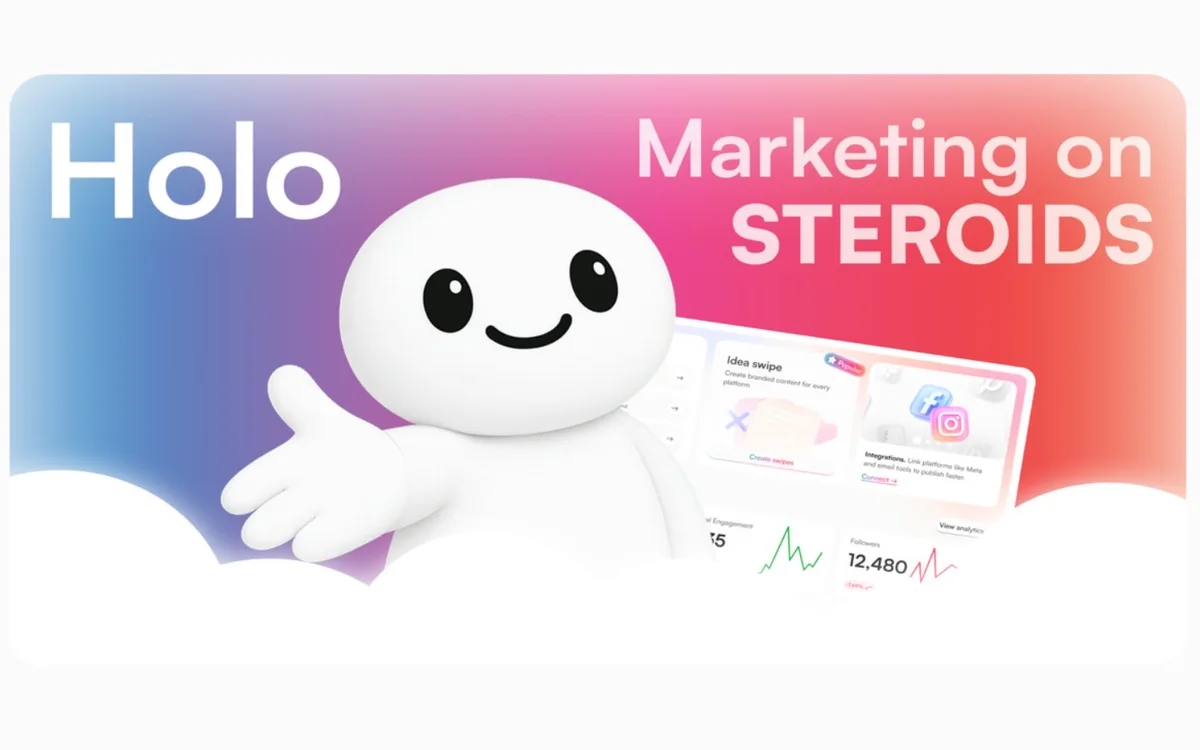
Holo is a marketing AI solution taking a different approach, and it sets out to close that gap from the other end. Instead of a prompt box, it starts with your website. Paste a URL and it spends about ten minutes building what it calls a Brand DNA: logo, colours, font, tone of voice, an ideal customer, and a catalogue of your products. Everything is editable, and a completeness score tells you what to confirm.
Our researcher ran this on our own site. It picked up that we write in the second person, that we have a habit of framing decisions as three-step processes, and that we position ourselves as independent, then quoted one of our headlines back accurately. The ideal customer it wrote about was an SME owner who wants to adopt AI but feels swamped by the options, which is a fair reading of our audience and not something we state anywhere.
For our wok restaurant owner, that step is the difference between a tool that knows nothing and a tool that already has the logo, the brand colours, the menu and a good understanding of who eats there.
Two features truly worth the money
Ad Ideas proposes named concepts, each already matched to a format: problem-solution, objection-handling, social proof, an educational explainer. You are choosing between five things that each have a job rather than staring at an empty field. Our reviewer found the ideas decent if a little cliché, which is roughly what you would expect, and any of them can be taken and reworked.
Competitor Ads is the most interesting one. Holo pulls the ads your competitors are currently running and shows how long each has been live. If the noodle place two towns over has been running the same lunch offer since March, they are not doing it out of sentiment. That is a real signal, available before you have spent anything, and most tools in this category do not give you it.
Production then follows. Clone rebuilds a proven layout, including a competitor's live ad, around your own product and message, and it was the most reliable feature in our testing. AI UGC makes creator-style video with lip sync and product-in-hand modes, and our reviewer rated it among the better implementations she has seen. Output publishes or schedules straight to Facebook, Instagram, TikTok, X, LinkedIn, YouTube, Pinterest, Threads and Reddit, with Meta Ads for campaigns and Klaviyo or Mailchimp for that neglected mailing list. Connect a channel and you get analytics reporting week by week on what worked.
Holo takes the idea even further than our own testing did. Holo explained: "the tool sets you a real 30-day target based on where your business actually is, then builds the week-by-week plan to hit it, the way a serious marketing strategist would. And it tunes that plan every week as the results come in."
The cost
Pricing starts at a very reasonable $12 a month for Starter, covering 200 creatives, with Scale adding all models, more simultaneous generations and priority support. There is no free trial. Monthly allowances do not roll over either, so the tool rewards a steady habit and punishes the occasional burst. Work out how often you will actually use it before you pick a tier.
Against a freelance designer's day rate, or an agency retainer starting in the low thousands, that is not even a close comparison. Whether the fourth restaurant fills up on a Tuesday is still not something the software can promise. But the deciding is what stops most small teams posting at all, and this is one of the few tools that has a real go at that part.
We tested Holo in depth for our independent scorecard — read the full Holo AI review for how it performed across features, integrations, languages and pricing.
Check out Holo: https://agentaya.com/recommends/holo-ai/
Disclosure: this article was produced as part of a paid partnership with Holo, and some links above are affiliate links that may earn us a commission at no extra cost to you. Our Holo AI review was produced separately, from our own testing. See our terms and conditions for how we work.