
Intercom: Conversational AI Agent for 24/7 Support and Sales
Intercom is a conversational customer service platform that integrates live chat, messaging, ticketing and automation with AI agents. In this Intercom review, we evaluate its proposition within the AI Agents category: an autonomous agent (Fin) trained with your own knowledge base to respond accurately, escalate to humans when appropriate and operate across multiple channels. For SMEs, this type of tool matters because it reduces response times, standardizes support quality, frees team hours and enables always-active conversational windows. If you’re looking for the best AI tool for results-oriented conversational agents, Intercom competes at the forefront thanks to its comprehensive approach (agent + helpdesk + automation).
AgentAya Verdict: Intercom
Intercom stands out for combining a generative AI agent (Fin) with a complete helpdesk and modern chat experience. For global businesses, its proposition is especially valuable when there is high volume of repetitive questions, need for 24/7 service and small teams that must prioritize efficiency. Strengths: immediate response in multiple languages, no-code training with your content, granular control of when the bot intervenes and fluid routing to human agents. Limitations: initial configuration curve (especially if you don’t have solid help articles), some advanced support in English and a plan structure that may require ROI analysis.
Recommendation: Although each case is different, Intercom can be ideal for SaaS, e-commerce and digital services SMEs that already have a knowledge base and seek reliable automation and scalability without sacrificing personalization.
Score Breakdown
| Category | Score | Description |
|---|---|---|
| Features & Functionality | ⭐⭐⭐⭐⭐ 5.0 | AI agent (Fin), ticketing, campaigns, knowledge base and 24/7 orchestration |
| Integrations | ⭐⭐⭐⭐ 4.5 | Connects with CRMs/helpdesks (Zendesk, Salesforce, HubSpot), channels and open API |
| Language & Support | ⭐⭐⭐ 4.5 | Multilingual for bot; extensive documentation; human support mostly in English. |
| Ease of Use | ⭐⭐⭐ 3.5 | Moderate learning curve; guided configuration |
| Value for Money | ⭐⭐⭐⭐ 4.0 | High ROI when there’s volume; requires usage evaluation to optimize cost |
AgentAya Overall Score: ⭐⭐⭐⭐ 4.3 / 5
The platform provides a solid balance between real automation, usability and ecosystem, with tangible impact on SME efficiency. However, it could represent a higher investment and require more complex configuration than other alternatives.
Ideal For
- Solo founders and SMEs with high query volume and reduced support teams.
- SaaS startups and e-commerce that need to qualify leads and resolve FAQs in real time.
- Teams that already have a knowledge base or AI-processable documentation.
- Businesses operating across multiple channels (web, email, social media, WhatsApp) and seeking to unify the experience.
Not Ideal For
- Companies requiring 100% support in specific languages from the provider in all instances.
- Organizations with extremely customised flows requiring complex custom development from the start.
- SMEs that don’t have content (articles/FAQs) to train the agent and expect perfect results. Fin performs better when a knowledge base already exists; if there’s no content to learn, the bot is limited.
Main Features
- Live chat and unified inbox: Web and app conversations, shared inbox, queues, SLAs and internal notes
- Integrated knowledge base: Multilingual articles and FAQs that feed the agent for accurate responses
- No-code automation and workflows: Rules, triggers and conversational journeys for sales and support
- Segmentation and in-app/email campaigns: Proactive messages based on user behavior to increase conversion
- Reports and analytics: Resolution dashboards, response times, satisfaction and bot/agent performance
- Human-AI orchestration: Controlled handoff to agents, macros and saved responses for consistency
- Mixed team planning: volume forecasting that incorporates both Fin-resolved and human-agent-handled conversations, with real-time performance tracking and automated shift scheduling, all from a single place.
- Real-time issue detection: AI analyzes all active conversations, groups related ones into a single incident, sends alerts with context and severity level, and allows teams to respond to affected customers and update Fin’s answers without leaving the platform.
- Monitors: automated review of 100% of conversations, with customizable scorecards applied consistently to both Fin and human agents, with prioritization by risk, volume, or channel.
- Fin Guidance version history: a complete record of every change made to Fin’s behavior rules, including author, timestamp, and status, with the ability to restore any previous version in one click.
Impact on SMEs: Less manual load, faster resolution, higher conversion in conversational channel and better operational predictability.

AI Functions
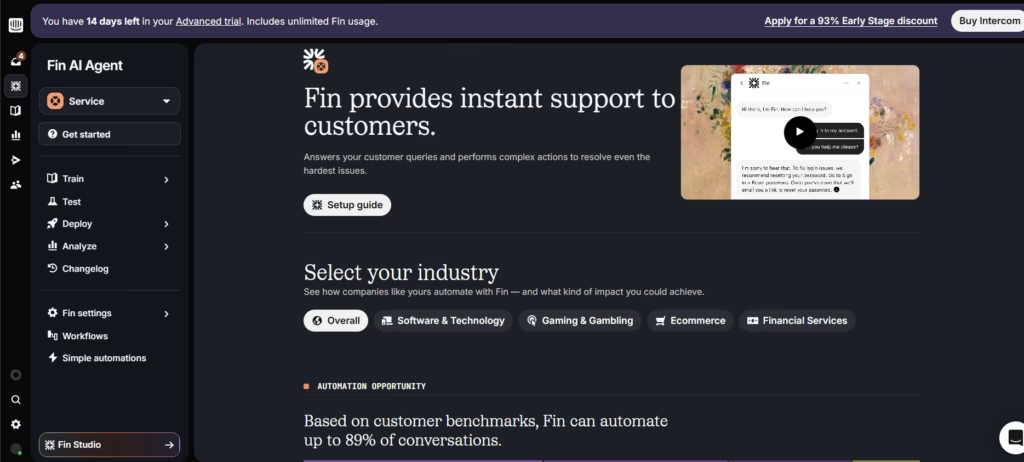
The core is Fin, a conversational agent that reads and understands your resources (articles, documents, URLs) and responds in natural language with prior validation to minimize errors. It can detect language, maintain brand tone and execute actions through configurable tasks (e.g., verify an order, update data or initiate a process). From a technical standpoint, Fin operates on the Fin AI Engine™, a patented architecture with six sequential layers: query refinement, relevant content retrieval (powered by the proprietary fin-cx-retrieval model), precision reranking (powered by the proprietary fin-cx-reranker model), response generation, accuracy validation, and continuous optimization. The generative core of this engine is Fin Apex 1.0, Intercom’s own model designed for speed and precision in customer service environments.
Fin also operates over email with channel-specific controls: it sends automatic follow-ups to customers who go quiet to confirm whether the issue was resolved, filters spam into a dedicated view where each case includes the reason it was flagged and can be corrected or retrained, lets you preview replies in a real threaded view before any customer sees them, and applies channel-specific guidance and escalation rules, so email isn’t governed by the same rules as chat.
The “intelligent” part is not just drafting responses: it’s finding the correct evidence, respecting business rules and deciding when to escalate. For SMEs, this translates to real self-service and hours saved on repetitive queries.
Integrations
Intercom integrates with CRMs (Salesforce, HubSpot), helpdesks (including functioning on top of Zendesk/Service Cloud), e-commerce (Shopify, WooCommerce), productivity (Slack, Gmail) and automation (Zapier). It supports key channels like WhatsApp, plus Instagram, Facebook Messenger, email, web chat and mobile apps. It has API and SDKs to extend functions and connect internal systems, facilitating SMEs to orchestrate data without changing their entire stack.
For e-commerce, Intercom is certified as a Shopify Plus Technology Partner and includes:
- Multi-store support to manage conversations from several stores in a single inbox.
- Order actions directly from the Inbox: edit shipping address, cancel or refund orders, and duplicate orders without leaving the conversation.
- Data Connector templates so Fin can resolve Shopify order queries autonomously.
- Support for EU workspaces (data residency compliance).
- Refund and compensation handling from within the Inbox: line-item refunds, gift card issuance, and replacement order creation without leaving the conversation. Refund amounts and tax are calculated automatically from the selected items, every action logs a reason from a standardized dropdown, and everything is captured in an auditing tab you can filter and export.
Intercom also includes a native Discord integration, with Fin responding directly within that channel. In addition, Fin can manage inbound sales conversations end to end; identifying visitor intent, answering product questions, qualifying prospects, and booking meetings or routing to the sales team as needed, without handoffs between systems. For businesses managing multiple brands, dedicated phone and SMS numbers can be assigned to each brand; inbound conversations are automatically tagged and routed based on the destination brand.
Security and Data Compliance
Intercom adopts an “enterprise-grade” security posture with an active focus on privacy and regulatory compliance.
Its infrastructure complies with major international information protection standards, including SOC 2, ISO 27001, ISO 27701, ISO 27018, HIPAA (for US health clients) and HDS (for France). Intercom also holds the CSA STAR certification from the Cloud Security Alliance, which evaluates security controls in cloud computing environments. Additionally, compliance with the EU AI Act is listed as an actively verified item in the company’s Trust Center.
The company encrypts all data in transit and at rest. Uses TLS/SSL with “A+” rating according to Qualys SSL Labs, along with Perfect Forward Secrecy protocols and AES-256 encryption for storage. Additionally, it maintains periodic external audits, penetration testing and bug bounty programs.
Regarding compliance, Intercom:
- Complies with the EU General Data Protection Regulation (GDPR)
- Offers an updated Data Processing Addendum (DPA) with the European Commission’s Standard Contractual Clauses (SCCs)
- Participates in the EU-U.S. Data Privacy Framework, the UK Extension and the Swiss-U.S. Framework, approved by the U.S. Department of Commerce, to guarantee secure international transfers
- Designates a Data Protection Officer (DPO) responsible for overseeing data management and handling privacy-related requests
- Applies retention policies and automatic deletion of information from inactive visitors (after 9 months), in line with GDPR requirements
- Carefully evaluates any information request from authorities or third parties, responding only to valid legal requirements and notifying the client whenever the law permits
Finally, all Intercom subprocessors and external providers must sign data processing agreements that replicate its security and compliance standards.
Language – Customer Service and Interface
The Intercom interface is localized in English, with the Messenger displaying automatically based on the user’s language settings. The main inbox is fully available in English, though some secondary areas may vary. The knowledge base and help center can be maintained entirely in English. Core channels (web chat, email, phone, and community) operate in English without additional configuration. Agents can also rate the quality of automatic translations directly from the conversation, feeding a continuous improvement process for the translation system.
AI Language – The Tool Itself
Fin understands and responds in multiple languages, as its multilingual capabilities cover more than 45 languages. The AI automatically detects the user’s language and responds accordingly; when content is missing in a language, it can rely on translation. For global businesses, this allows offering native support without manually replicating flows by language. Additionally, Fin can correctly handle vocabulary in sales or support contexts according to configuration. This aligns with the text stating that the agent “adapts to brand tone.”
Mobile Access
Intercom has native mobile apps for iOS and Android with access to inbox, notifications and real-time response. They are useful for remote or on-call teams. Although they are functional applications, the optimal experience for configuration and analysis remains on desktop.
Support, Onboarding and Account Management
Includes guided onboarding, Academy, tutorials, webinars and community. No-code configuration accelerates startup (train the bot with your articles, define rules and test before launching). For SMEs with little technical experience, the step-by-step approach and templates reduce learning time, although it is recommended to designate a project “owner” to maintain content and measure impact.
Ease of Use / UX
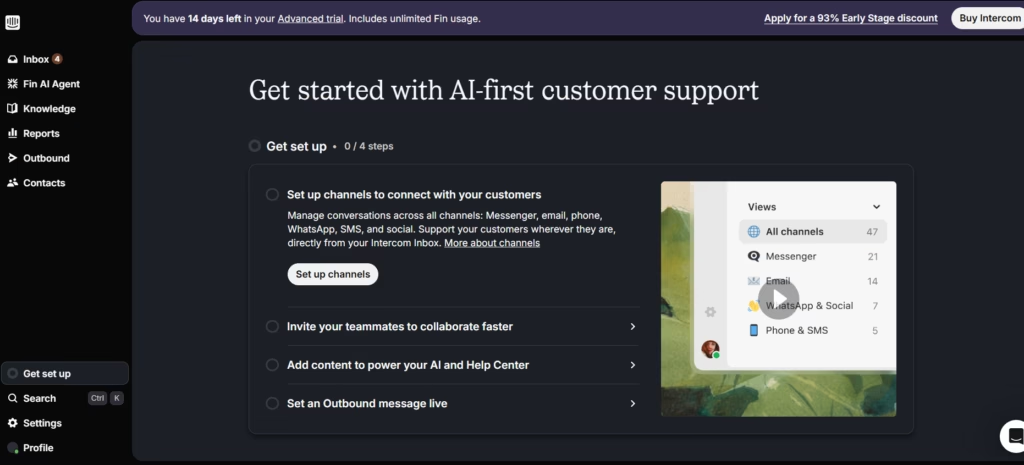
The interface is clean and familiar (messaging-style) with clear navigation across conversations, content, and automations. On first login, the platform guides users through the main setup steps.
Creating a basic bot and publishing articles is straightforward; complexity appears in advanced flows (segmentation, multiple rules, bot actions), something expected in powerful solutions. Implementing basic functions (web chat, simple automatic responses) usually takes a few days. However, configuring advanced rules and training Fin well can be complex. Many recognize that the interface has many options (too many for a novice).
Pricing and Plans
Intercom offers a 14-day free trial, accessible without a credit card, allowing exploration of all main service features and the Fin AI agent.
Its pricing model is organized around three main plans: Essential, Advanced and Expert.
These plans differ by the level of automation, customization, security and collaboration they provide. Each includes a configurable number of “Full seats,” which determine how many team members have full access to the plan’s tools. The final cost depends on the number of these seats and the chosen plan level.
Additionally, Intercom applies a usage-based model for certain components:
- Fin AI Agent: operates on an outcome-based pricing model, where charges only apply when Fin achieves a specific outcome. Outcome types include: query resolution (when the customer requires no further help after Fin’s last response), procedure handoff (when Fin completes a workflow designed to transfer to a human agent), and prospect disqualification. Successful prospect qualification carries a separate, higher per-outcome cost.
- Additional channels: Some channels like SMS, WhatsApp, calls or email campaigns are billed by use or volume
- Optional add-ons: Advanced modules like Proactive Support Plus (for proactive campaigns, product tours and surveys) or Copilot (AI assistant for human agents) can be added, available with fixed monthly fees depending on plan.
Among the optional add-ons, the Pro module includes automated conversation review through Monitors, custom AI scorecards, CX Score, AI Topics, and AI-generated recommendations; billed monthly based on the volume of conversations analyzed. The Copilot add-on (an AI assistant for human agents within the inbox) is billed per user per month.
Case Study
An e-commerce SME received hundreds of repeated questions per day (shipping, changes, stock). After centralizing its help center and training Fin with those articles, the bot resolved most first-level queries on web chat and WhatsApp. The human team concentrated on high-value cases (claims, B2B sales) and average response time dropped drastically. In 8 weeks, the chat conversion rate increased thanks to proactive messages to visitors with purchase intent and automatic lead qualification. Result: Lower operating costs and more sales without expanding staff.
Intercom vs Alternatives
| Tool | Pros | Cons |
|---|---|---|
| Intercom | AI agent + unified helpdesk; multi-channel; trains without code; solid UX | Initial curve; advanced support in English; evaluate cost/usage |
| Zendesk | Mature enterprise ticketing; broad ecosystem; granular reporting | Chat less “conversational” by default; AI less integrated out of the box |
| Freshdesk | Vertical AI preconfigured for e-commerce, fintech, travel, and logistics; fast setup; 24/5 human support. | Advanced AI features require additional paid add-ons. |
Related Tools
| Tool | |
|---|---|
 | |
 | |
 | |
 | |
 |
Frequently Asked Questions
How does Intercom’s live chat help increase sales?
Allows instant response, capturing and qualifying leads in real time, reducing friction and increasing conversion in conversational channels.
What is the return on investment (ROI) when using Intercom?
ROI is usually high when there’s volume: automation resolves much of the repetitive tickets, saves agent hours and improves customer satisfaction. Intercom offers an ROI calculator for specific estimates.
How does Intercom work? How do I create a developer account?
Intercom connects conversational AI with a multi-channel helpdesk (chat, email, social). To develop, you can create a developer workspace, access API/SDKs and test integrations and bots in a secure environment. Intercom has a “Developer Hub,” a dedicated space for developers where you can create, configure and test custom integrations through APIs, webhooks and tools like Canvas Kit.
How does Intercom adapt to my brand tone and workflows?
The AI agent allows configuring tone, length and style; additionally, it integrates with external systems and supports rules and actions to align chat to your processes (sales, support, operations).
Does Intercom support multiple languages?
Yes. The agent can operate in multiple languages and the interface supports content/localization; human support from the provider is managed primarily in English.