
Surfer: Content Optimization for Search Engines and AI
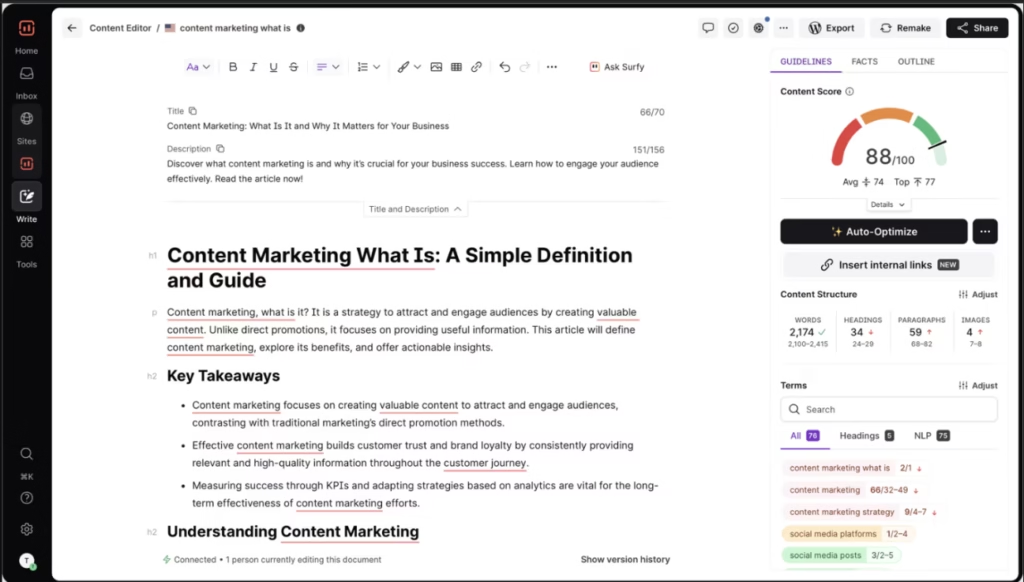
Surfer is one of the most recognized tools for content optimization with artificial intelligence. It combines data analysis, natural language processing (NLP), and machine learning to offer recommendations that help rank better in Google. Its distinctive metric, the Content Score, has become an industry standard by measuring a text’s SEO quality according to objective factors.
The Surfer AI suite now complements its offering by including the ability to generate complete articles ready to rank, detect machine-generated content, and humanize AI-generated texts for a more natural result aligned with human expression. For SMEs, this type of solution represents an accessible way to compete with large agencies: it allows writing, optimizing, and auditing content with real data, without needing a complete SEO team.
AgentAya Verdict
This is a comprehensive and data-driven tool for content optimization. Its Content Editor, advanced features like Topical Map generation, and conversational assistant Surfy make it a powerful option for SMEs wanting to improve their organic visibility and publish at scale.
This tool is ideal for growing teams and agencies managing multiple clients or blogs. While the cost may be a medium-high investment, its precision and depth are justified for businesses where content is the centerpiece of digital marketing.
Score Breakdown
| Category | Score | Description |
|---|---|---|
| Features and Functionality | 5.0 ⭐⭐⭐⭐⭐ | Audit, Content Score, AI SEO Writer, and Topical Map. |
| Integrations | 3.0 ⭐⭐⭐ | Google Docs, WordPress, and Zapier. Includes Contentful and API. |
| Language and Support | 3.0 ⭐⭐⭐ | Interface and support only in English, though can create quality multilingual content. |
| Ease of Use | 4.0 ⭐⭐⭐⭐ | Modern interface, medium learning curve. |
| Value for Money | 3.5 ⭐⭐⭐ | High precision, though expensive for small SMEs. |
AgentAya Overall Score: ⭐⭐⭐⭐ 4.1 / 5
An advanced AI solution for SEO optimization oriented to teams and agencies seeking performance and scalability.
Ideal for:
- SMEs with active content strategy.
- Digital agencies managing multiple SEO accounts.
- Writers or freelancers needing to optimize existing texts.
Not ideal for:
- Users with very limited budgets.
- Companies requiring support and interface completely in languages other than English.
- Businesses seeking technical SEO management (outside content).
Main Features
Content Editor, Content Score and Content Audit make up the set of features for working on content from start to finish: the Content Editor offers real-time recommendations based on top-ranking competitors; the Content Score evaluates the text’s SEO quality according to over 500 signals; and the Content Audit analyzes existing pages and suggests improvements. Building on that core, the following features stand out:
- Topical Map: generates topic maps to organize content clusters and establish topical authority.
- AI Tracker: monitors brand visibility in conversational AI tool responses (such as ChatGPT, Gemini and Perplexity).
- AI Detector & Humanizer: tools to detect machine-generated content and refine it to sound like natural human text.
- 1-click Internal Linking: automation to ensure semantic internal linking.
- Workspaces: manages multiple domains from a single environment without mixing context, brand or data across projects. Especially useful for agencies handling accounts for different clients.
- Sites: a central dashboard that brings together content planning, audits and performance tracking in one place, providing a comprehensive view of each domain.
- Mention Gap: identifies which conversational AI tool responses feature competitors but not the user’s own brand, pinpointing concrete visibility opportunities.
- Sentiment Analysis: evaluates the tone with which AI engines present a brand in their responses, making it possible to detect negative narratives before they affect reputation.
- Plagiarism Checker: verifies content originality before publishing to avoid penalties and maintain editorial standards.
- Real-time collaborative editing: multiple users can work simultaneously on the same document within the Content Editor, streamlining review and team-based production.
This tool centralizes analysis, writing and tracking in a single environment. For a small or medium-sized enterprise that depends on organic traffic, this means saving time on keyword research and manual optimization. It also helps maintain a consistent SEO quality standard across all articles, as well as preparing for the new wave of AI-based search.


AI Functions
Surfer integrates AI models trained with real-time data and natural language processing (NLP). What’s “intelligent” in Surfer isn’t just writing, but the ability to evaluate, compare, and adjust content based on the most recent SERP data.
- Content Generation (Surfer AI): Creates complete article drafts ready to rank in minutes.
- Semantic Optimization (Content Score and Coverage Booster): Uses machine learning to measure relevance, optimization, and identify thematic gaps in content.
- Content Humanization: Transforms AI-generated content to adopt human writing patterns and bypass detectors.
- AI Monitoring (AI Tracker): Tracks content visibility across search engines and conversational AI tools. Includes an updated Gemini integration to monitor brand presence within Google’s AI ecosystem, alongside complementary features such as Mention Gap, which identifies where competitors appear and the brand does not; and Sentiment Analysis, which evaluates the tone AI tools use when presenting the brand in their responses.
- AI Search Guidelines: Optimizes content with a single click to meet the citation criteria used by AI-powered search results, increasing the likelihood of appearing as a referenced source in tools such as ChatGPT, Gemini, or Perplexity.
- Pre-Publish Review: A pre-publication check that verifies readability, originality, and AI-optimized structure, increasing the likelihood of appearing in ChatGPT, Perplexity, and Gemini responses before content goes live.
- Auto Optimize: Updates existing articles in one click by adding smart entities and facts, improving text flow, and preserving brand voice to strengthen Google rankings and increase the chances of being cited in AI-generated responses.
Additionally, it features Surfy, a conversational assistant that expands Google information on specific topics.
Integrations
Surfer integrates with:
- Google Docs
- WordPress
- Zapier
- Contentful
This facilitates working without leaving usual content workflows. Additionally, the API is available for Enterprise plan customers, allowing automation of content creation, audits, and access to SERP data. It also allows integration with Google Search Console (GSC) to monitor performance.
Security and Data Compliance
Surfer indicates compliance with the General Data Protection Regulation (GDPR), ensuring users maintain ownership over their content and analyses. It employs HTTPS encryption and secure cloud storage.
The company is Surfer sp. z o.o. based in Poland. SMEs are recommended to review their privacy policy to confirm data retention and use.
Language – Customer Support and Interface
Surfer’s user interface is currently available only in English. Customer support communicates primarily in English, though it’s possible to contact them by live chat or email. Higher plans include personalized onboarding process.
AI Language – The Tool Itself
Surfer’s artificial intelligence can create and optimize content in multiple languages. It’s also possible to configure location and language for each project, adapting recommendations to local markets. This makes it viable for companies working on content in international markets.
Mobile Access
Doesn’t have a dedicated mobile application, but can be used from browsers on smartphones or tablets. The mobile experience is functional, though limited for audits or prolonged writing.
Support, Onboarding Process, and Account Management
Surfer has an extensive knowledge base, video tutorials, and regular webinars. Higher plans include personalized accompaniment, priority support, and business review calls. For SMEs with little technical experience, the initial learning curve may be medium, but available training resources facilitate gradual adoption.
Ease of Use / UX
The platform offers a modern and well-structured interface. The workflow is presented clearly and guided, covering from research to audit. While some advanced features require practice, users can quickly start generating optimized content using the Content Editor, which supports its focus on simplicity for obtaining organic traffic.
At the beginning of 2026, Surfer refined its interface to make it clearer and more action-oriented. With workspaces, switching from one to another automatically loads the brand settings, tone of voice and internal linking rules for each domain, which prevents context from bleeding across projects and simplifies navigation for those managing multiple accounts; on top of that, AI visibility monitoring is now better integrated into the workflow.
Pricing and Plans
Surfer structures its offering in Essential, Scale, and Enterprise paid plans, with monthly or annual billing options offering considerable savings.
Plans are distinguished by the quantity of optimizable and AI-generatable articles, number of audits, and capacity to use AI tools.
The Enterprise plan is designed for agencies and brands with high content volume, complex needs, or compliance requirements. Additionally, the platform allows purchasing AI article credit packages separately for greater scalability. The investment represents a medium-high cost and is suitable if SEO content is a fundamental part of the business.
Case Study
A marketing agency used Surfer to audit their client blog in the education sector. With Content Audit, they adjusted structure and semantic density, which allowed doubling organic visits in less than three months. Additionally, WordPress integration reduced publishing time by 40%.
Tool vs Alternatives
Surfer competes in a specific segment: content optimization using real-time SERP data and visibility monitoring across conversational AI engines. The most relevant alternatives serve different profiles, making the choice dependent on the scope each team needs to cover.
| Aspect | Surfer | Semrush | SEOpital |
| Focus | AI-powered content optimization with conversational AI visibility monitoring. | Comprehensive suite combining traditional SEO with AI visibility through Semrush One. | Automated SEO content generation based on semantic SERP analysis. |
| Key strengths | Content Score, Topical Map, AI Tracker covering ChatGPT, Gemini, and Perplexity, Mention Gap, Sentiment Analysis, and Workspaces for multi-domain management. | Extensive backlink and keyword database; AI Visibility Toolkit to monitor brand presence across LLMs; 50+ integrated tools. | Guided workflow for producing optimized articles in a few clicks; WordPress integration; low learning curve. |
| Limitations | English-only interface and support; no mobile app; mid-to-high investment. | Steep learning curve; high cost; advanced AI features available on higher-tier plans only. | Credit-based pricing model that can create uncertainty around the actual cost per article; limited integrations. |
| Ideal for | Content teams and agencies that need deep optimization and AI visibility tracking. | Brands and agencies with broad strategies requiring comprehensive SEO data and multi-platform visibility. | Teams or freelancers prioritizing production speed over advanced analytics. |
Surfer is the most specialized of the three for organizations where content is the core of their digital strategy. Semrush offers broader coverage but comes with greater complexity and cost. SEOpital is the most accessible option for those focused on content volume without requiring advanced analysis.
Conclusion
Surfer is the best AI tool for advanced content optimization. While other alternatives focus on technical analysis (Semrush) or simple automation (SEOpital), Surfer achieves the ideal balance between data-driven power and usability, making it an ideal option for SMEs and agencies seeking performance and scalability in their content.
Related Tools
| Tool | |
|---|---|
 | |
 | |
 | |
 | |
 |
FAQs (Frequently Asked Questions)
Is Surfer good for SMEs?
Yes. Although not the most economical, it offers data and precision that allow competing with large agencies.
Does it support content in multiple languages?
Yes. Surfer generates and optimizes texts in multiple languages.
What integrations does it offer?
Google Docs, WordPress, Zapier, and Contentful. Additionally, it offers an API for the Enterprise plan.
Does it have a mobile application?
No. Only works via browser.
What are the best alternatives to Surfer?
Semrush, if you seek comprehensive technical analysis, or SEOpital, if you prefer a more economical option focused on automation.