

Eustella Review
Eustella is a European AI assistant that pairs everyday chat with schedulable agents and memory files, keeping your data under EU privacy rules.
This is a young European contender with one very clear goal: data sovereignty and privacy at the centre of everything. Eustella comes from AI Newsrooms Technology GmbH, known as newsrooms.ai, a studio whose main product is a content creation platform for businesses and whose catalogue now includes Eustella. It isn't the most powerful tool on the market, but what it does offer is hard to find in one place: processing entirely within the European Union, no training on your conversations and a mobile-first approach. For a SME that handles sensitive information or works in a regulated sector such as healthcare, public administration or certain financial services, that European hosting can be a compelling argument against the American and Chinese options.
Our recommendation is a specific one. If privacy and control of your data matter more to you than raw power, and you don't mind growing alongside a tool that is still growing itself, it's worth watching closely and trying as soon as you can get access. If you need the highest capability today and immediate availability for a critical workflow, it's still early days.
Averaged from the breakdown below
- SMEs and freelancers who handle confidential information and want their data processed and stored inside the European Union.
- Organizations in regulated sectors (healthcare, public administration, research, financial services) where GDPR and EU AI Act compliance carry real weight.
- Users who work mostly from their phone and want an assistant that keeps up with them all day instead of tying them to a desk.
- Anyone who wants to hand off background work such as research, news summaries or topic monitoring to scheduled agents.
- Companies that need the highest capability available right now for a critical workflow and can't afford to rely on a tool in beta.
- Teams that need a wide catalogue of native integrations already working with the systems they run today.
- Organizations that want guaranteed uptime and certifications documented in writing before they adopt anything.
- Anyone after a mature, stable ecosystem without the constant changes that come with an early-stage product.
Key features
- A conversational chatbot that answers from its models' own knowledge or from internet searches, with advanced search and deep research modes.
- Personal memory, where you store information in plain language that you can review, edit or delete, and that the assistant draws on in later conversations.
- Projects that gather the documents and conversations around a single topic into one space, with a name, description, instructions and files, so the tool can work from that material without you uploading it again.
- A Personality setting, its "soul," that defines who it is, how it works and what it knows about you. You can even give it the shape of a companion with a character of its own.
- Group chats, so you can bring the assistant into a shared conversation with your team, your family or your friends.
- Reminders and note management for everyday work.
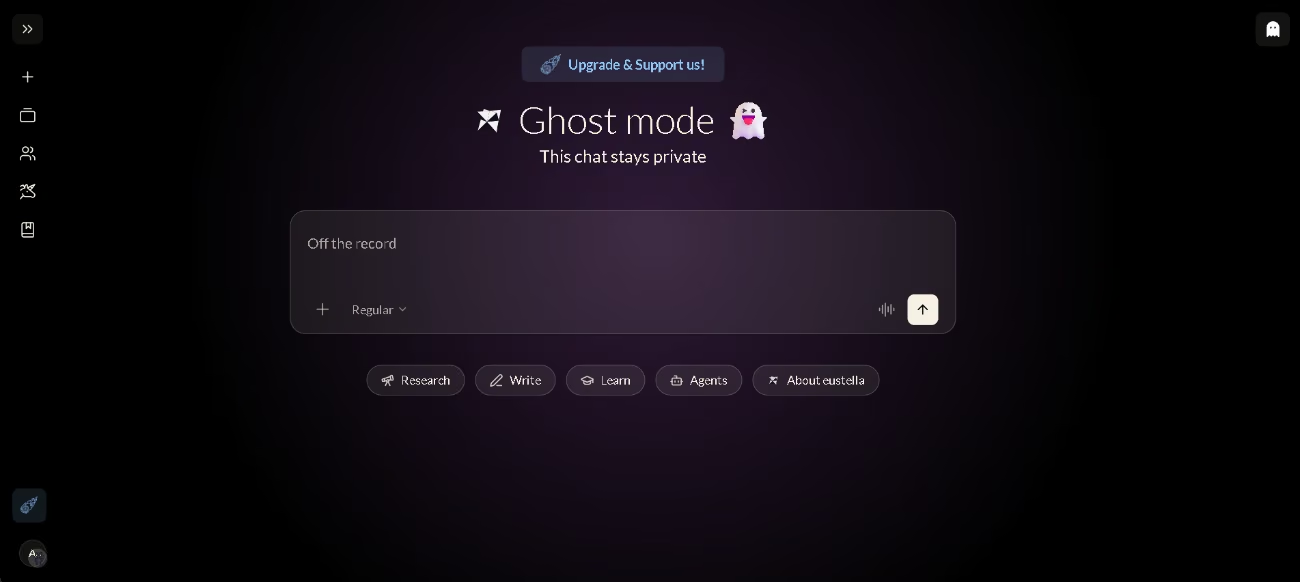
- A private mode (ghost mode) for private conversations.
For a small business, all of this adds up to something practical. Rather than spreading the work across a handful of separate subscriptions, a team gets writing, research, document analysis and automation from one account, and never has to explain the context twice, because memory and projects hold on to it. That saves coordination time and cuts spending on scattered licences.
AI features
- Multi-step deep research that pulls sources together, synthesizes them and turns them into a report.
- Multimedia creation: image generation from scratch or from existing images, plus a vision mode that analyzes images you upload or pulls the text out of them.
- Office features: creating, reading and editing Word, PowerPoint and Excel files, and analyzing PDFs and other text documents.
- Audio transcription through voice input, and music search.
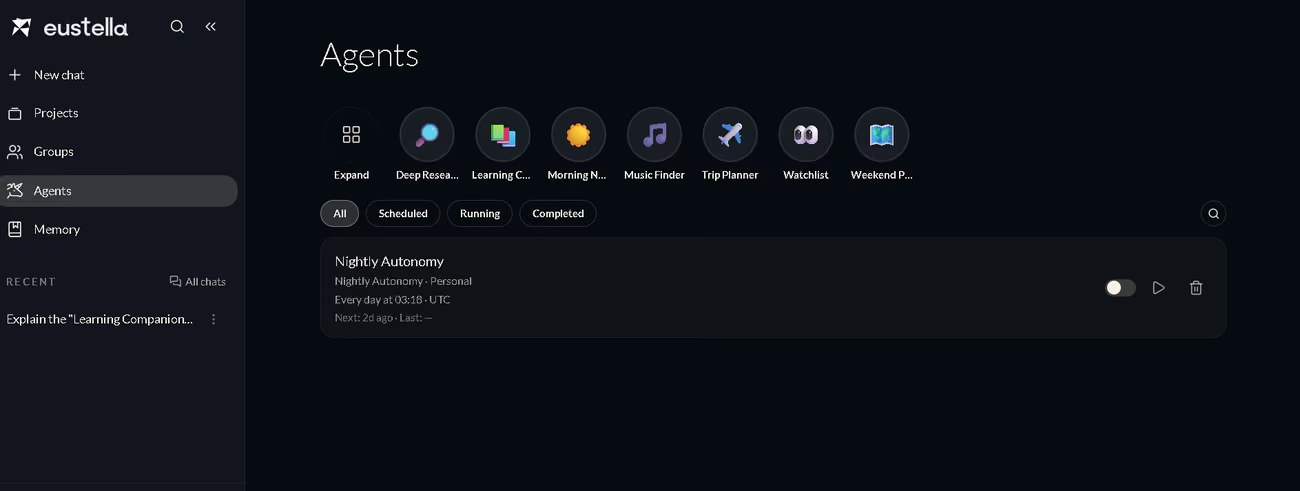
- Agents that run tasks in the background, several of them available out of the box (deep research, trip planning, a morning news briefing, topic monitoring that flags changes), plus the option to build your own with a name, a set of instructions and the tools it's allowed to use.
- Agent scheduling by time or interval, with a notification when the job finishes and the results saved to memory.
The really clever part isn't any single feature but the way the assistant picks its tools and strings them together. It decides for itself what to reach for, whether that's searching the web, reading a file, looking at an image or generating content, and folds the result into its answer. With agents, it goes further and plans and completes a whole assignment while you're somewhere else.
Integrations
- Early integrations with European services, such as the live cryptocurrency price feed and a product price comparison tool.
- Connections to your own MCP servers, announced as coming soon, which would let the assistant reach into your systems, databases and services. They aren't available yet.
- More integrations planned over the coming months, aimed at maps, travel, navigation, shopping, education and lifestyle.
- A platform for businesses and developers, separate from the consumer app, with agent infrastructure and an API, currently in private beta by request.
The potential has been announced, but many of the connections an SME would find most useful can't be counted on yet.
Data security and compliance
Everything about this tool revolves around data sovereignty, understood not as where a model came from but as who controls it, where it runs and under whose law. It runs open-source and European models including Mistral, Qwen, Gemma, GPT, Flux and Whisper, and states that it neither uses your conversations for training nor sells or shares your data. All processing and storage happen on European servers, with the information encrypted, so that, according to the company, not even the hosting provider can reach it. GDPR rights are handled within a month, and the company also declares compliance with the EU AI Act.
It avoids the big American providers, which fall under US data access law even when the data centre sits physically in Europe, and works with European ones instead. It's also candid about where that sovereignty ends: graphics cards are designed outside Europe, and some services have no real European alternative because the platforms themselves impose them, among them app store downloads, payments, notifications and third-party account logins. It also uses an American open-source analytics service, hosted in its European cloud, with pseudonymized data that excludes the content of conversations. On child protection, it investigates and deletes accounts belonging to anyone under sixteen. As always, review a provider's terms carefully before processing sensitive data.
Language: customer support and interface
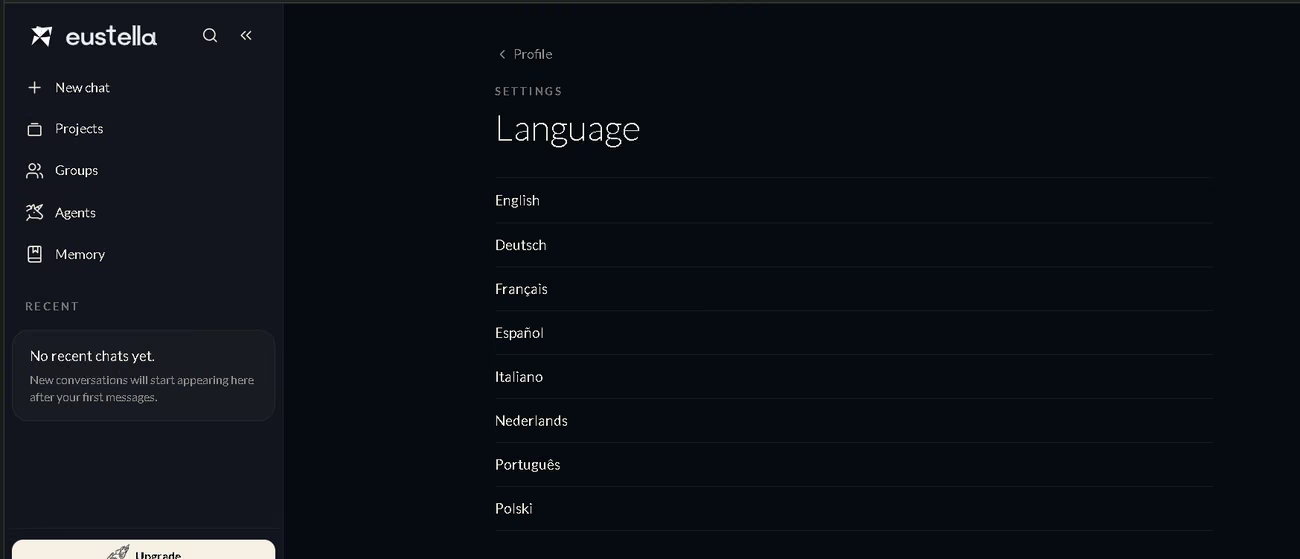
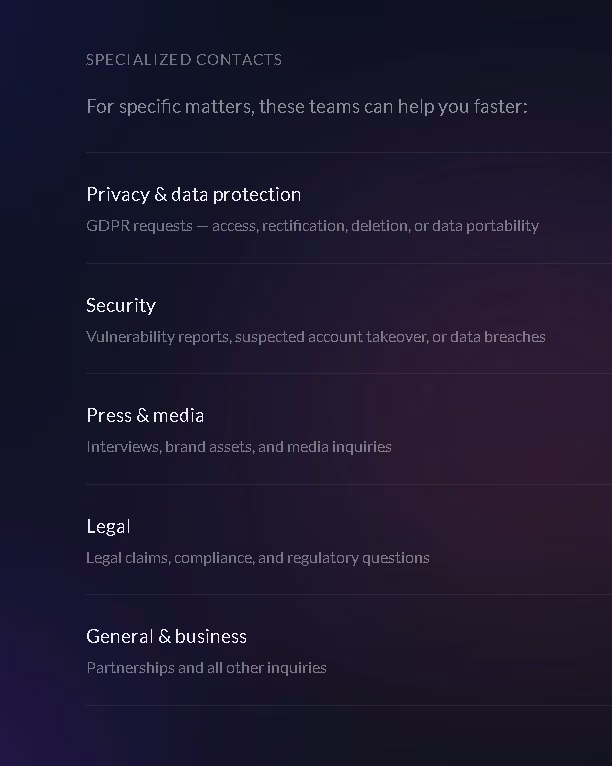
Support from a human comes entirely by email. The general channel replies within two business days, and there are dedicated mailboxes for privacy and data protection, security, press, legal matters and business enquiries. There's no live chat, no phone line and no substantial knowledge base beyond an FAQ section. The interface comes in eight European languages, English, French, Spanish and Dutch among them. Because the tool is so new, the company says official documentation and more detail on the AI models behind it are coming soon.
AI language support
The tool's features cover the same languages as the large language models running underneath, more than a hundred of them, including every major European language and most of the world's most widely spoken ones. In our own testing, its English was flawless, both in understanding and in writing. With that many languages covered, an SME can work in a tool whose interface, functions and features are available in its own language, writing instructions naturally and getting back a result with the right tone.
Mobile access (iOS, Android, others)
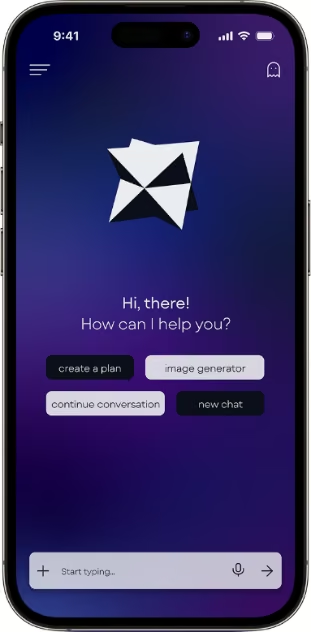
The product was built mobile-first, on the premise that an AI assistant should be with you on the device you use most. There are Android and iOS apps alongside the web version, all synced through a single account, so you can switch devices without losing your place. Unlike the many assistants designed for the desktop first, here the phone experience is the starting point rather than an afterthought, which means you can work entirely on the move. One caveat: the app doesn't install models on your phone, so it needs an internet connection to answer, because the processing happens on its European servers.
Support, onboarding and account management
Rolling this out involves installing nothing extra and configuring no models or servers. You sign up and start typing. One nice touch for newcomers is that when you choose an agent, the tool asks whether you want to run it straight away or would rather hear first what it does and when to use it, and that explanation appears in the same chat. It's aimed at beginners who can't yet tell one agent from another, and it's easy enough to skip. Activate a specific agent and it opens by telling you what it needs from you. Account management all sits in user settings, where you'll find the support email address, language options, your usage tracking and the option to reset the companion's personality, which sends you back through onboarding.
Ease of use / UX
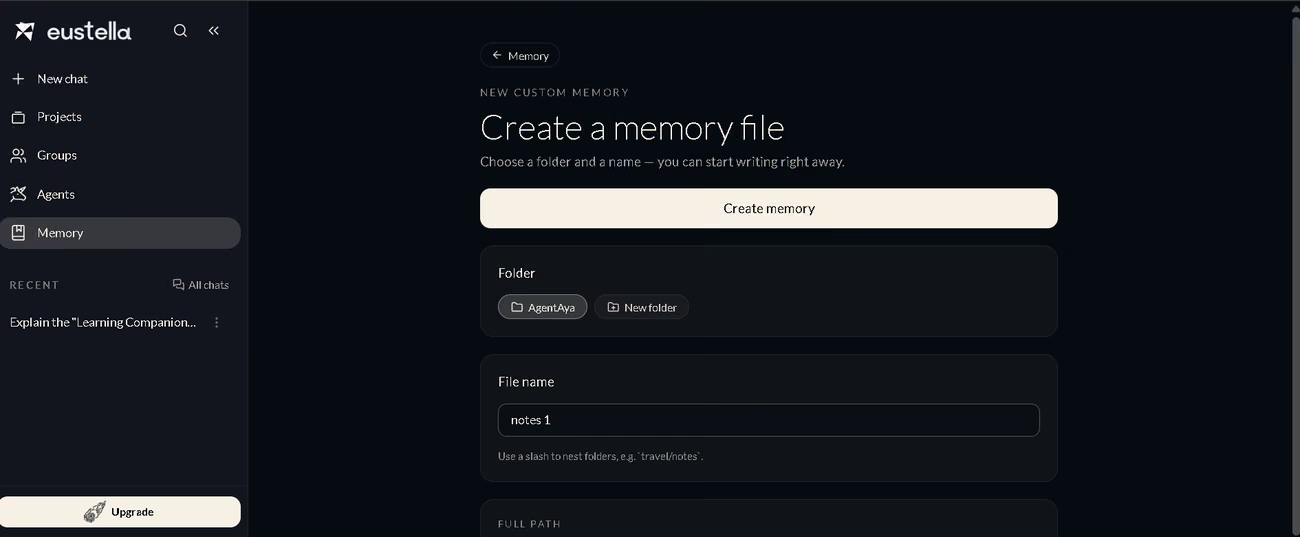
The tool works much like ChatGPT and is extremely easy to use. From the outset, its AI doesn't try to please you at any cost or drown you in apologies; it answers concisely and directly. Everything it told us during testing was accurate, and when we asked a question there was no way to answer, it made clear that it didn't have access to that information and so couldn't give us a proper answer. We added files to memory and the tool used them appropriately.
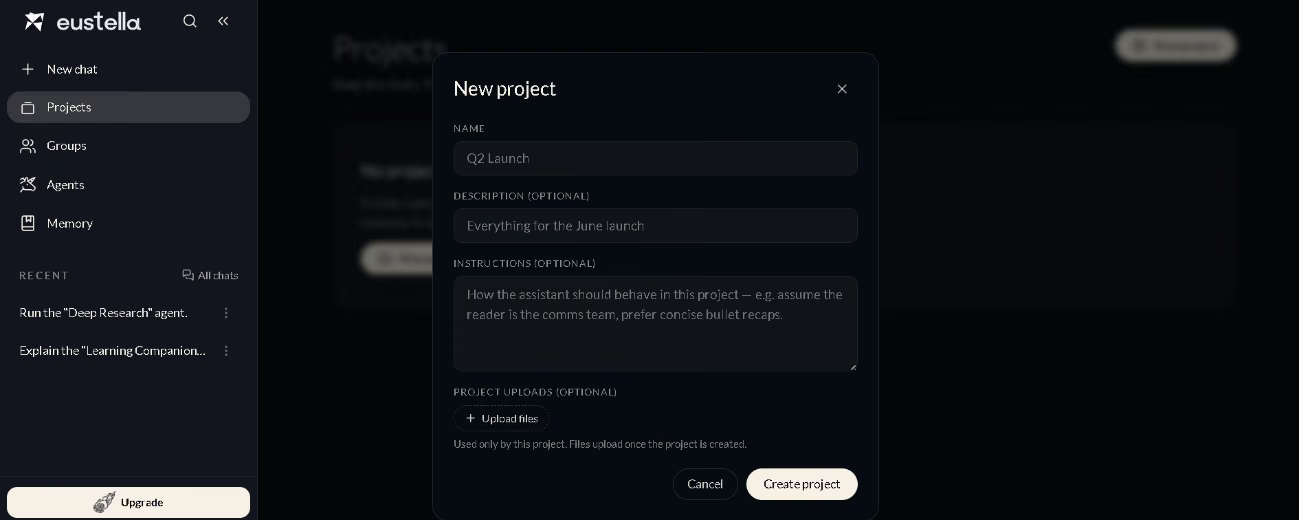
We also created a project, a very simple process, and tried out the deep research agent. The learning curve is minimal, and with no models or servers to configure, an SME starts getting value almost immediately.
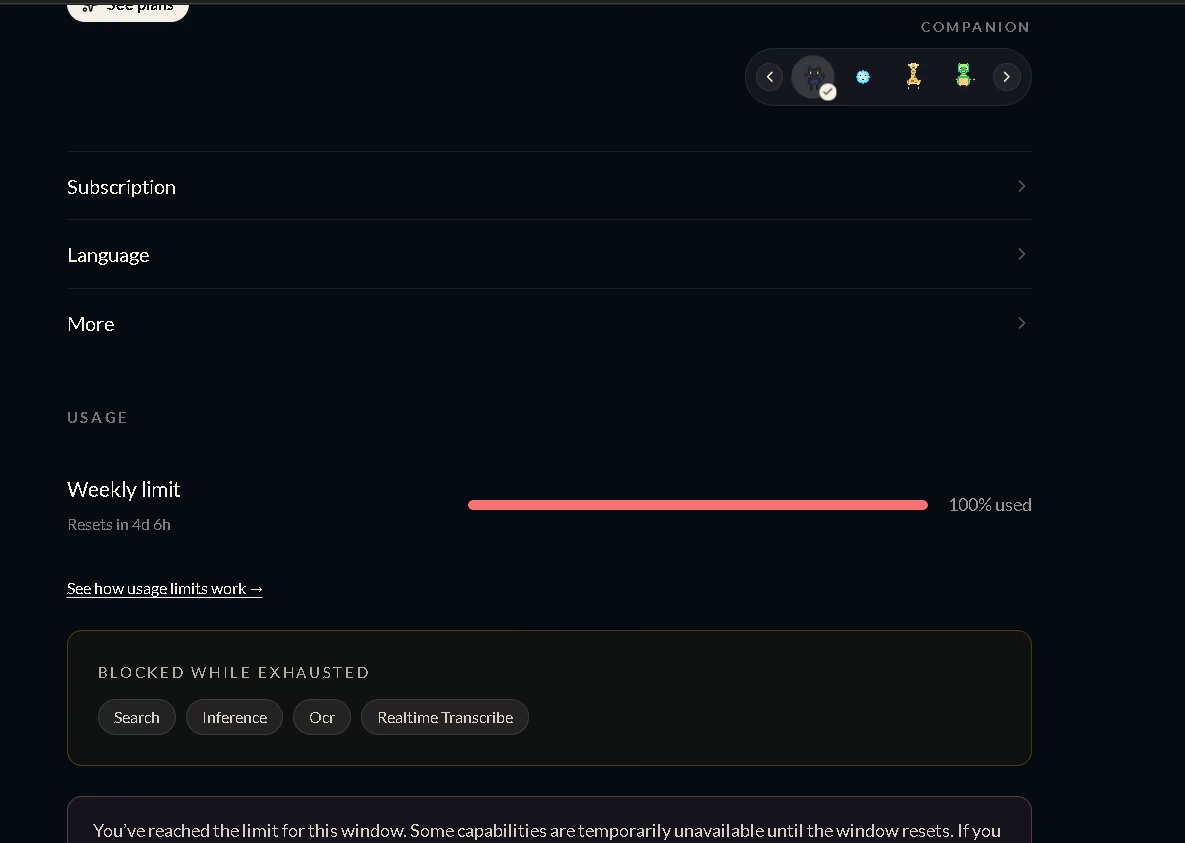
In our experience on the free plan, and bearing in mind that this is a new tool and these were our use cases, the one negative note concerns the credit allowance. It ran down quickly once we chained tasks like deep research or image generation, and then you have to wait for it to reset. Refills are weekly, and in our case that meant four days.
Pricing and plans
You can use it free, and there are three paid plans on top, billed monthly and cancellable whenever you like. What separates the tiers is the usage allowance, a single weekly pool shared across everything the tool does, from chats and searches to images, file reading and agent runs, and it grows with each step up:
- Free. The essentials to get going: chat, web search and research, image and document generation, projects, the iOS, Android and web apps, and European data sovereignty.
- Comet. Adds a bigger allowance and a basic agent on top of the free tier.
- Star. Adds more usage again, plus scheduled agents.
- Cosmos. Comes with the largest allowance of all and access to the most powerful model.
In the app, your consumption shows as a percentage of your allowance rather than as a bill, and you can track it from user settings. The higher plans add a safeguard that caps usage over the last five hours, so one burst of activity can't drain the pool in a single go, and you can top up with extra credit, which only comes into play once the regular allowance runs out. Bear in mind that generating images or scheduling agents costs more than a chat message.
Prompt engineering is still necessary (give it a role, give it context, be specific), but it has changed shape. With today's models, concise instructions work better and cost less, so the skill lies in supplying clear, controlled context rather than writing sprawling commands. Better instructions mean better results and fewer credits spent. Hence the best use for personal memory: feed it your verified files and ask it to work only from that material, which sharply reduces the risk of false information slipping in.
Case study
As a new and small project, the company doesn't publish a client roster yet, so the best evidence available comes from professionals who have evaluated it first-hand. A writer at NotebookCheck put it thoroughly to the test: he used the travel agent to plan a two-day getaway to Paris, planned a tabletop roleplaying session (The Dark Eye) and coded a small tool. His conclusion was that for the vast majority of users the app is already very practical, and that the open-source models it relies on have matured into genuinely capable tools. You can read the full story here.
Videos
Eustella vs alternatives
ChatGPT is the American benchmark, a mature platform, though its data is processed outside Europe and falls under US data access law. Kimi is the open, low-cost route, technically very capable, but Chinese in origin and governed by law outside the European Union. Eustella keeps everything in Europe, doesn't train on your conversations and runs auditable open models under European law, in exchange for less capability today and a new product still in beta. These characterizations reflect how each company positions itself and the information publicly available, not an AgentAya verdict.
| Aspect | Eustella | Kimi | ChatGPT |
|---|---|---|---|
| Origin | European (Vienna) | Chinese | American |
| Models | Open and European, auditable | Open weights | Proprietary and closed |
| Privacy | No training on your data; the heart of the product | General use may feed the service | Data use depends on your settings |
| Approach | Mobile-first | Technical power and agents | Mature, full-featured platform |
| Maturity | Closed beta, still evolving | Highly capable, sign-ups paused at times | Established product |
The honest summary: if keeping data in Europe, privacy and regulatory compliance top your list, Eustella is the closest fit of the three. If you want the most capability you can get, ChatGPT is still ahead for now. And if technical power at low cost appeals to you and neither its origin nor its lighter safeguards give you pause, Kimi is an alternative worth considering.
FAQs
What is Eustella and what does it do?
It's a European AI assistant with agent capabilities, available on Android, iOS and the web. It answers questions, writes and analyzes documents, generates images, carries out research and runs tasks in the background through agents, with all data hosted in the European Union.
Is Eustella free?
There's a free version covering the essentials, plus three paid plans billed monthly that raise the usage allowance and unlock agent capabilities. You can start at no cost and scale up when you need to.
Is Eustella a good ChatGPT alternative for an SME?
It is, particularly if privacy, data sovereignty and GDPR compliance matter to you. The big American platforms are still ahead on raw capability, but its European package is hard to match on that front.
What languages does Eustella work in?
The interface comes in eight European languages, English included, and the model understands and writes in many more.
Still weighing up Eustella?
See how it compares with the other tools we've reviewed in AI Agents.