

Fonio Review
Fonio strikes a convincing balance between real automation, simplicity, and localization for multiple languages. The one caveat worth flagging concerns transparency around data processing, which is worth reviewing depending on your sector.
Fonio makes something widely accessible that until recently seemed reserved for large call centers: an intelligent phone reception service, always available and configurable without any technical know-how. Its biggest advantage for English-speaking users is clear from the first minute: the platform comes with English voices, and offers a English contact number, a combination you rarely find among providers of this kind.
The tool stands out for how quickly it can be deployed, its integration with calendars and CRM systems, and a knowledge base that the assistant draws on during the conversation to answer questions without human involvement. You manage everything from the browser, since there is no dedicated mobile app, and while the company hosts its servers in Germany, it relies on several outside providers to process the calls.
Recommendation: an excellent option for medical practices, administrative offices, professional firms, shops, and freelancers that field a high volume of repetitive calls and want to stop missing them. It is not the right fit if your support revolves mainly around text messages.
Averaged from the breakdown below
- Medical or radiology practices and clinics that handle hundreds of routine calls a day.
- Freelancers and micro-businesses that cannot afford to miss a single call after hours.
- Administrative offices, real estate agencies, and firms that need to route calls by department or by person.
- Businesses that want to book appointments over the phone, synced with their calendar in real time.
- Companies whose main support channel is text or email rather than voice.
- Organizations with very strict requirements for keeping data residency entirely within Europe, with no third-party providers.
- Teams that need to manage the platform from a native mobile app.
Key Features
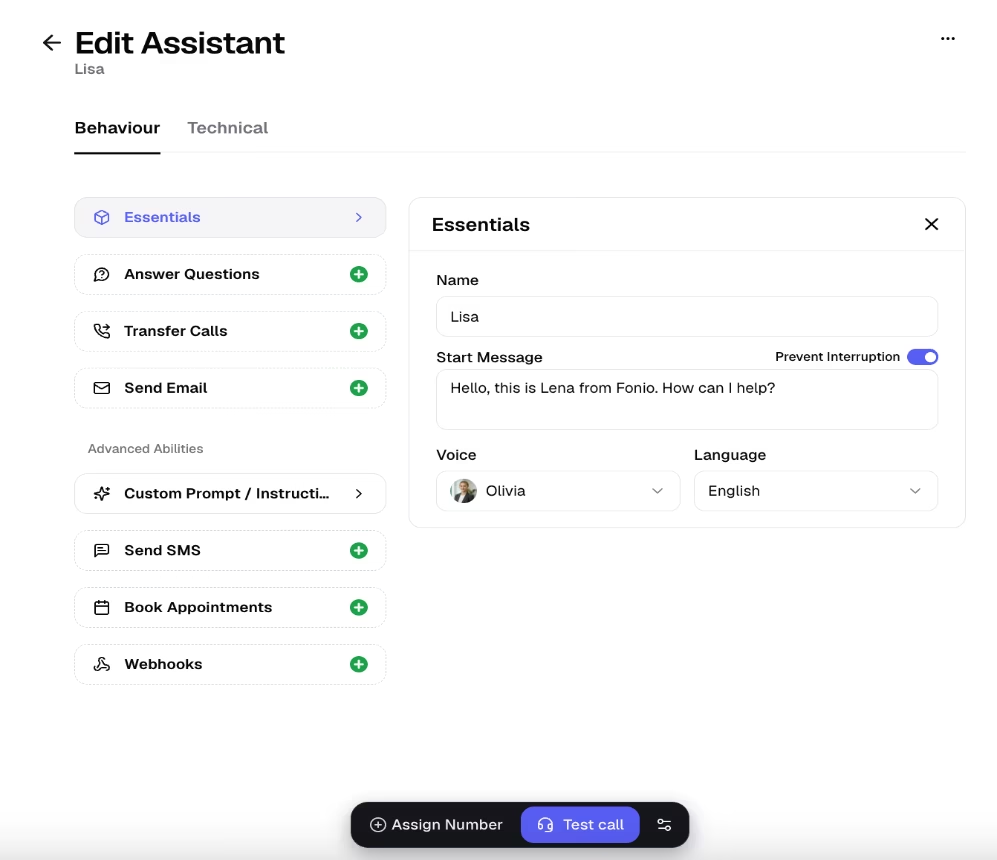
- Round-the-clock call answering with a natural-sounding voice and a customizable welcome message.
- Smart call forwarding based on "If, then" rules, with an alert email whenever a forward fails.
- Appointment booking through three routes: cal.com, Calendly, or the built-in Scheduler, which also lets you reschedule and cancel.
- A knowledge base built from question-and-answer entries, PDF documents, a company profile, and live web search.
- Post-call actions: automatic transcription, email, and SMS.
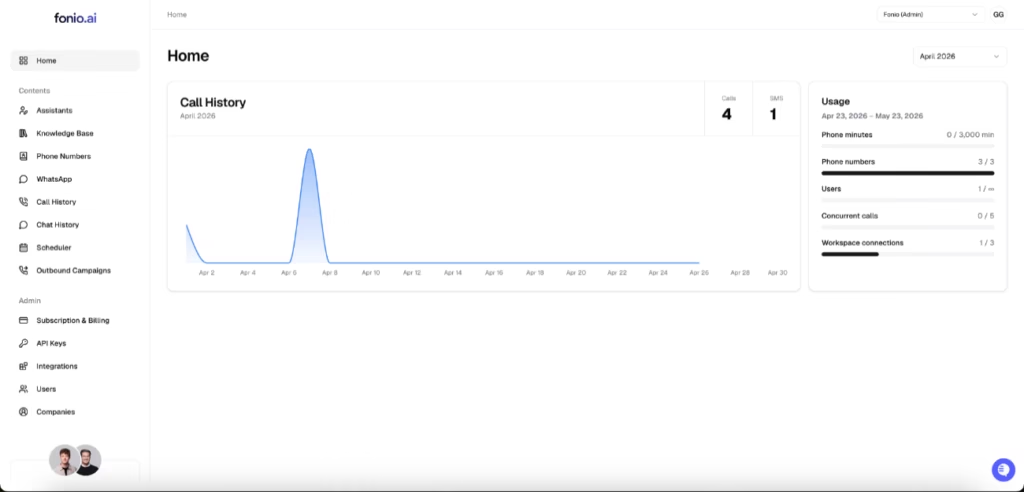
- Analytics with a unified inbox for calls and conversations, filtered by channel, assistant, direction, and outcome.
- A WhatsApp channel available as an add-on, using the same configuration as the phone assistant.
- Variable extraction and precise handling of critical data such as emails, phone numbers, or customer numbers.
These capabilities add up to tangible savings: fewer missed calls, less manual logging, and more hours available to the team.
AI Features
- Natural language understanding that identifies the reason for each call and responds in context.
- Automatic language detection when voice-and-language mode is on, letting the caller switch languages partway through the conversation.
- Extraction of structured data from speech, mapped automatically to the matching CRM fields.
- Live web search, which you can restrict to your own domains, for information that changes often.
- Integration triggers based on the instructions you describe in the assistant's prompt.
- Creativity settings, equivalent to the model's temperature, plus a more precise model for capturing sensitive information.
The genuinely clever part is not just wording the responses, but deciding what to do at each moment. The assistant reads its prompt live during the call and works out when to book, transfer, search the web, or run an integration; it turns rambling, spoken language into clean data ready for the CRM and throws out whatever is irrelevant. Fonio says its assistant resolves up to 98 percent of callers' questions, and when it is unsure how to proceed, it offers a callback or hands the caller off to a real person.
Integrations
- Calendars: cal.com, Calendly, and the fonio Scheduler, which connects to Google and Microsoft accounts.
- CRM systems: syncing with HubSpot, Salesforce, and Pipedrive, particularly in the field assistant.
- Native connectors: email, SMS, HTTP requests, web search, and Google Sheets.
- Extended automation: Make and n8n as a bridge to Slack, Notion, your own databases, and plenty of other tools.
- An extra WhatsApp channel for clients who would rather write than call.
- API and webhooks for connecting internal systems, documented in the Onboarding Academy.
Worth pointing out: Fonio covers the tools most widely used in Spain and Latin America, such as a local phone number and WhatsApp, which makes regional adoption smooth and painless.
Data Security and Compliance
Fonio says it builds its own orchestration layer so that data stays under its control, unlike other providers that resell US services under white label. Its servers sit in Nuremberg, Germany, through the provider Hetzner, inside the European Union. To process the calls, though, the tool leans on external data processors, some of them based in the United States, covered by the Data Privacy Framework between the European Union and the US and by standard contractual clauses.
The company complies with the General Data Protection Regulation and the UK Data Protection Act, and states that it never sells data to third parties without consent. Its policy points to pseudonymization and encryption both in transit and at rest. Audio recordings stay available for 30 days, with a beta feature that deletes them automatically if the caller declines to be recorded, and the top-tier plan offers zero data retention.
Language: Customer Support and Interface
The platform and the help center are available in English. User support runs mainly through email, and there is a contact number, along with a form and the option to schedule a demo.
AI Language: The Tool Itself
The assistant supports more than 35 languages and detects the caller's language automatically when set to "Multi" mode. The assistant understands and responds in English with ease; its speech recognition and language generation rely on models from specialized external providers.
Mobile Access
Fonio runs as a web platform in the browser, at app.fonio.ai. From the caller's side, though, the interaction happens over the phone no matter the device, and the WhatsApp add-on brings in a text channel that is fully native on mobile.
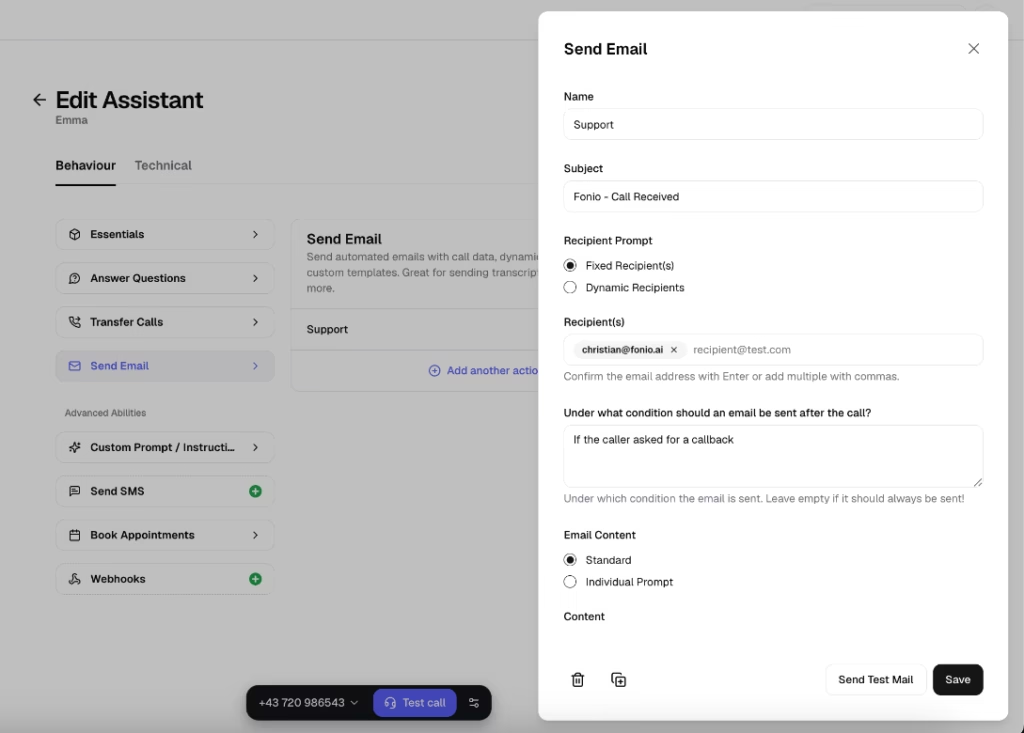
One of the biggest time-savers for small teams is the automatic sending of emails and SMS messages the moment a call ends. You set up each action with a fixed recipient, when it should always go to the same address, or a dynamic one, when the destination depends on the topic discussed, and you build its content from variables the AI agent fills in: the conversation summary, the full transcript, the caller's number, the duration, or the start timestamp. On top of these, you can add the custom variables you define in data extraction, such as the customer's name, the order number, or a requested date, which drop straight into the subject line, the email body, or the SMS text.
Support, Onboarding, and Account Management
Onboarding is especially well thought out. Fonio offers an academy with explainer videos and short courses, plus a help center with smart search, prompt templates, and webinars.
The no-code setup gets an assistant up and running in a few minutes, and the 30-day money-back guarantee takes the risk out of trying it. This step-by-step approach keeps it accessible to SMEs with no technical background; more advanced account management, with an individual service-level agreement, is reserved for the top-tier plan.
Ease of Use / UX
Creating an assistant is as simple as heading to Assistants, clicking Create new, picking a voice and greeting, and pasting your website's URL so the tool builds your company's knowledge automatically. You write forwarding conditions in plain language as "If, then" phrases, and a test-call button helps you check the setup. The learning curve is gentle: one testimonial gathered by fonio describes how someone with no developer background built a fully working phone assistant in a little over 30 minutes.
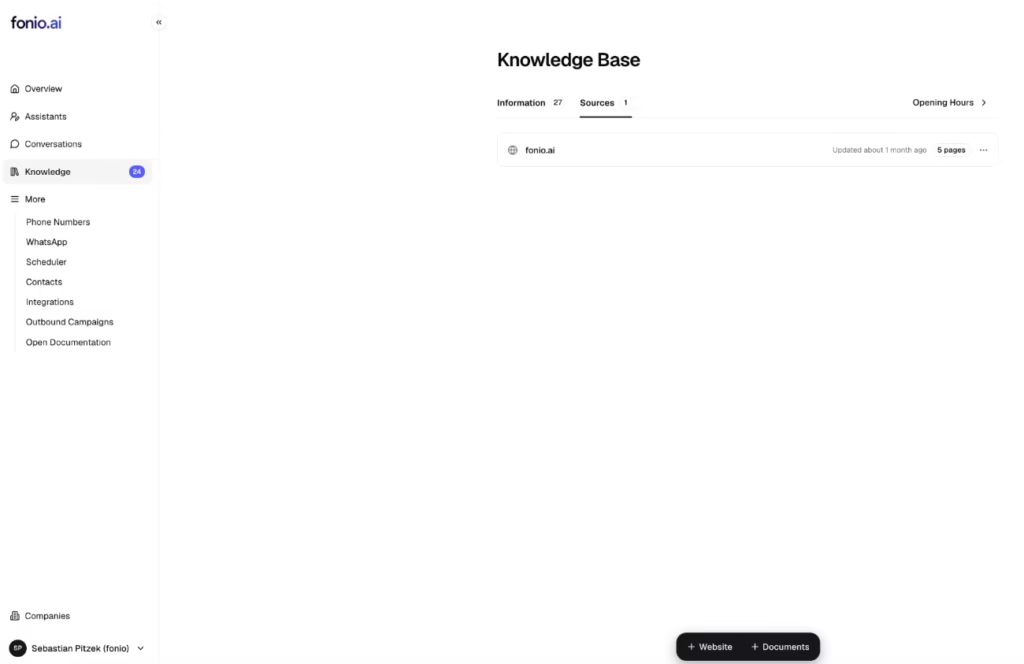
What separates an assistant that sounds robotic from one that really delivers is the knowledge base. Fonio calls it the assistant's brain: the cleaner and more complete it is, the more calls resolve on their own, without callbacks or transfers. It comes down to four complementary building blocks: question-and-answer entries for specific, recurring queries; PDF sources for longer content such as brochures or policies, always with readable, non-scanned text; the free-text company profile with the basic business details; and live web search, which you can restrict to your own domain, for information that changes often. A real win for time-strapped SMEs is that the tool proactively suggests new entries drawn from the documents and websites you add, already written out with a question, answer, and source; you just review and confirm them, and the knowledge base grows almost by itself. Per-assistant access control only works with PDF sources, while question-and-answer entries always apply to every assistant, so anyone who needs separate knowledge sets has to rely on separate documents.
With this knowledge base complete and current, an SME can see real value within days: the assistant answers accurately, escalates to a person only when it is truly needed, and keeps the experience consistent on every call.
Pricing and Plans
Fonio splits its offering into three main subscriptions and one add-on, with monthly or annual billing, a discount for paying annually, and a 30-day money-back guarantee.
The entry-level plan targets businesses with only a few calls a day and includes one assistant, one number, a scheduler, and a wide catalog of voices and languages. The mid-tier plan, the most popular one, adds several simultaneous calls, more numbers, its own SIP trunk, and outbound calls with campaigns. The top-tier plan is built for high volumes and adds a custom voice, zero data retention, and an individual service-level agreement.
The WhatsApp add-on, which needs an active subscription, brings a monthly bundle of conversations, contacts, a WhatsApp number, and all the integrations. To gauge the return, the tool itself lets you try it in seconds and schedule a demo before you commit.
Case Study
DZAM, the Amstetten Diagnostic Center, is a radiology center equipped with computed tomography, magnetic resonance imaging, and other large machines, serving much of the Mostviertel region in Lower Austria. It takes 300 to 400 calls a day, many of them routine and irrelevant, which were swamping the team. For about two months now it has used Fonio, which filters those calls and handles them directly, saving one to two hours a day that the team can put toward essential work. Going forward, the center hopes to connect its calendar to book appointments automatically and to get better statistics. You can read the full case study here.
Videos
Fonio vs Alternatives
| Tool | Pros | Cons |
|---|---|---|
| Fonio | Voice and telephony specialist; platform, voices, and support in English; no-code setup in minutes; servers in the European Union. | Built around the phone channel rather than text; no dedicated mobile app; depends on external providers to process calls. |
| Intercom | AI agent (Fin) paired with a full help desk; multichannel and very quick to set up; a modern chat experience. | Less specialized in the enterprise voice channel; some of the advanced support is in English; its per-resolution pricing can be hard to predict. |
| Ada AI | Strong omnichannel coverage across chat, voice, email, and messaging; low-code automation; a broad ecosystem of enterprise integrations. | Dashboard available only in English; complex to implement; needs a budget for integrations and a fair amount of technical capacity. |
The key difference is focus: Fonio was born for localized phone support and excels at it, while Intercom and Ada AI shine in multichannel conversational support centered on text and in more enterprise-oriented settings.
FAQs
Is Fonio a good choice for SMEs?
Yes. Its no-code setup, round-the-clock availability, and the staff hours it saves make it especially useful to freelancers, medical practices, and shops with a high volume of repetitive calls.
Does Fonio support multiple languages?
Yes. The platform, the help center, and several voices are in English, French and other languages.
How long does it take to set up Fonio?
The assistant is ready in a few minutes. The total time depends on integrating it with your current systems, but the basics are in place almost immediately.
Where is Fonio's data stored?
The servers sit in Nuremberg, Germany, inside the European Union, though to process the calls the tool turns to external data processors covered by the Data Privacy Framework and standard contractual clauses.
What are the best alternatives to Fonio?
The standout alternatives are Intercom and Ada AI, both geared more toward multichannel conversational support by text, while Fonio specializes in voice phone support.
Still weighing up Fonio?
See how it compares with the other tools we've reviewed in AI Agents.