

Cofounder Review
An ambitious platform, solid on the engineering side, held back today by a short track record.
Cofounder shines as an all-in-one assistant for early-stage technical founders who want to get from idea to a deployed product without building the infrastructure from scratch. Its biggest strength is that it sets up the repository, the deployment, the database and the authentication, then lets you review and approve rather than code every line yourself.
The AI is multilingual and can understand and work in several languages, but the interface itself is English-only. Additionally, the product is new, and it builds web applications only, on top of a closed technology stack.
Our recommendation is clear. It's well worth it for founders who like having the whole company lifecycle orchestrated in one place. Anyone who would rather pick their own technology than the stack of Cofounder is better off waiting for the product to mature before jumping in.
Averaged from the breakdown below
- Solo founders building a software company who want to hand operations off to agents.
- Early-stage SMEs and startups that prefer to validate and launch before they hire.
- Technical founders comfortable working in English and with the Next.js, Supabase and Vercel stack.
- Mobile or desktop projects, since the product builds web applications only.
- Teams that need the freedom to choose their own technology stack.
- Large companies that want a platform with a long track record of large-scale use.
Key Features
- Central orchestrator: Cofounder works as a manager agent, which the company calls a superoptimizer, and parcels out the work across departments rather than running as isolated agents.
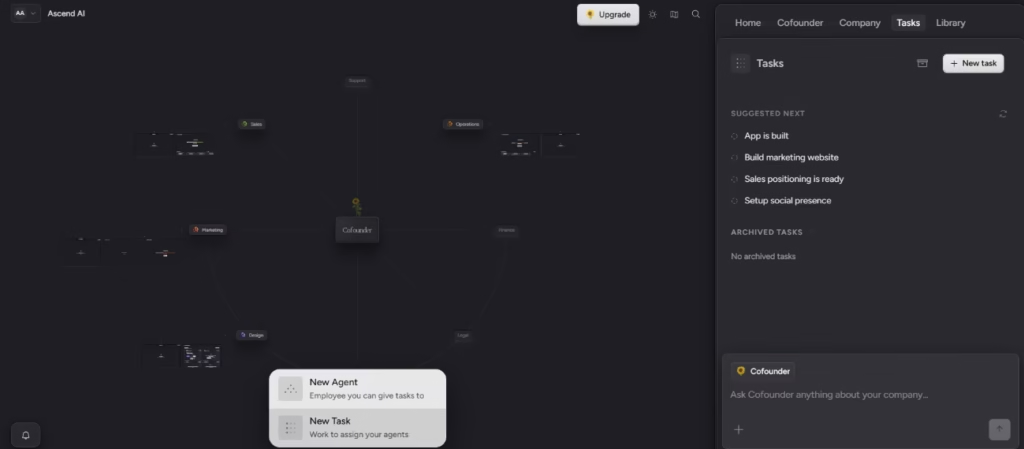
- Visual roadmap (Canvas): the product's main surface lays out active tasks, running agents and next steps on a navigable canvas. Each node shows whether an agent handles it or whether it needs you, and you can zoom in and out to move between the company overview and the detail of a single task.
- Departments with their own space: each department opens a focused workspace inside the Canvas, with its own agents, tasks, files, rules and context.
- Human approval: agents ask for your sign-off before sensitive actions. The official mockup flags incorporating the company and opening the bank account as tasks that need approval.
- Natural-language editing: you tweak deliverables by talking to the agent, with no manual controls to fiddle with. We saw this firsthand when editing the brand kit.
- Managed services: the platform runs your GitHub, Vercel and Supabase accounts for you, along with domains, email and secrets, while you build.
- Project graduation: you can claim ownership of those projects whenever you like, though the company itself advises against it, since it then loses the ability to manage the configuration.
- Background tasks: it runs several tasks at once, the way it finished building the brand kit while we kept moving ahead.
- Central settings panel: a panel in the top-left corner pulls together billing, usage, integrations, skill import and creation, and database access.
AI Features
- Ideal customer definition: at the start, the agent sharpens your customer profile and value proposition with selectable questions, before you write a single line of code.
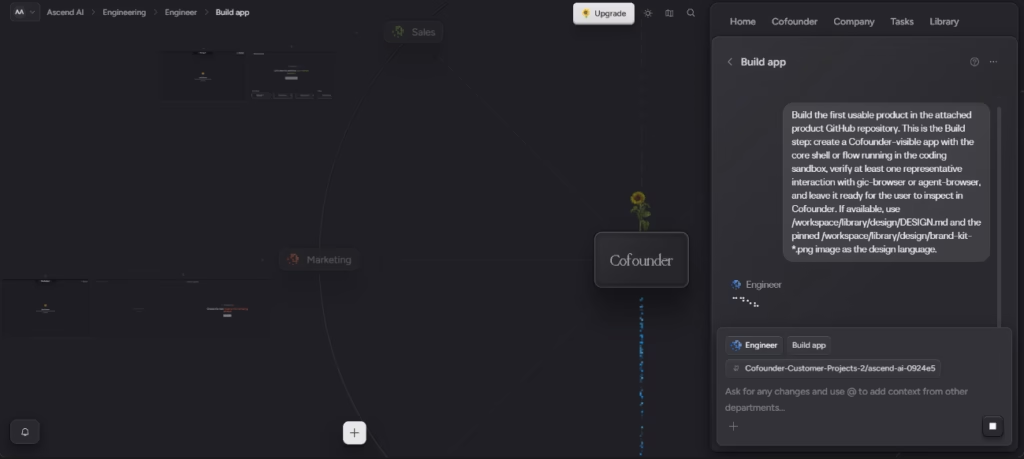
- Code generation: it builds pages and components from descriptions, sketches or screenshots, writes the code, applies the styling and wires it up to the server side.
- Browser agents: they test the application on their own, record a video of the changes and help debug errors from the interface all the way down to the code.
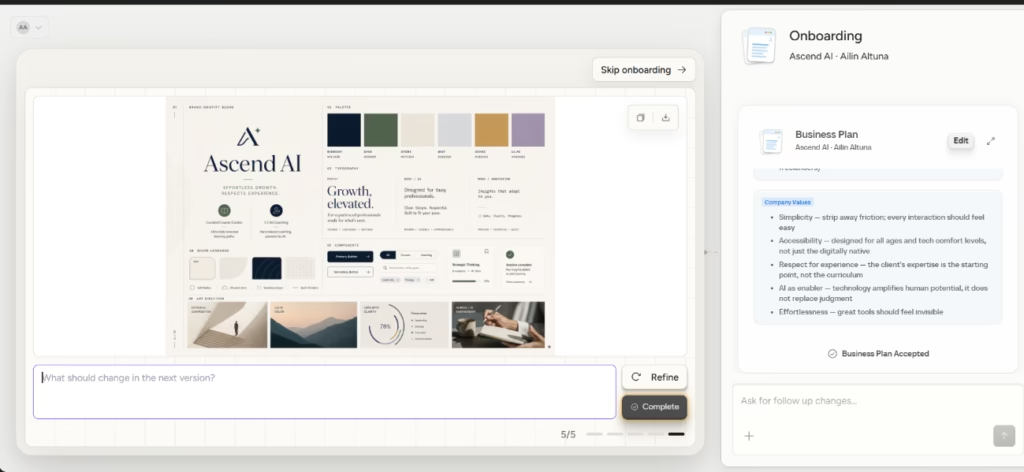
- Design agent: it builds a complete brand kit from a chosen style and visual references, then saves it as a specification in a file the other agents draw on.
- Sales and marketing: it drafts and distributes content, runs campaigns and gives agents their own email inboxes, with an upfront warmup that helps them build a safe sending history before they reach out to prospects.
- Company memory: it imports business knowledge from other AI tools so Cofounder remembers it for future work.
- Model selection: you choose which AI models power the main conversation and the agents' work, and you set a global preference for response style.
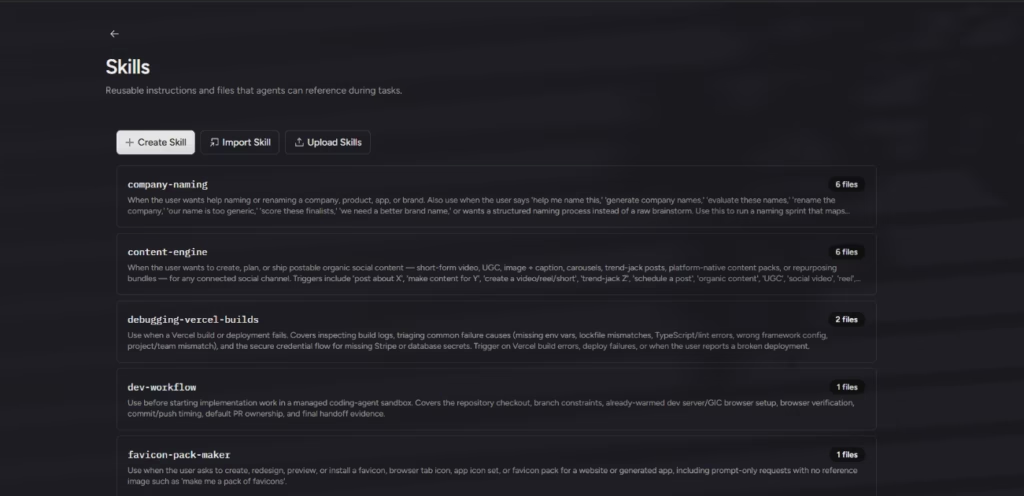
The agents draw on skills, a set of instructions and reference files, to carry out their tasks to consistent standards. Cofounder ships with built-in skills for areas like engineering, marketing, finance and operations, and lets you create, import or upload your own.
Integrations
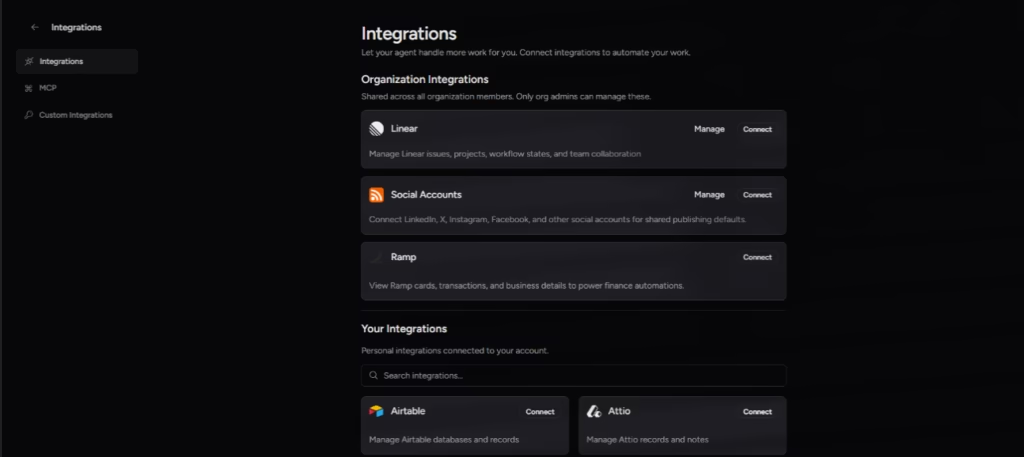
Cofounder keeps organization integrations, shared by every member and managed only by administrators, separate from personal ones, which tie to your account.
- Standard integrations: the usual app connections.
- MCP: connections with third-party apps, powered by Composio.
- Custom integrations: for private API keys.
After onboarding, the agents arrive natively connected to GitHub, Vercel and Supabase, tied to the projects the product itself creates, among them one repository for the application and another for marketing.
The catalog is extensive:
- Organization integrations: Linear for issues and projects, the social accounts (LinkedIn, X, Instagram and Facebook) for shared publishing, and Ramp for finance automations.
- Personal integrations: Gmail, Google Drive, Google Docs, Sheets and Slides, Notion, Airtable, Attio, Intercom, PostHog, Sentry, Datadog, PagerDuty, Metabase, Neon and Google Search Console, among many others.
- Email and inboxes: Postmark for transactional email and Agentmail for the agents' inboxes.
Once you connect Linear, the platform can act as an agent inside that tool.
Data Security and Compliance
Cofounder offers SOC 2 compliance on the Team plan and takes good care of its users' credentials: it encrypts them twice, never shows the secret values in the interface and, inside the agent's sandboxed environment, uses a placeholder that the trusted server swaps for the real credential only when the request goes out.
The database applies row-level security, so each user sees only their own records. For company memory, only administrators import context, and the system warns you not to load secrets or private personal data. As we saw earlier, the decisions that carry the most legal or financial weight run through your approval.
Language: Interface and Customer Support
The interface and the documentation are in English.
AI Language
The main language is English, but the AI is multilingual and can operate and produce work in several languages.
Mobile Access
Cofounder runs as a full web interface, with no mobile version.
Support, Onboarding and Account Management
Cofounder offers its own technical documentation, email support and priority support on the Team plan. It handled the handoff from the previous version cleanly: the company gave advance notice of the Cofounder 1 retirement schedule, let users export their conversations and bumped existing users to the front of the waitlist. You can read that as a sign of careful communication with its user base.
Ease of Use/UX
Onboarding is guided and quick: you choose your role, the stage of your idea, the company name and a free-form description, and the agent shows up right away, summing up your business and refining the details with selectable questions.
From there, the product suggests next steps based on what you've already done and collects everything that needs your approval in a single queue.
You pick a starting visual style, add references if you want and the agent generates a brand kit in about two minutes. Creating a task comes down to describing what you need and letting Cofounder assign the right agent, while you set up custom agents with a name, instructions, model and scheduled tasks.
Admin lives in the top-left panel, which gathers billing, usage, integrations, skills and the database without making you leave the environment. That centralization keeps the administrative side in plain view while the operational work plays out on the canvas.
Pricing and Plans
Cofounder uses usage-based pricing: each plan includes a monthly usage allowance, and you only pay more once you go past it. That usage covers the agents, AI model usage, compute, the database, support, advertising and data purchasing, and the page throws in a calculator that estimates the total based on the size of your business.
There's a seven-day free trial and two paid plans: Cofounder Pro, aimed at a founder building and running their company, and Team, still on the way, which adds multi-user collaboration, SOC 2 compliance and priority support. Keep in mind that the total cost grows with how much work the agents take on, so value for money depends a lot on how much you delegate to the platform.
Case Study
Yohei Nakajima, creator of BabyAGI and a venture capital investor at Untapped Capital. In May 2026 he used Cofounder to build around ActiveGraph, his new open-source agent execution environment under the Apache 2.0 license. According to the case Cofounder published in its resources section, Nakajima handed it his GitHub repository and asked for a marketing site and a newsletter; the tool read the repository, picked up the brand signals, stood up the site and connected Resend to capture emails. It then added a blog, drafted and sent several newsletters and kept the project's announcements going.
In two weeks, Nakajima had pulled together a working environment, a published article, a marketing site, an active newsletter, a blog and a growing audience, all while he stayed focused on the research. His reflection sums up the product's case: "If I had had Cofounder three years ago," he says, "BabyAGI could have been a company."
Cofounder vs Alternatives
Cofounder competes in the emerging category of platforms that build and run companies using AI agents. Two alternatives with different approaches are NanoCorp and Polsia.
NanoCorp and Polsia represent the opposite philosophy to Cofounder: they generate and run a company from a single instruction and aim for it to operate almost on its own, with minimal intervention. Cofounder, by contrast, is organized like a real company with departments, where the agents ask for your approval before any sensitive action.
| Platform | Approach | Pros | Cons |
| Cofounder | Agent orchestration with human approval. | Approval-based control at every step; extensible with its own code and API; project portability; SOC 2 certification on the Team plan. | Requires greater founder involvement; closed stack limited to web applications. |
| NanoCorp | Autonomous operation with minimal intervention. | Builds and runs a company from a single instruction; public plan structure. | Does not support bringing your own AI keys or self-hosting; mentions no certifications; bills advertising separately. |
| Polsia | Operation through autonomous agents. | Very fast startup; polished agent-driven experience; manages advertising and infrastructure for the user. | Autonomy with no decision-making options; making corrections consumes credits; documentation behind the subscription wall. |
FAQs
What is Cofounder?
It's an agent orchestration platform that coordinates the work of several departments to help you build and run a software company from one place.
Who is Cofounder for?
It targets early-stage software companies, solo founders and small teams that want to validate, build and launch without hiring a full team upfront.
Can I use Cofounder with my own code?
You can connect your own codebase, though the product wasn't primarily designed for that. The best experience comes from a project Cofounder sets up from scratch.
Can I take my project with me if I leave the platform?
Yes. The paid plans let you claim ownership of the managed projects, though the company advises against it, since it then can't manage the configuration.
What technology does Cofounder run on?
It standardizes its stack on Next.js for the web side, Supabase for database and authentication, and Vercel for deployment, always on web applications.
Still weighing up Cofounder?
See how it compares with the other tools we've reviewed in AI Agents.