

Inkling Review
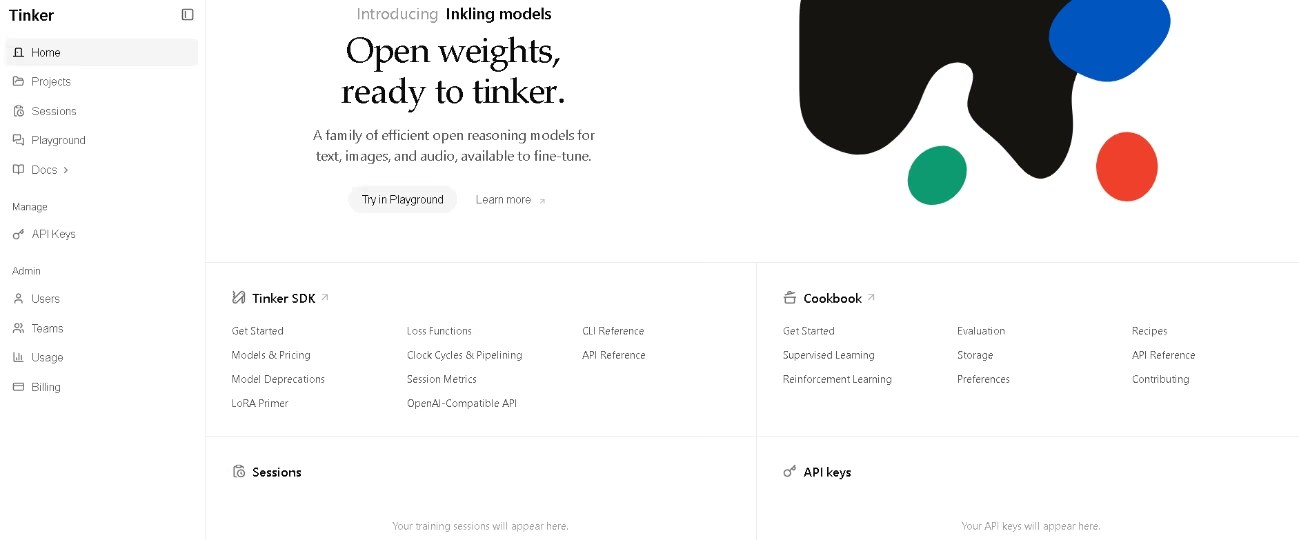
Inkling is Thinking Machines Lab's open-weights multimodal model, downloadable and fine-tunable on your own infrastructure through the Tinker SDK.
Three things make Inkling interesting to us: the license permits commercial use without royalties, it handles audio and images natively, and its reasoning effort control turns quality into cost in a transparent way.
On the other side of the ledger, running a model this size demands serious infrastructure, even though the weights are free. Our recommendation: if you have a technical partner or someone with a machine learning background, evaluate it as a foundation of your own. If you want a finished tool, look elsewhere and come back once the ecosystem around it fills out.
Averaged from the breakdown below
- Development studios and technical teams that want a model of their own, private and tuned to their domain.
- Organizations that cannot send their data to providers in certain jurisdictions for regulatory compliance reasons.
- Agent projects where cost per task and latency matter more than the top score.
- Businesses working with audio or scanned documents.
- SMEs and freelancers without a technical profile who want a tool that works out of the box.
- Terminal-based coding workflows, where other open models do better.
- Tasks that lean on the model's memory without connecting it to web search.
- Applications in medicine, law, or critical decisions, which the company itself advises against without further validation.
Key features
Two sizes and an efficient architecture
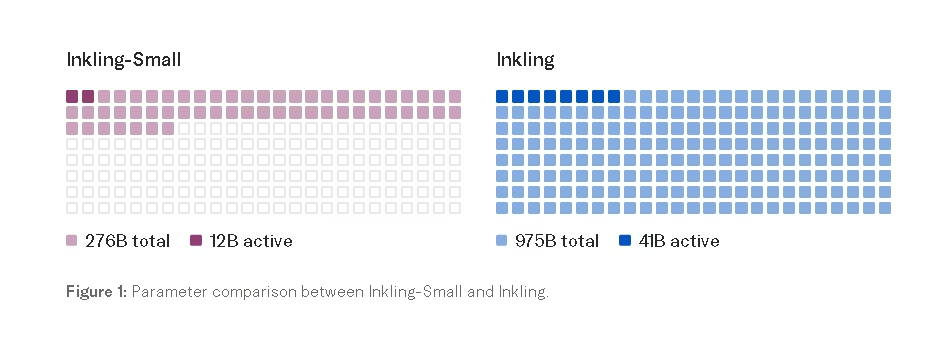
- The main model packs close to a trillion total parameters but activates only a fraction of them per token, a design that makes it cheaper and faster to run.
- The context window reaches one million tokens natively, with narrower options when you train on the platform.
- A scaled-down version at roughly a quarter of the size matches or beats the larger one on several reasoning and coding benchmarks; the big model holds its edge on factual knowledge.
Access and ways to use it
- A permissive license, which allows commercial use, modification, and fine-tuning without royalties.
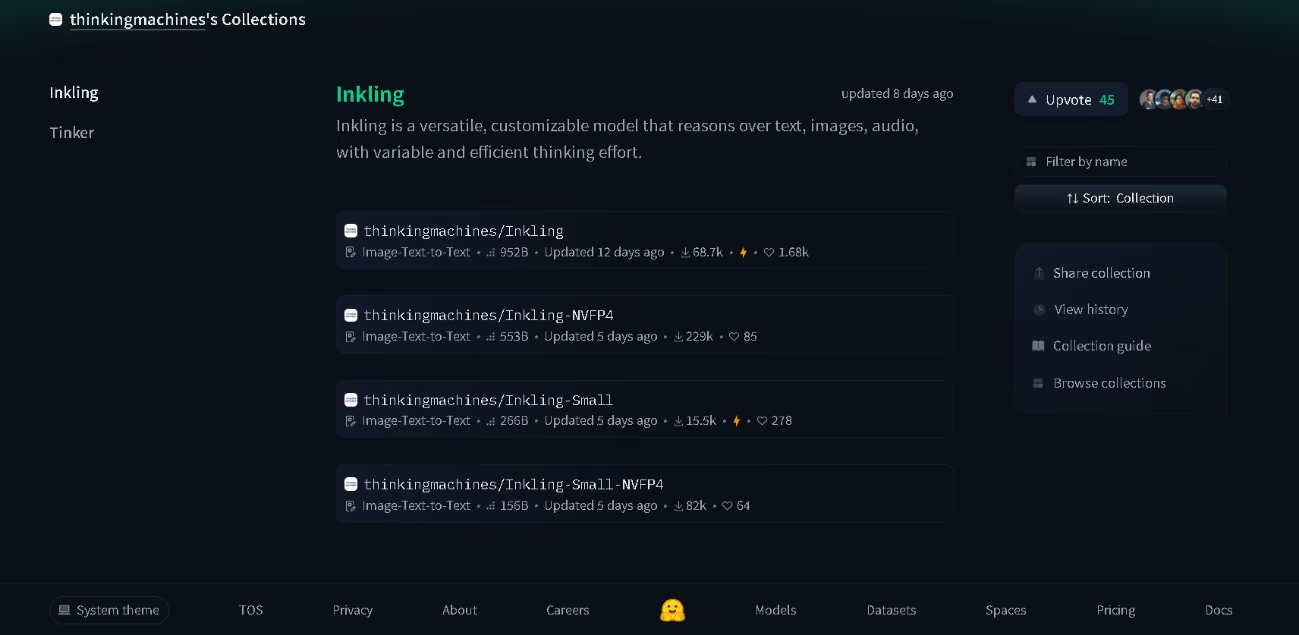
- Direct download from Hugging Face: an account and a login are all you need to get the weights. The catalog carries the original checkpoints plus compressed versions for recent accelerators, which the company itself presents as an option for efficient inference.
- Three routes: self-host the model, use it through third-party providers that offer it hosted, or fine-tune it on Tinker, the company's own training platform.
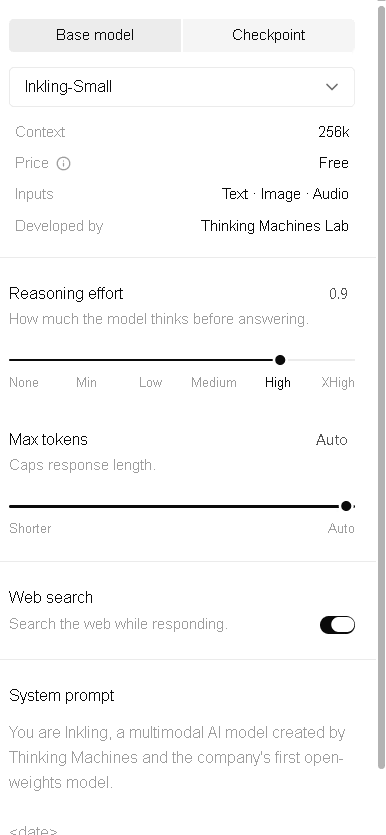
- A conversational playground in the console, with an editable system prompt and a button that shows you the code behind each request.
For a small team, these pieces solve a money problem. Rather than paying for every call to a provider and renegotiating as volume grows, an SME adapts the model once and runs it wherever it makes sense. The resulting model stays in their hands, so the knowledge they invest in training it never feeds someone else's product.
AI features
Reasoning control
- Effort adjusts through a single value, with six reference levels running from no reasoning at all up to the maximum, and you can set it from inside the agent's own runtime.
- Efficient token use: it matches an open NVIDIA model on an agentic coding benchmark while spending roughly a third of the tokens.
Answer reliability
- Calibrated answers: it flags its own uncertainty instead of inventing a convincing output, because its training rewards holding back when the odds of being right are low.
- Claim verification during training, with a grader that checks each factual statement through web search and penalizes anything that does not hold up.
- Forecasting with well-calibrated confidence, trained on a broad corpus of questions that already have answers.
Agents and multimodality
- Tool use and agentic coding, with the tool set randomized during training so the model never becomes dependent on one specific environment.
- Audio understanding: transcription, answers about a recording, speech style classification, and extraction of names and dates.
- Visual understanding: image description, questions about what it sees, document reading, and classification.
The truly clever part here is not that it generates text, but that it manages its own mental spending and knows when it does not know. The effort control turns model choice into a per-task decision, and calibration cuts down on the need to review every answer. One detail shows how far that logic reaches: during training, the reasoning chain grew more concise on its own, without anyone setting that as a goal. Next to that, decoding audio or preparing images before the request goes out is standard processing, done well, but nothing out of the ordinary.

Integrations
- Five open-source libraries for local deployment, each with its own documented recipe.
- Five third-party providers that host the model, each with its own rates.
- Availability on a model router, so you can swap it into existing setups with no extra work.
- Compatibility with the ecosystem's most widely used model library, plus a rendering tool released alongside the model.
- Serverless inference in beta, limited to this family of models, with a waiting list for production use.
There is an API. The platform exposes two compatible interfaces, one in the OpenAI format and one in the Anthropic format, so you can point tools built for those providers at it by changing nothing but the base URL and the key. Both sit in beta, and the company presents them for testing and low-volume internal use.
Data security and compliance
Data ownership stays with the customer. The company states that whatever you upload to the platform serves only to fine-tune your own models, never to train theirs, and it lets you download the checkpoints you generate. It also documents how it isolates data across organizations, teams, and projects, with roles that define who sees what, so access control is there by design.
On model behavior, the company ran internal tests, hired four independent organizations before launch, and fine-tuned a variant with its safeguards stripped out to measure what it could really do in the worst case. It concluded that releasing the model added no significant risk beyond what other open models already allow. It names one residual risk outright: every so often it complies with harmful requests when someone frames them as role play or asks indirectly, and it recommends wrapping the model in external filters rather than trusting its refusals. The point that should carry the most weight in a business decision is a different one: whoever fine-tunes the model answers for the safety of their version, not the maker.
Language: customer support and interface
The console and the full documentation are in English. In practice, the contact channels stay open and nothing stops you from writing in another language, but treat that as a possibility rather than a commitment from the provider.
AI language
The official model card names English as the intended language and mentions general multilingual capability. The company itself warns that performance varies across languages and dialects, especially those less represented during training. The model handles English and Spanish, among others, and on the general multilingual benchmarks it publishes, it holds its own against the models it is measured against. The technical documentation confirms that for now, the model works with twelve languages.
Mobile access
There are no dedicated mobile apps. The console runs in a browser and the model is consumed through the API or self-hosted, so the real work happens on a computer. That absence fits what this is: a piece of infrastructure to build with, not a consumer product. If your team needs AI on a phone, the mobile app will be the one you build on top of the model.
Support, onboarding, and account management
- A progressive five-level learning path, from your first API call through to production, with two dozen guides in interactive notebooks you can read, run on your own machine, or try online without installing anything.
- A cookbook with fifteen complete training examples, among them chat fine-tuning, mathematical reasoning, coding with sandboxed execution, search tool use, rubric-based grading, and image classification.
- A guide dedicated to this model inside the cookbook, with its own sections on reasoning effort, audio, and images.
- Support channels: email, a Discord community, and two public repositories for reporting bugs or requesting features.
- A public changelog documenting every update to the platform and the documentation.
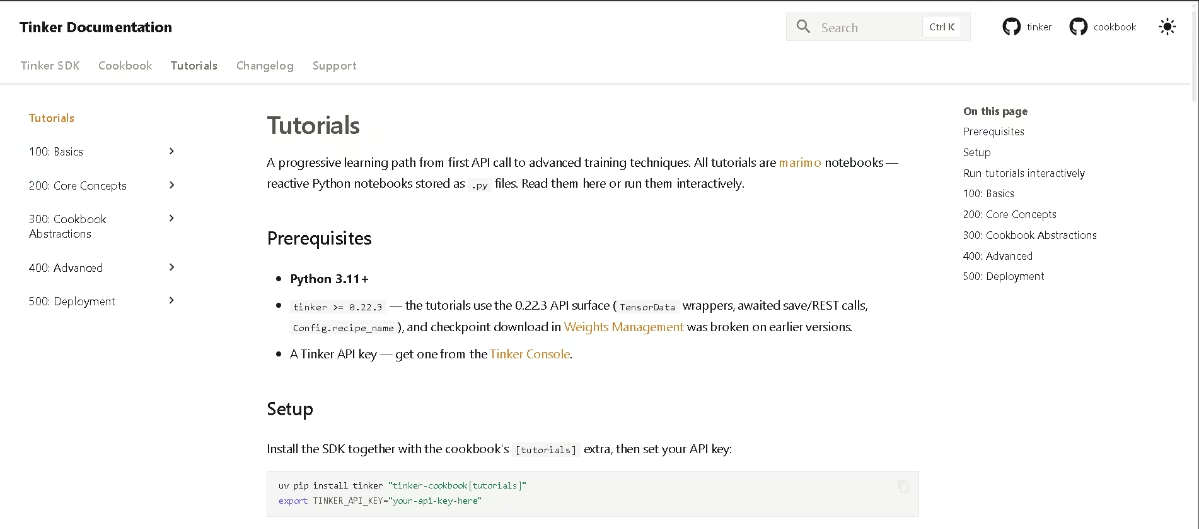
The documentation does not just explain, it teaches, and that puts it above the industry average. Even so, an SME with little technical experience will not find a guided path to a business outcome here. What it will find is a course in model training.
Ease of use and UX
The console is simple. Creating a project, generating an API key, finding the support channels, and reviewing billing are all visible, direct actions, and the usage section lets you check consumption, buy credits, and export everything to a spreadsheet.
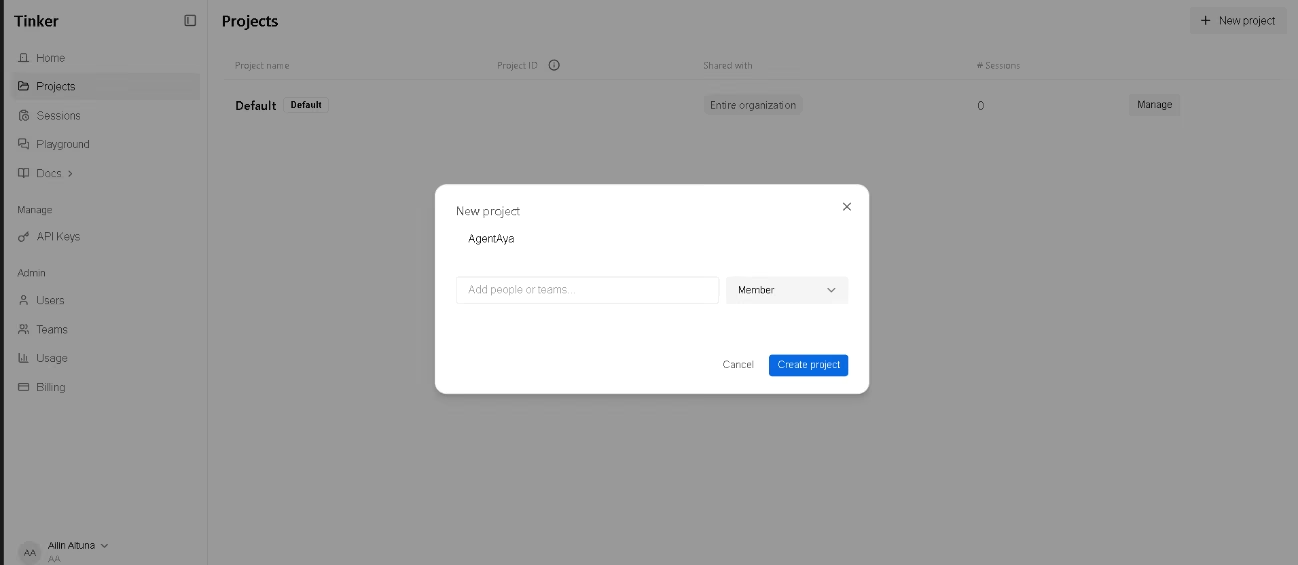
The problem is not the interface but the nature of the tool. Two very different levels of difficulty are at play: using the model as it comes is within reach of any team with a programmer, while fine-tuning it demands quality data of your own, the judgment to evaluate results, and someone who understands training. The first level can deliver results quickly; the second takes weeks of work.
Pricing and plans
- There are no subscription plans or named tiers. The billing scheme works differently from a typical tool.
- The weights download free from Hugging Face under a permissive license. On your own infrastructure, using them costs nothing in license fees.
- Signing up is free, and the playground is open to every organization with no billing for now, so you can try the model before spending anything.
- Training and using the API do call for credits bought up front, with storage for the models you train billed separately.
- The company is running a limited-time discount on the use of this family of models.
- The structure separates processing what you send, generating the answer, and training, with a reduction when a request reuses context that is already stored. Models on this architecture bill on active parameters, which makes them cheaper than dense models of comparable quality.
- Third-party providers set their own rates, so it pays to compare before choosing.
The business behind all this is worth understanding, because it affects how predictable your costs will be. If the weights are public, nothing forces whoever downloads them to pay the company to run them, and the revenue has to come from the training platform and the hosted ecosystem. That bet is still unresolved, which argues against building an entire business on the assumption that today's terms will hold.
Case study
Since this is a new tool, we found no documented case studies. There are, however, independent tests that show how it behaves in real work.
In an evaluation published by Build Fast with AI, a technical team used the model to split the payments module out of a large service, running the task at three different effort levels. The low level produced a working but superficial solution. The maximum caught two additional edge cases, including a currency rounding error that was already sitting in the original code, though it multiplied the reasoning spend several times over. The middle level turned out to be the sweet spot, and out of that came a practical rule any team can copy: work at a medium level by default and push to the maximum only when something breaks. The same team handed it a recording of a work meeting and got back a transcription, a reasonable read on who said what, and answers about each person's commitments, all in a single conversation and with no separate speech recognition pipeline to set up.
In the evaluation published by Decrypt, a very long prompt produced nothing functional at all, and only after it was shortened did the model deliver a basic result, though one with features worth noting. It failed a classic logic puzzle because it pulled from memory the answer to a different version of the problem, a trap that caught two closed frontier models as well. And while writing a story, it went and searched the web on its own initiative, but then invented biographical details about a real person. Comparing the two tests yields the most useful lesson of all: the result depends enormously on how you frame the request, and the company itself admits the model occasionally slips on following instructions precisely.
Inkling versus the alternatives
Inkling and Kimi K3 are both LLMs, that is, large language models, and both are multimodal, though their scope differs: Inkling processes text, images, and audio, while Kimi K3 works with text and images. Eigent is neither an LLM nor a model of any kind. It is an open-source desktop application that orchestrates several agents and runs on whichever model you connect to it.
| Aspect | Inkling | Kimi K3 | Eigent |
|---|---|---|---|
| What it is | Multimodal LLM as a foundation to build on | Multimodal LLM with a complete product ecosystem | Application that coordinates agents, with no model of its own |
| Openness | Open weights with a confirmed permissive license | Open weights with licensing details still to be pinned down | Open source application |
| Audience | Technical teams and product builders | SMEs with some technical profile, plus advanced users | Professionals who want to automate their desktop |
| Input modalities | Text, image, and audio | Text and images, with vision in the loop | Depends on the model connected |
| Agents | Slots into other environments, with no orchestrator of its own | Native swarm with work split by role | Orchestration is its core function |
| Local execution | Yes, with powerful infrastructure | Possible, with very high requirements | Yes, local-first by design |
| Availability | Free, immediate download | New sign-ups temporarily paused | Free download with a free version |
| Safeguards | The strongest of the three, with external evaluation | Sparse, according to early users | Depend on the model you choose |
The honest summary: if you need a tool that works today, with complete support behind it, Kimi K3 wins hands down. If you want to automate desktop tasks with local files without handing over your data, Eigent solves that better than either of the others. Inkling is the right call when your goal is a model of your own, private and adapted, with clear legal permission to commercialize it.
FAQs
Is Inkling a good option for SMEs?
Only indirectly. It serves anyone building products for SMEs very well, along with companies that have a technical team and want a model of their own. An SME without a technical profile will get no value from it as it comes, because it is not a finished application.
Is Inkling open source?
Not exactly. It is an open-weights model under a license, so you can download it, modify it, fine-tune it, and commercialize the result without royalties. The company keeps the training data and the training code to itself, and that is what separates this from full open source.
Is Inkling multilingual?
The model understands instructions and answers in more than ten languages, though its official model card names English as the intended language and the company warns that performance is uneven from one language to the next.
Does it need training before it works?
No. It arrives fully trained and answers from the first moment. Fine-tuning is optional and serves to specialize it in your domain, your format, or your tone.
What are the best alternatives to Inkling?
For an SME that wants immediate results, Kimi K3 is the most complete open alternative. If the goal is automating local tasks, Eigent fills that role. On the proprietary side, the Claude and GPT families remain the benchmark.
Still weighing up Inkling?
See how it compares with the other tools we've reviewed in AI for Chatbots.