
Kimi K3 Review
Kimi K3 is Moonshot AI's open model, pairing everyday chat with an agent swarm, plugins and scheduled tasks that take on long multi-step work.
Kimi K3 is a frontier model backed by a surprisingly complete ecosystem. Three reasons make it stand out to us: it performs at a very high level in coding and agent work, it is open-weight (anyone will be able to download and run the model), and its cost per use is low compared with the big proprietary models from the United States. That combination puts pressure on Silicon Valley's closed business model, and that is the real headline.
That said, as we write this review, Moonshot has paused new subscriptions to Kimi K3 because of extremely high demand (we explain this in detail below), so a new user cannot sign up just yet. On top of that, early users report that the model ships with very few of the safeguards that US companies do impose, which is good or bad depending on who uses it. We tested the tool through the session of someone who already had an active account, and it was a good experience. Anyone who doesn't know it yet can join the waiting list and wait for the slots to reopen, because availability will come back.
Averaged from the breakdown below
- SMEs and freelancers with technical skills who need coding, automation, or autonomous agents.
- Teams that work with long documents, spreadsheets, or presentations and value the one-million-token context window.
- Startups and studios that want to generate websites, games, or prototypes from visual references.
- Companies in heavily regulated sectors that require certifications and written, documented compliance guarantees.
- Teams with no technical skills at all who only want a simple, ready-made chatbot.
- Organizations that need to deploy the model on their own without powerful infrastructure, since Moonshot recommends setups with 64 accelerators or more.
Key features
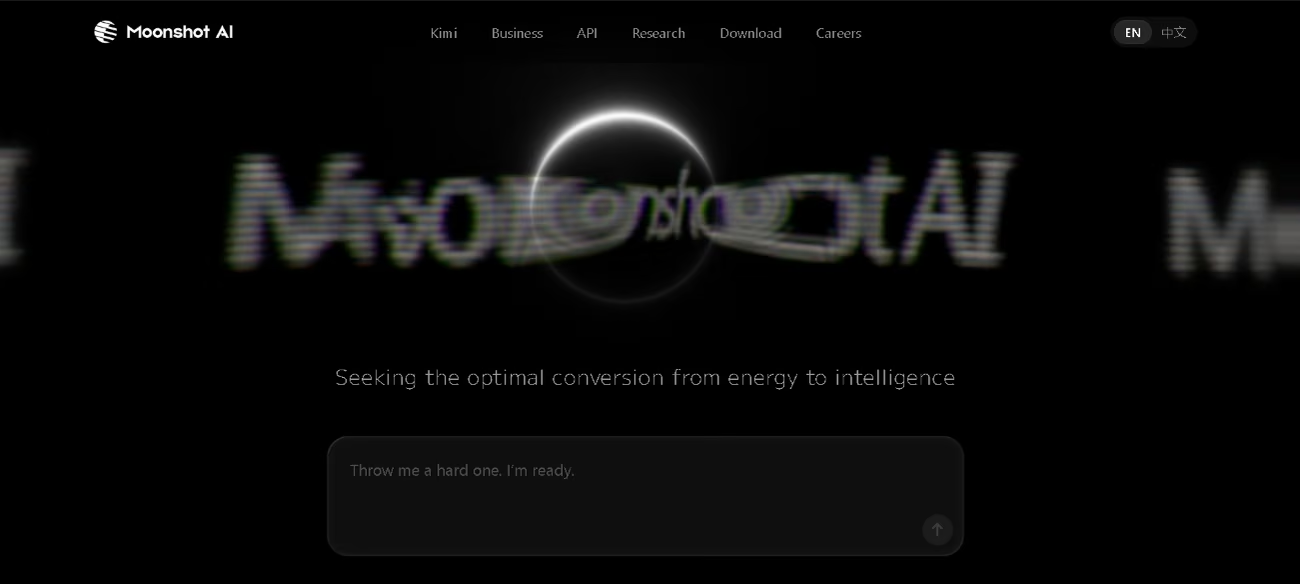
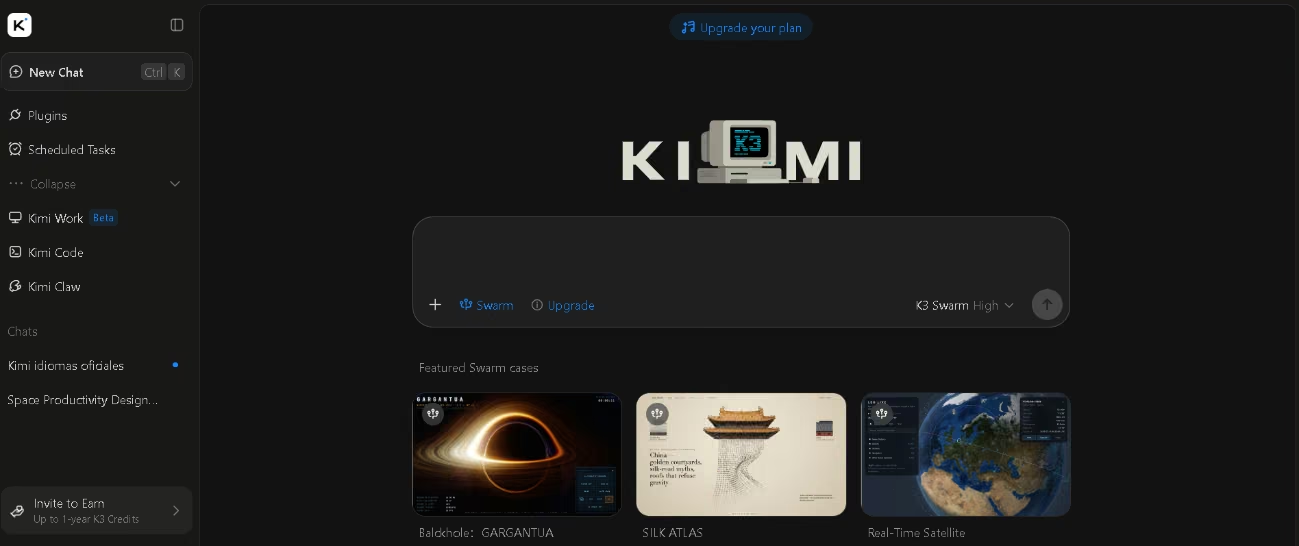
- Several ways to use the same model: Kimi on the web (an all-in-one workspace), Kimi Work (a desktop app for Windows and Apple silicon Macs), Kimi Code (a coding agent in the terminal and as an editor extension), Kimi WebBridge (a browser extension for agentic tasks), and Kimi Claw (a cloud deployment of a personal assistant with memory and personality).
- A context window of up to one million tokens, built for large codebases and long, coherent conversations.
- Built-in creators for documents, presentations, spreadsheets, and websites, with export to office formats and one-click publishing.
- A library of reusable skills and a catalog of plugins to connect data sources and external services.
- Two complementary help centers, one focused on product features and the other on account and plan matters.
- When you share a conversation, the interface lets you copy the text or the link and generate images or documents from it.
This tool is a long-context LLM, the kind of model built to read and understand enormous amounts of text in a single session, with capacities that range from 100,000 to more than a million tokens. That headroom lets these models work with entire documents, whole codebases, research papers, and long, multi-turn conversations without losing track of what came before. In practice, this means you can analyze large volumes of information, review extensive documentation from start to finish, and keep your reasoning coherent across all the material, which is especially valuable for business tasks, research, and advanced AI workflows. It is exactly what allows Kimi K3 to sustain long projects without breaking them into fragments.
For an SME, this architecture means one concrete thing: instead of paying for and learning five different programs, a small team gets writing, analysis, coding, and automation from a single account. That saves coordination time and cuts spending on separate licenses.
AI capabilities
- The Kimi K3 model itself: 2.8 trillion total parameters, a proprietary attention architecture (Kimi Delta Attention and Attention Residuals), and native visual understanding, which lets it work with text and images inside the same model.
- "Vision in the loop": Kimi K3 switches between writing code and looking at screenshots of its own output to fix it on the fly, which is especially useful when turning a visual reference into an interactive product.
- Long-horizon programming: it sustains lengthy engineering sessions with little supervision, works through large repositories, and uses terminal tools.
- Deep research that gathers and synthesizes sources and turns them into reports or visualizations.
- Reasoning effort levels (low, high, and max) to match the model's intensity to each task.
- Agent Swarm, Kimi's multi-agent capability, which coordinates up to 300 subagents in parallel and supports more than 4,000 tool calls per task.
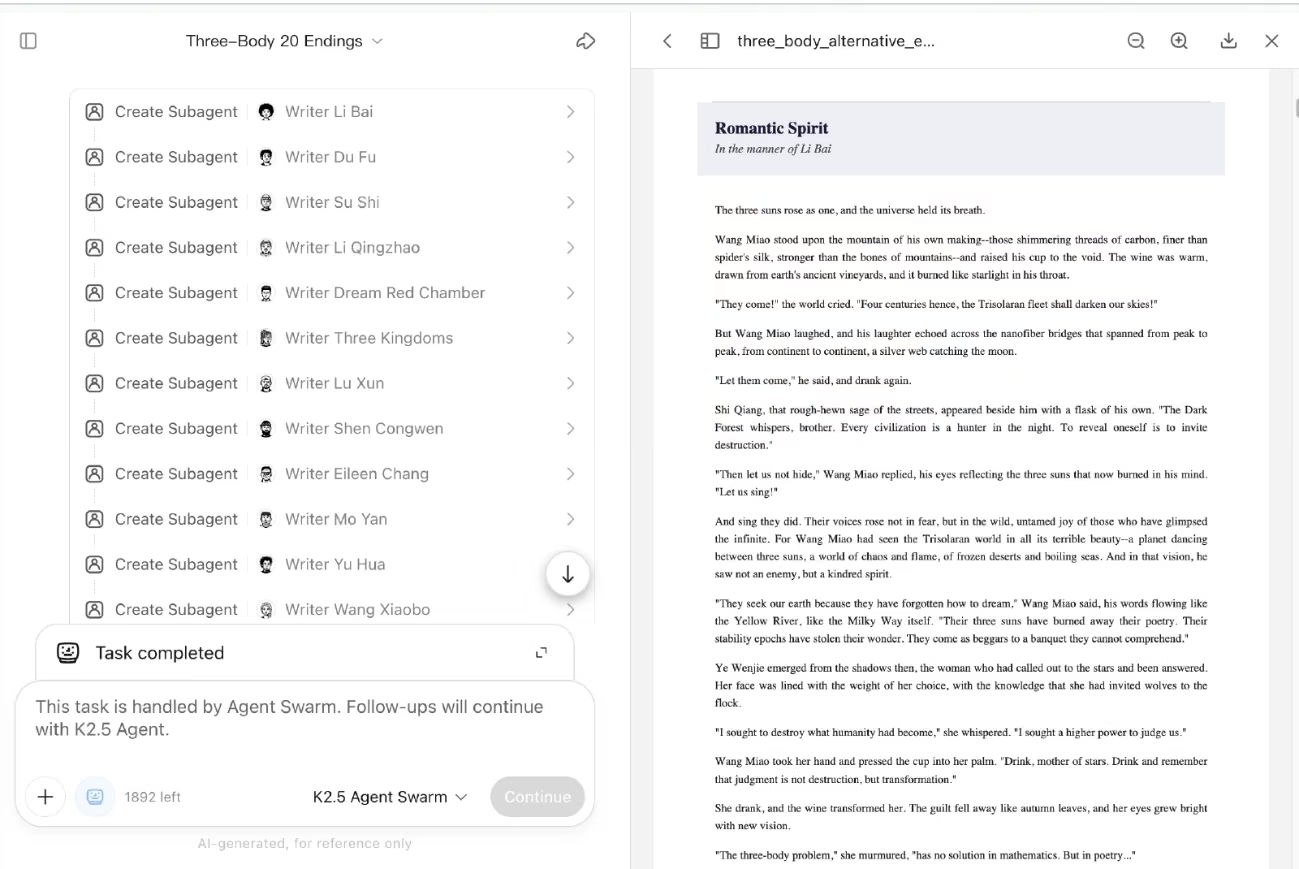
The agent swarm sets Kimi K3 apart from an ordinary chatbot. Instead of solving everything in sequence, an orchestrator breaks the task into subtasks, distinguishes what can run at the same time from what has to wait (dependency-aware parallelism), and divides the work among agents with defined roles: researcher, analyst, writer, software engineer, and presentation builder. Between stages it applies checks that catch inconsistencies before moving on (for example, if the interface expects a field under one name and the data side returns it under another). Each agent keeps its own isolated context so it doesn't contaminate the others' work, and at the end a synthesis-and-review phase gathers and verifies the results. This approach shines in large-scale searches, long-form writing, batch processing, reading many files, competitive analysis, and code projects spread across modules, tasks where a single inline agent turns into a bottleneck.
What we consider truly "intelligent" here is not just what it produces, but how it works: Kimi K3 plans, splits the problem among specialized agents, and checks its own progress. By comparison, many of the office functions (converting a file, applying a format) are just well-built standard software.
Integrations
- Plugins for work and data services: Canva, Notion, Stripe, GitHub, Supabase, Neon, and Cloudflare, among others.
- Financial and reference sources: Wind, S&P Global Market Intelligence, the SEC, the World Bank, the IMF, and Binance, useful for analysis and research.
- Compatibility as a coding agent with external tools such as Claude Code, OpenCode, and Codex.
- An available API compatible with two protocols (the OpenAI format and the Anthropic format), which makes it easy to migrate without rewriting existing code.
- WhatsApp integration through a community skill rather than a native connector, a point worth keeping in mind in Spain and Latin America, where WhatsApp is the default channel.
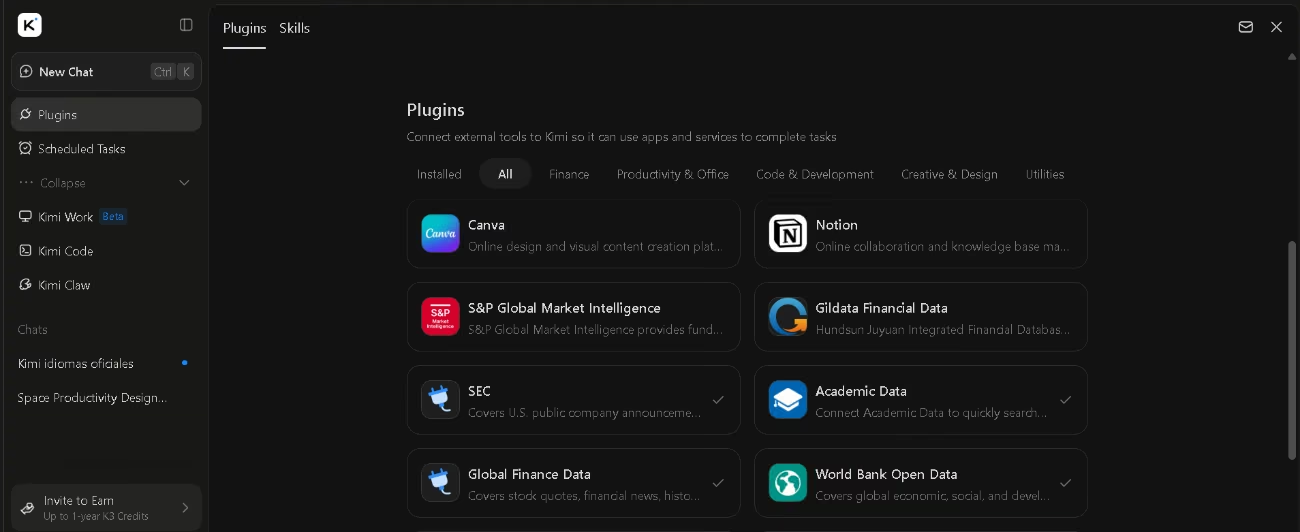
The cost per use of the Kimi K3 API is low, and it drops even further when requests reuse cached context. Because it works with the same protocols as OpenAI and Anthropic, it connects to tools designed for closed models with minimal changes, and since it is an open-weight model, anyone will be able to download it and run it on their own. That mix of low price, compatibility, and openness puts direct pressure on the subscription business of the big US labs. When an open, customizable model matches a closed one for a fraction of the price, many companies prefer to integrate it, adapt it, and avoid sharing their data with third parties. For an SME, that competition translates into more options and more reasonable prices.
Data security and compliance
The platform's terms of service belong to Moonshot AI PTE. LTD., an entity governed by the laws of Singapore that resolves disputes through arbitration at the country's international arbitration center. Under those terms, the customer keeps ownership of the content they enter and generate, and Moonshot does not claim it as its own. That said, unless a separate written agreement says otherwise, Moonshot may use the content to maintain and improve its services. The business plan (Kimi Business) does state that it stores data in isolation and does not use it for training, a meaningful difference for anyone handling sensitive information.
The app listing confirms that data is encrypted in transit and that users can request its deletion. Using the API requires being at least 18 years old and complying with export-control and sanctions rules.
There is one point that we at AgentAya cannot overlook: early users report that Kimi K3 ships with very few of the safeguards that US companies build into their most advanced models to guard against cybersecurity or biological risks. That makes it more "free," but also more delicate in inexperienced hands, and it is worth bearing in mind before you connect it to business processes.
Language: customer support and interface
Kimi's interface is available in Spanish and many other languages, in addition to English. Its two help centers are also available in Spanish and other languages, so a Spanish-speaking user finds both the product and the self-service documentation in their own language, without having to fall back on English to sort out questions.
AI language: the tool itself
Here Kimi K3 is a multilingual model that understands instructions in Spanish and other languages, and because it is multimodal it does not rely on text alone, since it interprets images within the same conversation. Both the early reports and our own experience point to natural responses that strike the right tone in Spanish.
Mobile access
Kimi has dedicated apps for iOS, Android, and HarmonyOS, with a high store rating and more than five million downloads. Syncing across devices lets you start a task on your phone and continue it on your computer without losing your place. That said, the most demanding capabilities (working with local files, browser automation, or the agent swarm in the desktop app) are built for the computer, so the phone works better as a complement than as your main workstation.
Support, onboarding, and account management
- Help Center focused on the tool's features, plan and account matters.
- Onboarding materials in the resources section: tutorials, how-to guides, and articles that walk you through the first steps.
- Developer channels around the API: a console, a forum, a community, and email contact.
- Dedicated technical support and seat-based member management in the business plan (Kimi Business), built for teams.
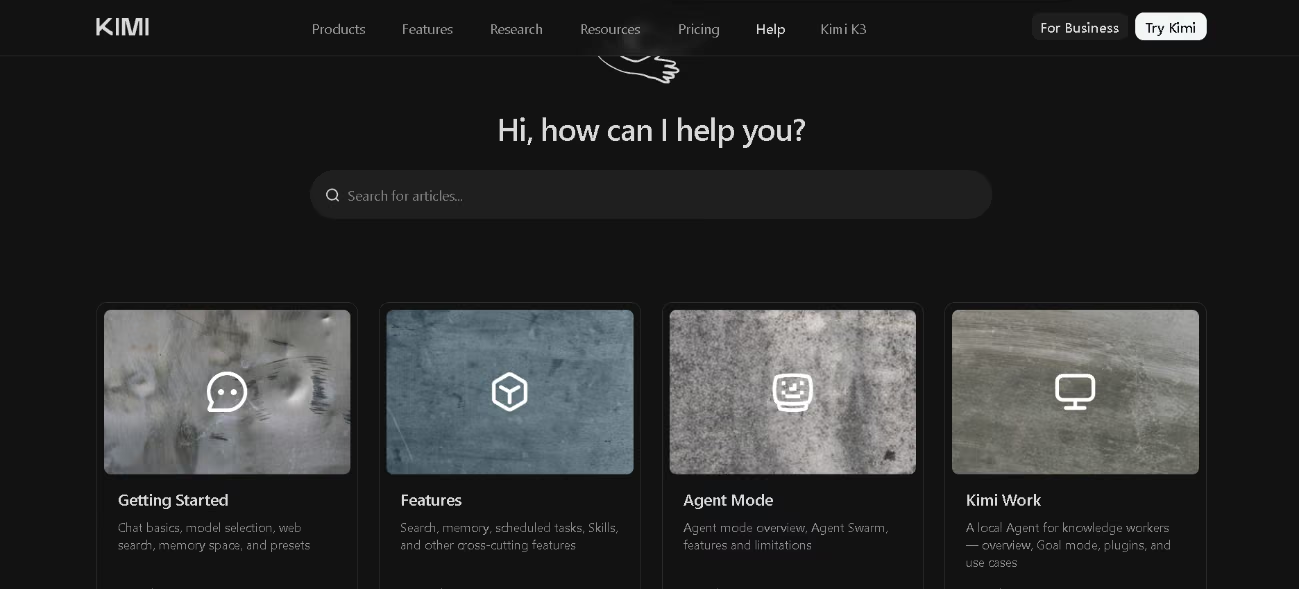
An SME with little technical experience can get started from the web or the phone by leaning on those two help centers, which cover both day-to-day use and account administration. Getting the most out of the agents and the coding does call for a learning curve and, preferably, someone with technical skills on the team.
Ease of use and UX
The apps aimed at end users are polished and run on conversation: you describe what you want in plain language and the system carries it out. That is their biggest strength for anyone who doesn't code. The catch is that Kimi K3 is, at heart, a very powerful tool: the more ambitious the task (agents, code, large-scale research), the more it pays to understand what you're asking for and how to review the result. An SME can get quick value on simple tasks, but full performance arrives when the team spends time defining its processes and instructions well.
Pricing and plans
- There is a free tier that lets you try the platform at no upfront cost.
- The paid plans are organized into several tiers with musical names (from lowest to highest), billed monthly or annually, with a discount on the annual option.
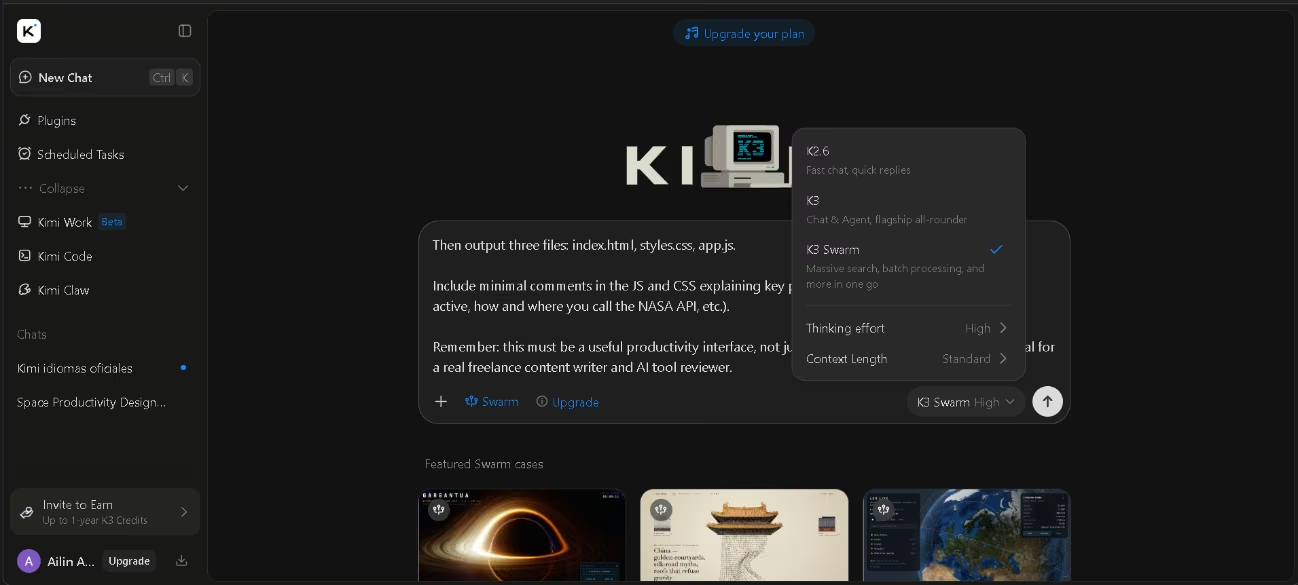
- Kimi K3 requires one of the mid or higher tiers; the free tier offers more credits, but only for Kimi's earlier models, not for the flagship.
- Access to the one-million-token context window, to the Kimi Claw deployment, and to the goal-based working mode unlocks from a mid tier upward.
- The coding membership (Kimi Code) has been split into its own line, geared toward development workflows.
- There is a per-seat business plan and a pay-as-you-go API, with a pricing model that makes requests cheaper when they reuse cached context.
- The platform offers trials and promotional launch vouchers from time to time.
Overall, the value for money is among the most attractive on the market for the technical level it delivers. The caveat, today, is about availability rather than cost.
On July 19, 2026, barely 48 hours after launch, demand for Kimi K3 pushed Moonshot's compute capacity close to its limit, and the company paused new subscriptions. Existing subscribers are not affected, because Moonshot prioritizes its compute for people who are already members. The reopening will be gradual, in batches, as the company expands its data-center capacity, and no specific date has been announced. We'll stress the nuance again: this is a situation of the moment, not a shutdown.
Case study
At Frutas del Sol, a family citrus cooperative in the Murcian district of Alquerías, customer service had turned into a bottleneck: between 450 and 550 interactions a day, most of them repeat questions about deadlines, invoices, and order status, which overwhelmed a five-person team and caused them to miss important calls. After several trial phases (first an internal assistant, then basic support on WhatsApp and the website chat), they brought in Kimi K3 to handle routine queries and pass only the complex cases to a person.
According to the documented case, the average response time went from 18 hours to 45 minutes, customer satisfaction rose by around 30%, and the team stopped firefighting and turned to building customer loyalty. It wasn't automatic or perfect: they had to map processes, feed the system real answers, maintain the knowledge bases every week, and watch out for the occasional hallucination (it once made up a discount). The lesson we take away is the same one that company learned: the technology is the wild card, but the real work is done by whoever understands their business and sits down to organize it. You can read the full article here. https://scriptfinance.es/blog/kimi-k3-desafia-a-opus-4-8-y-gpt-5-5
Kimi K3 vs. alternatives
There are already plenty of comparisons pitting Kimi K3 against ChatGPT or Claude. We compare it against MiniMax instead, another multimodal AI platform.
Two details strike us as decisive. First, MiniMax organizes every conversation with a kind of easy-to-reach folder that keeps the generated materials in plain view (websites, files, anything produced in that session). Second, the credit logic: Kimi offers more credits on its free tier, but reserves them for its earlier models, whereas on MiniMax you may have fewer actions available and still use every model, because the cost depends on the action you run and not on the model you pick.
| Aspect | Kimi K3 | MiniMax |
|---|---|---|
| Focus | Frontier model for code, agents, and long-horizon reasoning | Multimodal ecosystem (text, voice, image, video, and music) with agents |
| Flagship model size | Very large (2.8 trillion parameters) | Considerably more compact |
| Context | Up to one million tokens | Broad, without a focus on massive context |
| Free tier | More credits, but only for earlier models | Fewer actions, but access to every model |
| Work organization | Agent swarm and several access apps | A per-conversation folder with the generated materials |
| Mobile | Apps for iOS, Android, and HarmonyOS, with syncing | Android-only app, in English, slower than the web |
| Current availability | Subscription sign-ups temporarily paused | Available with no sign-up restrictions |
Honest summary: if your priority is raw power in coding, agents, and long context, Kimi K3 is in a league of its own. If you want a complete multimodal platform, with voice and video generation, immediate access, and more flexible credit management, MiniMax is the more practical option today, especially while Kimi K3 keeps new sign-ups closed.
FAQs
Is Kimi K3 a good option for SMEs?
Yes, especially for teams with some technical skills who make the most of the coding, agents, and long context. For very basic use, you may end up paying for power you won't use.
Is Kimi K3 a multilingual tool?
Yes. It is a multilingual model that understands and writes well in several languages, including Spanish, English, Italian, French, Portuguese, Chinese, Japanese and Korean. On top of that, the interface and the two help centers are available in Spanish and other languages, so a Spanish-speaking user works in their own language from start to finish.
Is Kimi K3 open source?
It is an open-weight model: Moonshot publishes the model's values so you can download it and run it. It's best not to confuse this with full open source, since some licensing details are still to be pinned down.
What are the best alternatives to Kimi K3?
MiniMax is a very solid multimodal alternative that's available right away. On the proprietary side, the go-to options are still the Claude and GPT families.
Still weighing up Kimi?
See how it compares with the other tools we've reviewed in AI for Chatbots.