

Microsoft Foundry Review
Microsoft Foundry brings the whole agent lifecycle into one place, from choosing a model and grounding it in your data to evaluating and governing it in production.
Foundry is one of the most complete platforms on the market for building and governing enterprise-grade AI agents. Its greatest strengths are the vast catalog of models from multiple providers, the depth of its governance and observability layer, and permission-aware retrieval with citations that delivers verifiable answers. For an SME, it shines most when you are already working inside the Microsoft ecosystem and need to move from a pilot to something that lives in production with fine-grained control.
It is not the best choice for very small teams or tight budgets: it covers a lot of ground, the learning curve is real, and billing can get complex. Our recommendation: a highly recommended tool for SMEs and companies with intermediate or advanced technical needs (or prior Microsoft experience) that want secure, scalable, and well-governed agents.
Averaged from the breakdown below
- SMEs and companies already operating within the Microsoft and Azure ecosystem.
- Development teams that need agents with their own identity, memory, and multi-agent orchestration.
- Organizations with serious requirements around security, network isolation, and compliance.
- Projects that combine several models from different providers in a single environment.
- Use cases that go beyond a pilot and need to scale, evaluate, and audit.
- Solo founders or very small teams looking for an instant setup.
- Projects on a very tight budget or sensitive to cost per interaction.
- Non-technical users who only need a basic assistant.
- Use cases solved by a simple low-code workflow or an assistant within Microsoft 365.
Key Features
- A very broad model catalog from multiple providers, with families such as GPT, Claude, Llama, Mistral, Phi, DeepSeek, and Cohere, plus open models. Because this is a Microsoft platform under constant updates, you will very likely have access to the latest models in each family.
- Agent service (Foundry Agent Service): lets you create declarative agents defined by instructions, or hosted agents that run your own code, with serverless scaling and a managed endpoint.
- Multi-agent orchestration with built-in patterns (sequential, group chat, handoff) and support for open frameworks.
- Built-in tools and knowledge (Foundry Tools) for tasks such as text recognition, translation, speech, or document understanding, plus a connection to your organization's knowledge.
- One-click publishing of agents to Microsoft Teams and Microsoft 365.
- Foundry Local, to run models directly on the device and at the edge, with offline operation.
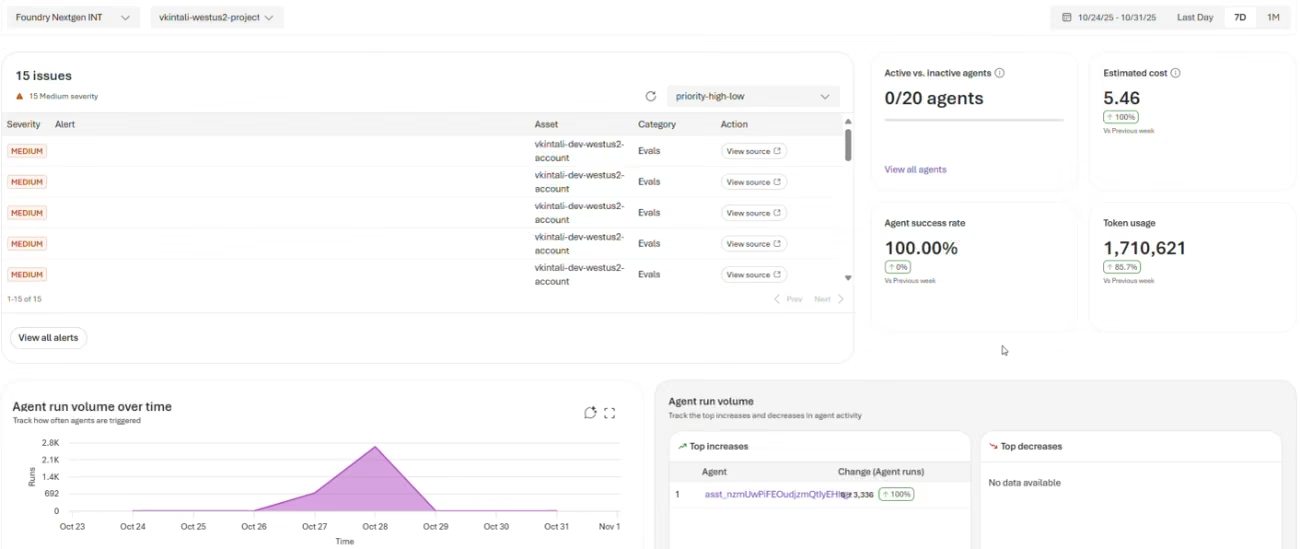
- A control plane (Foundry Control Plane) with traces, metrics, and governance across your entire fleet of agents and models from a single place.
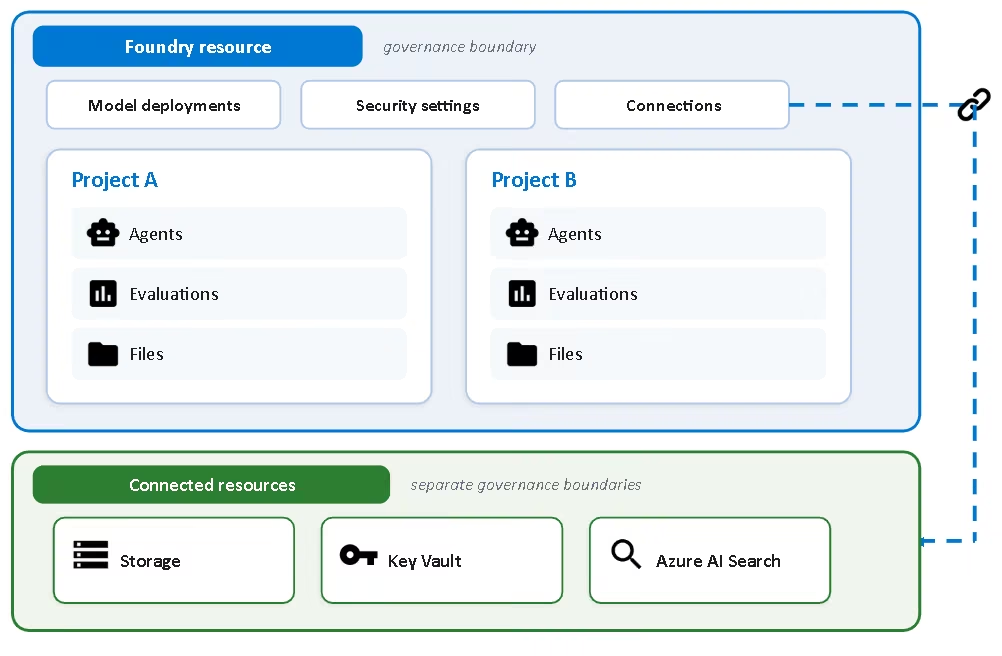
In terms of its overall structure, Microsoft Foundry is organized in layers. At the highest level sits the Foundry resource, which centralizes governance: security configuration, connectivity with other services, and management of the deployed models. Within that resource, you create projects, which act as isolated workspaces where each team builds and evaluates its use cases, reusing models and connections that are already configured without repeating the technical setup each time. Each project owns its own elements (files, agents, and evaluations), and beneath them sit Azure services such as storage, search, and key management, which retain their own governance boundaries. This separation lets the IT team apply centralized controls while teams work with autonomy.
For an SME, all of this translates into saved time and money: instead of building and maintaining the infrastructure for models, security, knowledge, and monitoring separately, everything lives on a single platform with consistent rules, which speeds up the move from idea to a production system.
AI Features
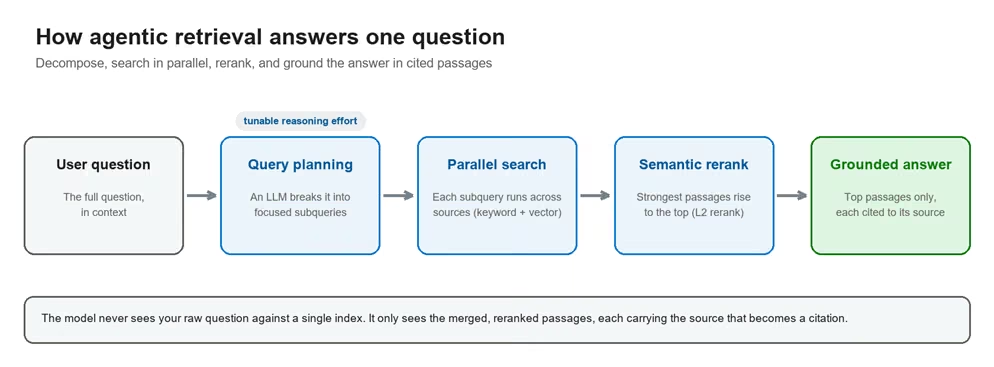
- Agentic retrieval with Foundry IQ: it breaks a complex question into subqueries, searches multiple sources in parallel, reranks the results by relevance, and answers only from what it retrieves, providing verifiable citations and respecting each user's permissions.
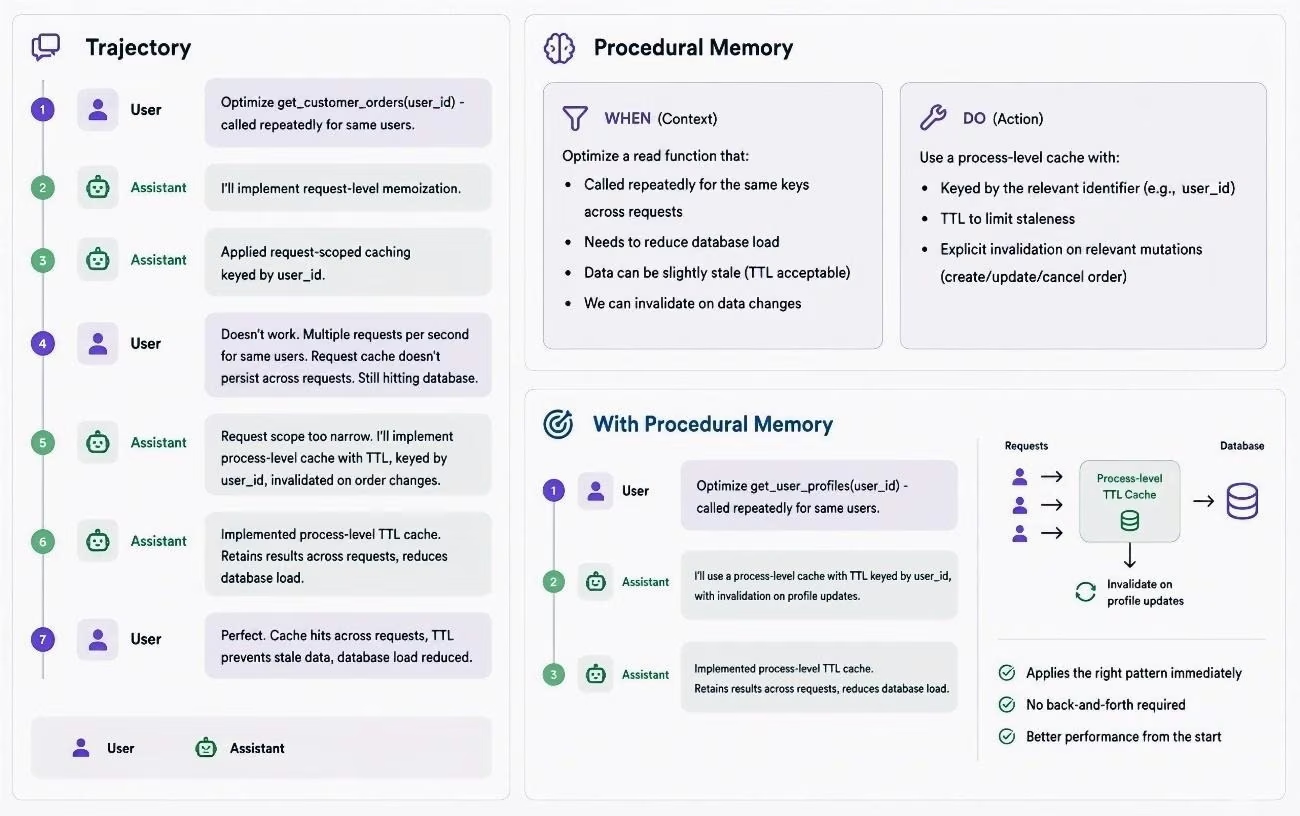
- Procedural memory: agents learn from their previous experience, record what works best in similar situations, and stop repeating the same mistakes.
- Intelligent model routing: the platform can automatically pick the most suitable model for each query, seeking the best balance between quality and cost.
- Automatic quality evaluation, test set generation, and attack simulation (including prompt injection) to validate agent behavior.
- Content safety filters that detect and mitigate harmful content and anomalous behavior at runtime.
- Model customization through fine-tuning and distillation, with minimal coding.
What is truly smart here is not that the agent writes well, but that it answers based on what your organization actually knows. Permission-aware retrieval with citations turns a "because the model says so" into a "here is the source you can verify." This is an increasingly central issue in enterprise AI adoption, and it is not unique to Foundry, but it is exactly where a platform like this delivers real trust: every answer is anchored to authorized, traceable data.
Integrations
- Microsoft ecosystem: Microsoft 365 (Teams, Copilot), Microsoft Fabric, SharePoint, GitHub Copilot, Copilot Studio, and Visual Studio Code.
- Azure Logic Apps: a wide range of connections to enterprise systems such as SAP, Salesforce, Dynamics 365, Office, and Adobe, among many others.
- Data: Azure Cosmos DB, Azure Database for PostgreSQL, Azure Databricks, and managed Redis, plus OneLake in Microsoft Fabric.
- Model Context Protocol (MCP): securely connects agents with external APIs and tools, and can even turn existing APIs into MCP servers.
- Unified API and SDK for Python, JavaScript, C#, and Java, with an API compatible with OpenAI formats, plus a command-line interface and a Visual Studio Code extension.
- Security and governance through Microsoft Defender for Cloud, Microsoft Purview, Microsoft Entra ID, Azure Monitor, and API Management.
Yes, there is a robust API and a complete SDK, which are in fact among the most valued aspects of the platform.
Data Security and Compliance
Foundry builds on Azure's security infrastructure. Identity and access are managed with Microsoft Entra ID, role-based access control, and dedicated identities for the agents, following a least-privilege approach. For network isolation, it supports injection into a virtual network (your own or managed) and private endpoints, so that traffic never reaches the public network unless explicitly authorized; it fits well into zero-trust architectures.
Data at rest is stored in the designated Azure region, and organizations can bring their own storage and their own key store, with customer-managed encryption (256-bit AES). Data governance is reinforced with Microsoft Purview (sensitivity labels) and threat detection with Microsoft Defender for Cloud. The platform supports multi-factor authentication and granular access controls, and it inherits Azure's broad compliance coverage; for details on specific certifications, it is best to consult Microsoft's compliance documentation.
Language: Customer Support and Interface
The Foundry portal and the Azure console can be displayed in Spanish according to your language preference, and the official documentation is available in Spanish. In practice, much of the interface is localized, though some sections or technical messages may appear in English. Azure support is offered in several languages, including Spanish; the exact language, channels, and hours depend on your subscription plan and region.
AI Language: The Tool Itself
The models available in Foundry understand and generate high-quality Spanish, thanks to their multilingual training, so you can build agents that hold natural conversations with Spanish-speaking customers without intermediate translation. On top of that, the platform's language tools include language detection, translation, and speech, with support for Spanish and many other languages. Retrieval works even on documents in formats and languages the system has not seen before, which is useful for companies that work with documentation in several languages.
Mobile Access
Foundry is a development platform, and its main surfaces are the web portal, the command line, the SDK, and the Visual Studio Code extension, all designed for comfortable work from a desktop computer.
Agents developed on the platform are published in one click to Microsoft Teams and Microsoft 365. Since those apps do have mobile versions, end users can access those agents from their phones, even though the building work is done from the desktop.
Support, Onboarding, and Account Management
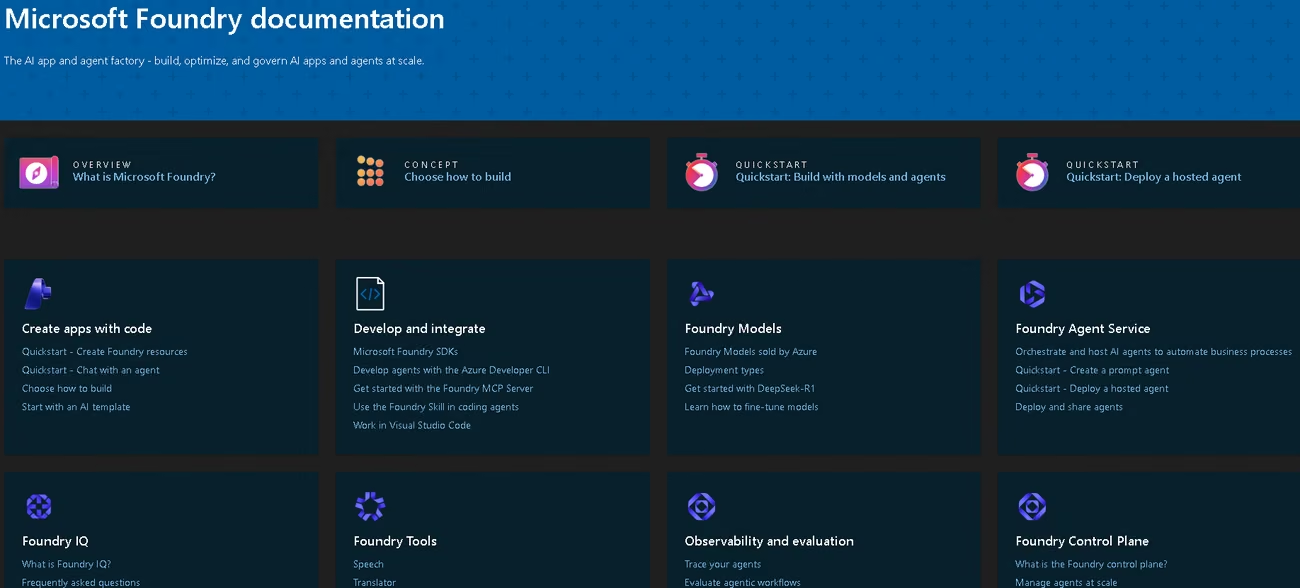
- Extensive official documentation, with quickstart guides, step-by-step tutorials, and code samples in public repositories.
- Videos, courses, and certifications through Microsoft's learning resources.
- An active community on GitHub, YouTube, and Discord for answering questions and sharing solutions.
- Enterprise support plans and account management for larger organizations, along with learning programs such as the ESI, which is how we at AgentAya got started with agent development.
Microsoft's documentation and materials are among the most complete out there, both in terms of language coverage and the variety of guides and tutorials. The only caveat is that, precisely because they are so complete, they can feel overwhelming, and sometimes the challenge is not a lack of information but knowing how to find it. []
Ease of Use / UX
This tool's architecture is comprehensive and useful, yet also very large. To ease the entry, the platform offers a spectrum that runs from the declarative (instruction-based agents, with no code) to full code (hosted agents), plus a portal with a playground, ready-to-use templates, and a guided path that takes you from idea to prototype. In our experience, the new interface is intuitive, building flows feels quick, agent orchestration is easy to manage, and deploying a model to start using it is surprisingly fast.
Even so, Microsoft Foundry packs a lot of features, models, and connection options, on top of frequent product and branding changes. Anyone new to AI development will need patience to get comfortable; developers are the ones who get the most out of it, and teams already familiar with the Microsoft ecosystem start with a clear advantage. A more guided onboarding, with interactive walkthroughs, would make the first experience friendlier.
Pricing and Plans
- Consumption-based model (pay-as-you-go): you are billed according to the services you use, and each service has its own billing scheme.
- Commitment tiers for more predictable costs, and token-based billing for the models.
- There is no single Foundry price, because it is made up of several Azure services; to estimate costs, you use the Azure pricing calculator.
- A free Azure account with starter credits, plus a free search tier and a free token allocation for proofs of concept.
- Foundry Local lets you run models on the device with no per-token cost and with no need for an Azure subscription in that mode.
- Cost management tools with budgets and alerts to avoid surprises.
Like every Microsoft product, the plans and pricing can be complicated, because they reflect the company's global scale. We always recommend checking the pricing and plans page for your country. On top of that, Microsoft has tools with plans that are independent of one another, yet a single plan can grant access to several: for example, an Azure account lets you try Power Apps, Power Pages, and other tools, even though each keeps its own billing.
Case Study
In the case of a Swiss company specializing in complex document processes, DTI Group built its COGNAiO platform on Azure and Microsoft Foundry (including document understanding) to bring agentic document intelligence to regulated sectors such as banking, insurance, healthcare, and telecommunications. Rather than relying on templates, the platform interprets documents by their meaning and context, working with formats and languages it has not seen before.
Compliance was designed as part of the architecture, with decision logging, confidence thresholds, and human oversight. The results reported in the case are striking: processing time per case dropped sharply in a lending scenario, accuracy in understanding and validating documents came close to perfect, and page processing stayed well below the required service levels, freeing the team for higher-value tasks. A good example of how an SME or mid-sized company can move from automating isolated tasks to redesigning entire processes.
https://www.microsoft.com/en/customers/story/26808-dti-group-azure
Videos
Tool vs Alternatives
If you are looking for alternatives to Microsoft Foundry, here are two platforms we have reviewed that are worth comparing it against:
| Tool | Key advantages | Limitations | Ideal for |
|---|---|---|---|
| Microsoft Foundry | Model catalog from multiple providers; agents with identity, memory, and multi-agent orchestration; permission-aware retrieval with citations (Foundry IQ); centralized governance and oversight; deep integration with the Microsoft ecosystem; local and edge execution. | Requires learning time; frequent product and branding changes; complex billing. | Companies in the Microsoft ecosystem that need to scale and govern agents in production. |
| Vertex AI | Integration with Google Cloud; Gemini models; retrieval-augmented search (RAG); grounding with Google Maps; Agent Garden with ready-to-deploy samples; MLOps tools. | Demanding learning curve; console mainly in English; usage-based costs that require planning. | Companies already working in Google Cloud that want scalability and technical control. |
| Stack AI | No-code enterprise platform with a drag-and-drop interface; SOC 2 Type II, HIPAA, and GDPR certifications; on-premises deployment; more than a hundred enterprise integrations. | Very limited free plan compared to a custom enterprise plan; no mid-tier options for SMEs. | Mid-sized and large companies with regulatory compliance requirements. |
FAQs
Is Microsoft Foundry a good tool for SMEs?
Yes, especially for SMEs with some digital experience or that already work in Azure. It offers plenty of scalability and control, though its breadth and learning curve can be steep for someone just starting out.
Is Microsoft Foundry multilingual?
Yes. Both its support and its features are multilingual: the documentation and support cover several languages, including English and Spanish, and the models understand and generate text in different languages with high accuracy.
How is Foundry different from Power Apps or Copilot Studio?
Foundry is for building and governing AI systems and agents at scale, with a great deal of control. Power Apps and Power Pages target low-code business apps and portals, and Copilot Studio targets simpler assistants within Microsoft 365.
What are the best alternatives to Microsoft Foundry?
Vertex AI is a solid alternative for those who live in Google Cloud, and Stack AI is a good fit for organizations that prioritize regulatory compliance and a no-code enterprise platform.
Still weighing up Microsoft Foundry?
See how it compares with the other tools we've reviewed in AI Agents.