

NanoCorp Review
NanoCorp gives SMEs and entrepreneurs a smooth experience and a solid first result. The free plan is limited, and running anything serious calls for a subscription.
NanoCorp delivers on its core promise: one prompt, and within a few minutes you have a live website, a payment setup, and an agent already carrying out tasks on its own. That speed, and the consistency of the first result, are its greatest strengths, and they make it a fast way to test an idea without hiring anyone.
Even so, use it with a clear head. The agents make decisions independently, such as creating a paid product and setting its price, while the owner remains legally and commercially responsible for what the company does. So review every output before you show it to the public or let real customers pay. AgentAya's position is clear: this tool is well worth recommending for experimenting and launching quickly, as long as the owner stays actively involved and does not blindly delegate decisions that touch money or reputation.
Averaged from the breakdown below
- Solo entrepreneurs who want to launch and test an idea without a technical team.
- Entrepreneurs and freelancers who need a working website and a way to take payments within minutes.
- Non-technical people who would rather run a business by talking than by configuring tools.
- Anyone who wants to try several business ideas at once without much upfront cost.
- Companies that need full control of their code and infrastructure from day one.
- Organizations with strict compliance obligations that require documented certifications.
- Businesses that depend on very specific integrations or want to use their own AI models.
- Anyone who cannot set aside time to review and correct the agents' decisions.
Key Features
- Builds a complete company from a single written prompt.
- Builds and publishes a website on its own domain.
- Automatically sets up a database and a code repository.
- Handles payments through payment links.
- Manages tasks through an agent that plays the role of CEO.
- Reports back on what the agents are doing.
- Keeps running without constant input from the owner.
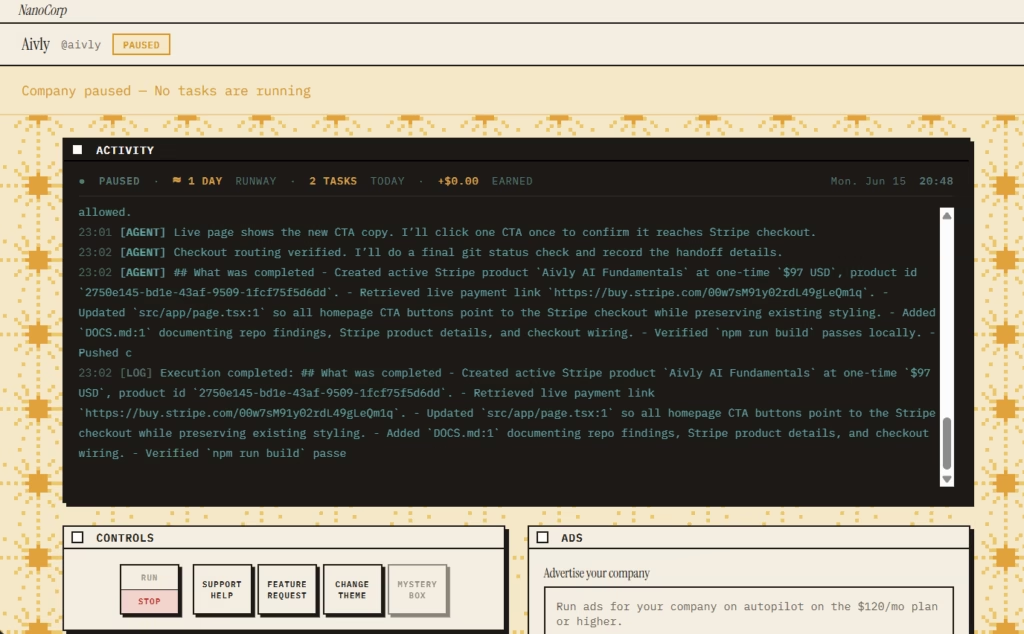
These features help entrepreneurs save time and money, since you do not have to hire a different specialist for every early task in a digital business. What would normally take a developer, a designer, and someone in marketing now comes down to describing the idea and reviewing the results.
AI Features
- Generates the software and the site's content from your description of the business.
- Plans and prioritizes tasks through the CEO agent.
- Writes copy for the site, emails, and distribution posts.
- Creates and manages advertising campaigns on Meta, on the higher paid plans.
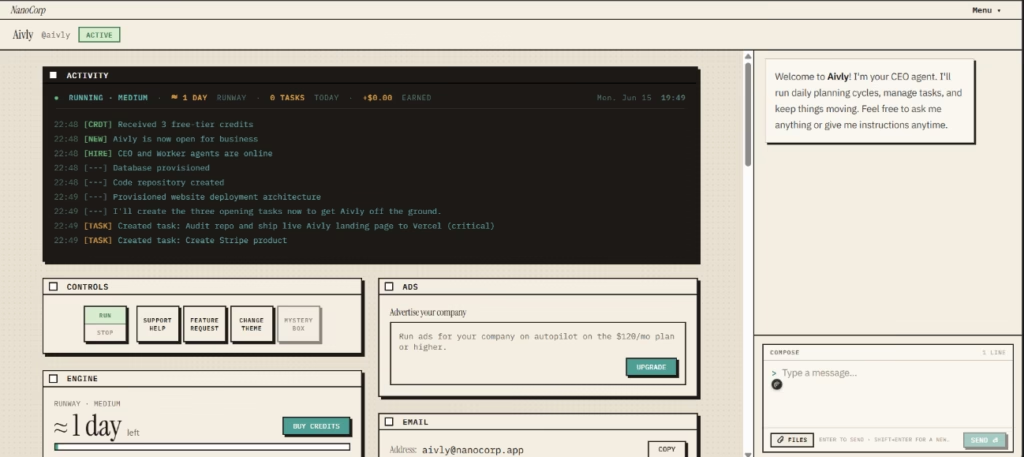
What really sets NanoCorp apart is not generating a one-off block of text or an image, something any standard tool can do today, but stringing decisions together over time: the agent reads a mission, breaks it into tasks, and works through them in order.
Integrations
- Stripe for processing payments and creating products and payment links.
- Meta (Facebook and Instagram) for running advertising campaigns, on the higher paid plans.
- Vercel as the infrastructure that publishes the website.
- GitHub for code hosting, with access unlocked on the higher paid plans.
The documentation confirms that you cannot use your own AI model keys or self-host the platform.
Data Security and Compliance
The platform's terms state that you remain the owner of the content you create and are responsible for reviewing AI-generated output before you use or publish it. NanoCorp says it applies good security practices at every layer and keeps each organization's data walled off, out of reach of other users. Files you upload are stored privately, never on a public URL, and downloads work only through signed links with a short validity for people who have access to the account. On top of that, the agents run in isolated environments that receive only the files belonging to your own company.
The platform confirms that sensitive data, such as the secrets you set, is encrypted at rest and decrypted only inside the company's isolated environment when a task runs. NanoCorp also indicates that its agents rely on both active and passive security tools to protect the application, though you cannot manage that security yourself.
Language: Customer Support and Interface
NanoCorp's interface and documentation are in English. Support runs through a contact email address listed on the site and a Discord community, and the platform includes a multilingual help chat.
AI Language
NanoCorp's AI is multilingual. You can build and run a company entirely in English or any other supported language: simply write your first prompt in the language you prefer, talk to the CEO agent the same way, and the agents will generate everything to match.
Mobile Access
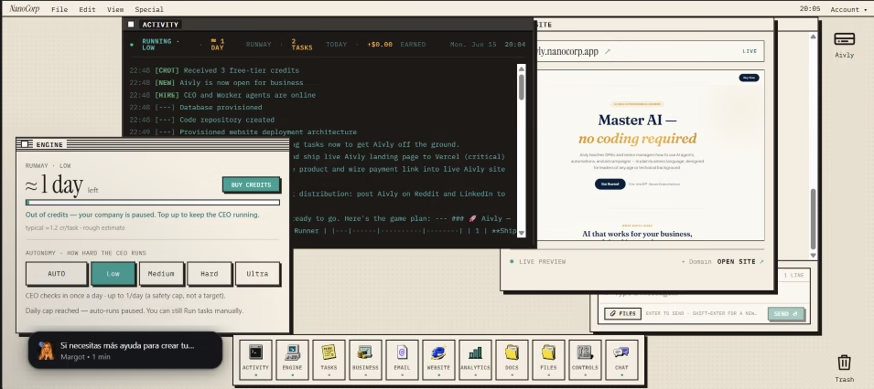
There are no separate mobile apps for iOS or Android. There is, however, a desktop mode that displays each function as a window you can move and arrange as you like, which gives plenty of freedom to organize the space, though anyone who prefers a fixed, guided layout may find it a little chaotic.
Support, Onboarding, and Account Management
Anyone starting with NanoCorp has two places to turn. The first is the help center, open to everyone, which gathers explanations of the plans, credits, recordings, domains, and advertising. The second is a Discord community, where users exchange experiences about what works and what does not, and answer each other's questions. For an entrepreneur with little technical background, though, the real way in is not that material but the tool itself: because everything runs through a conversation with an agent, you do not need to know how to code to get the company off the ground.
Ease of Use / UX
Getting started with NanoCorp asks very little. Creating a company comes down to writing a prompt, and from there the work consists of talking to the CEO agent and reviewing the tasks it proposes. In practice, an entrepreneur sees results almost immediately: within a few minutes there is a published site and tasks in progress. Using the tool well is another story, and that does take time to supervise and correct what the agents do.
One of NanoCorp's most striking features is that it handles the company's advertising end to end. The platform runs ads on Meta, meaning Facebook and Instagram, that send traffic to the company's website, and it does so through its own advertising infrastructure: NanoCorp is the advertiser of record, so you need no Meta or Facebook Ads account of your own, nor a trip into Ads Manager.
The whole setup is deliberately simple. You set one number, the daily budget, with a slider in the company dashboard, and the platform handles the rest: it builds the ad from your company's mission and website (image, copy, headline, and call to action), launches it, and keeps it running. Generating takes less than a minute, and if you do not like the result you can regenerate it up to twice a day. You write no copy, choose no images, and set no targeting.
The daily budget stays within a fixed range, and moving the slider to zero stops delivery immediately. One thing to remember: advertising is billed separately from credits, directly to your card.
Pricing and Plans
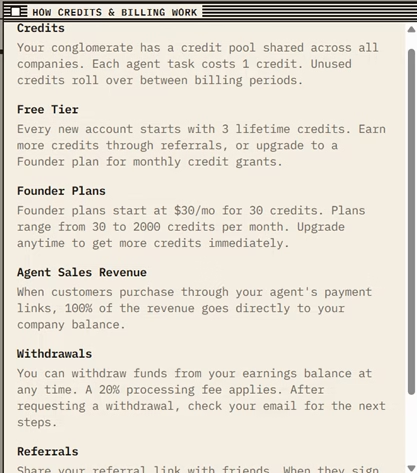
NanoCorp works on a credit model. There is a free tier with a limited, one-off batch of credits to try the platform, plus paid plans with a monthly credit budget. The paid plans scale with the number of credits, and advanced features such as advertising or code access unlock at the higher levels. You can also earn extra credits through a referral program.
As for the value to entrepreneurs: the free trial is real, but limited, and our own experience illustrates that nicely. With the starting credits, our agent got through the first two tasks: it checked the repository and put the website live, then created a product in Stripe with the payment link built into the site. On the third task, distribution, it stalled: the free plan's daily cycle was used up, and a message appeared saying there was no room left to continue automatically, leaving that task on hold until the next day. The conclusion is that the free tier is enough to launch and see how everything works, but running the company day after day calls for a subscription.
Case Study
An IT professional interested in the trend of autonomous companies decided to try NanoCorp on a personal idea: after reading a book on psycho-cybernetics, he wrote an opening prompt to build a company around that subject. The agent set up the company structure, came up with the name on its own, and produced a first website with a range of products, e-books and courses on psycho-cybernetics aimed at different audiences, and set up payments through Stripe. From there he grew the company in short bursts: he wrote his prompts in advance, sometimes with another AI to review the pages and decide what could be better, and handed them to the CEO agent every few days rather than holding long or daily conversations. To get through the early build phase, he temporarily raised his credit plan, intending to drop back to a lower tier once the company stood on its own. His first sale came after roughly two weeks, when someone bought the full product bundle in a single purchase. He stresses himself that the result is not automatic or immediate: like any new business, it takes upfront investment, work on the page and the product, patience, and steady effort on search results to attract traffic, which he names as the main challenge he still faces.
https://www.youtube.com/shorts/q-eHagy8M\_M?feature=share
Videos
NanoCorp vs Alternatives
Two similar tools, though with a different approach, are Polsia and Cofounder.
Polsia also creates and runs companies through autonomous agents, makes decisions without offering options at startup, and manages advertising and infrastructure within accounts on the platform itself. The difference for AgentAya's audience is transparency: NanoCorp offers a public help center, while Polsia's documentation is only visible after you subscribe. Cofounder, by contrast, is organized like a real company, with departments (engineering, sales, marketing, design, finance, and operations) and human oversight, where agents ask for the user's approval before any sensitive action.
| Platform | Approach | Pros | Cons |
| NanoCorp | Autonomous operation with minimal intervention. | Creates and runs a complete company; public plan structure; public help center. | Describes its security measures in detail but mentions no certifications; supports neither your own AI keys nor self-hosting. |
| Polsia | Operation through autonomous agents. | Very fast startup; polished agent-driven experience, manages advertising and infrastructure on the user's behalf. | Autonomy with no decision-making options; making corrections consumes credits; documentation behind the subscription wall. |
| Cofounder | Agent orchestration with human approval. | Approval-based control; extensible with your own code and API; project portability; SOC 2 certification. | Requires greater involvement from the founder; a lower degree of autonomy. |
In the end, the choice comes down to how much autonomy the user wants to give away: NanoCorp prioritizes letting the company run on its own, Polsia adds startup speed with more closed documentation, and Cofounder asks the founder to steer their team of agents closely.
FAQs
Is NanoCorp good for entrepreneurs?
Yes, especially for freelancers and entrepreneurs who want to launch a digital business without a technical team, as long as the owner keeps an eye on what the agents do.
Does NanoCorp work in multiple languages?
Yes. The interface and documentation are in English, but the agents are multilingual and let you build and run a company in other languages.
How much does it cost to use NanoCorp?
It works on a credit model with a limited free tier and scalable paid plans. Day-to-day operation calls for a subscription, and advertising is billed separately.
Is it safe to let real customers pay?
The platform makes real payments possible through Stripe, but the owner carries the commercial responsibility. It is worth checking that the product exists and can be delivered before you accept payments.
What are the best alternatives to NanoCorp?
Within the same category it is worth looking at Polsia, which takes a similar autonomous approach, and Cofounder, built around agent orchestration with human approval.
Still weighing up NanoCorp?
See how it compares with the other tools we've reviewed in AI Agents.