
What's the Best AI Translator for SMEs in 2026? A Real-World Comparison
9 min read
Machine translation has evolved from a simple curiosity into a strategic pillar for any SME or professional with international clients. Not all tools are equal, though: while some prioritise the number of languages, others focus on corporate security or literary fluency. In this analysis, we put four market leaders head to head — SYSTRAN, Google Translate, DeepL and Microsoft Translator — to find out which one offers the best return on investment for your business.
Test Methodology: From a Technical Report to the Prose of Cervantes
To make this comparison genuinely useful, we put the tools through two challenges originally written in Spanish. First, an excerpt from the ONTSI 2024 report, packed with statistics and business management terminology, to assess technical accuracy. Second, a passage from the Don Quijote of Miguel de Cervantes, whose classic prose tests whether AI can capture the soul of a text or merely produce a literal translation. The results proved decisive in defining each platform's profile.
- Text 1 (Business): An excerpt from the ONTSI 2024 report on AI adoption in Spain. Here we looked for accuracy in figures and percentages, and the correct translation of terms such as "automatización de flujos de trabajo". https://www.ontsi.es/es/publicaciones/indicadores-de-uso-de-inteligencia-artificial-en-espana-2024
- Text 2 (Creative/Literary): An excerpt from the opening of Don Quijote de la Mancha, by Miguel de Cervantes. The aim is to analyse how AI handles historical and descriptive terms from classic Spanish prose, assessing whether it manages to keep the rhythm and period feel or settles for a purely literal translation. https://www.cervantesvirtual.com/obra-visor/el-ingenioso-hidalgo-don-quijote-de-la-mancha-6/html/05f86699-4b53-4d9b-8ab8-b40ab63fb0b3_2.html#I_5_
Methodology note: This comparison uses the free web versions of all the translators, which carry significant limitations compared with the enterprise editions: character limits per translation, no custom glossaries and less control over data privacy. Paid plans remove these restrictions and add features such as model training with your own terminology (SYSTRAN ModelStudio, Google AutoML, Microsoft Custom Translator), corporate translation memories and integrations with professional CAT tools. Results vary with engines customised for specific sectors.
SYSTRAN: The Gold Standard for Security and Business Accuracy
With an overall score of 4.6 / 5, SYSTRAN positions itself as the most robust tool for corporate environments. Its PNMT™ neural engine stands out for understanding the full context of sentences, allowing impeccable adaptation to the tone of regulated sectors. It's the ideal option for SMEs handling sensitive information, such as contracts or technical manuals, as it guarantees total privacy: data is neither stored nor used to train external models. Although its learning curve is somewhat more technical, its ability to deploy on local servers or private clouds offers a level of technological independence its competitors can't reach.
This score, the highest in the comparison, reflects that AgentAya prioritises security, data control and enterprise customisation. SYSTRAN is the only tool that allows installation on your own servers or in a private cloud under your control, engine training with your own terminology, and fully offline operation. These advantages are critical for regulated sectors and are not matched by any competitor. DeepL offers privacy in its Pro version but no local installation; Google and Microsoft process data on their own servers with no option for internal deployment.
Text 1 - Technical Translation
SYSTRAN correctly translates "en 2024" as in 2024, in line with DeepL and Microsoft and avoiding Google's error (by 2024). The translation is functional and accurate in business terminology, though more literal than its competitors: help in decision-making is less natural than assistance in decision-making (Microsoft) or support in decision-making (DeepL). It offers no tone options or regional variants, which limits its flexibility compared with DeepL (UK/US) and Microsoft (standard/formal/casual).
Text 2 - Creative Translation
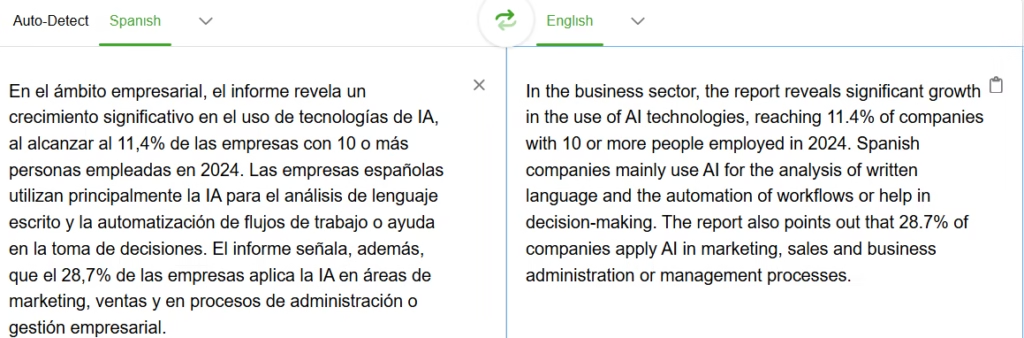
Here SYSTRAN struggles with literary texts. Some terms prove problematic: "rocín flaco" becomes skinny hog (confusing a nag with a pig), "galgo corredor" becomes greyhound in a corridor, "duelos y quebrantos" turns into duels and cracks, and "vellorí" into fine hair. Phrases like "seco de carnes, enjuto de rostro" come out as dried with flesh, a face-wrapper, losing the original meaning. While Google got the cultural equivalences right (eggs and bacon, homespun) and Microsoft maintained grammatical coherence, SYSTRAN requires considerable supervision for literary content or anything with cultural references. As a useful feature, SYSTRAN's free web translator lets you select any word in the translation to get a detailed vocabulary breakdown with multiple meanings and contextual examples — a valuable tool for users who need to understand the lexical options available.
Google Translate: Global Reach and Instant Versatility
Google Translate achieves a solid score of 4.4 / 5, cementing itself as the most versatile solution for everyday use. Since its expansion with the PaLM 2 model, the platform now supports more than 240 languages, making it unbeatable for businesses operating in markets with less common languages. Its great value for an SME lies in its mobile ecosystem, enabling instant translations through the camera or live conversations. While its approach is more generalist and can fail on critical legal texts, its zero cost for consumer use and pay-as-you-go API deliver immediate ROI for the tourism sector and retail businesses.
Text 1 Technical Translation
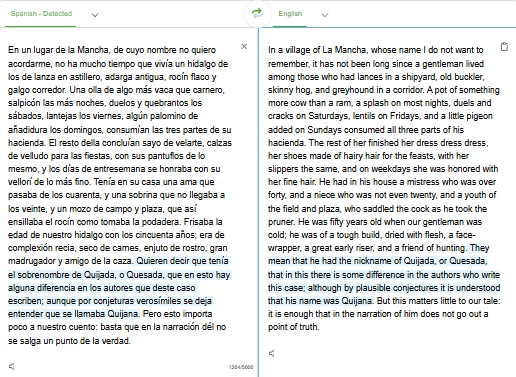
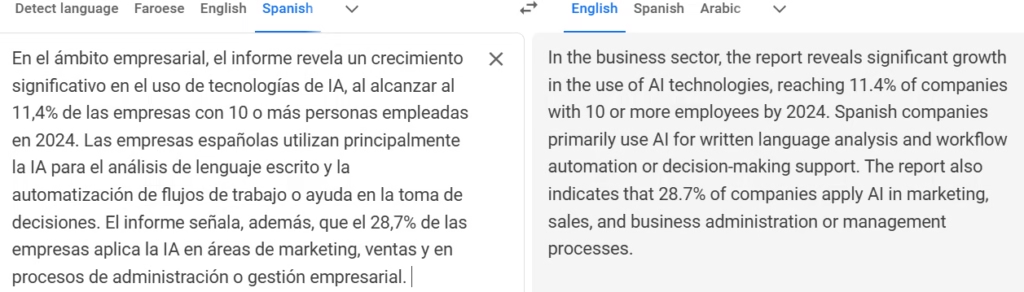
Google Translate demonstrates technical competence but less contextual rigour than DeepL. While DeepL guarantees statistical accuracy (in 2024), Google uses by 2024, a temporal nuance that changes the meaning of the annual figure. Google's competitive advantage is its scalability, with support for more languages, ideal for SMEs with a presence in emerging markets. However, its lack of localisation options (British vs. American) puts it behind DeepL in terms of brand consistency and native naturalness. In short: Google is the solution with the greatest reach, but its lack of style customisation increases the human editing workload in corporate translation.
Text 1. Spanish to English
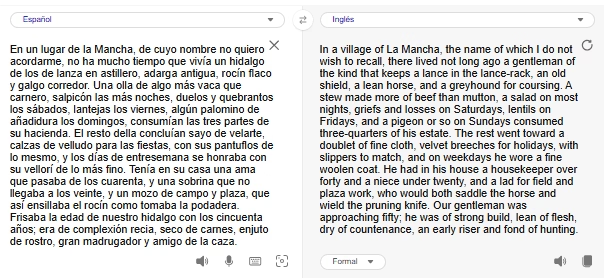
Text 2 Creative Translation
This test demonstrates Google's accuracy with cultural content. In the opening of the novel, Google Translate matches academic translations such as Ormsby's: "vellorí" becomes homespun (rustic wool), "lanza en astillero" becomes lance in the rack, and "duelos y quebrantos" becomes eggs and bacon (a perfect cultural equivalence). DeepL, although it offers regional variants (UK/US), uses velvet for "vellorí" (less historically faithful) and leaves "duelos y quebrantos" untranslated. For SMEs creating historical SEO content, Google leads in lexical technical accuracy; DeepL, in grammatical fluency.
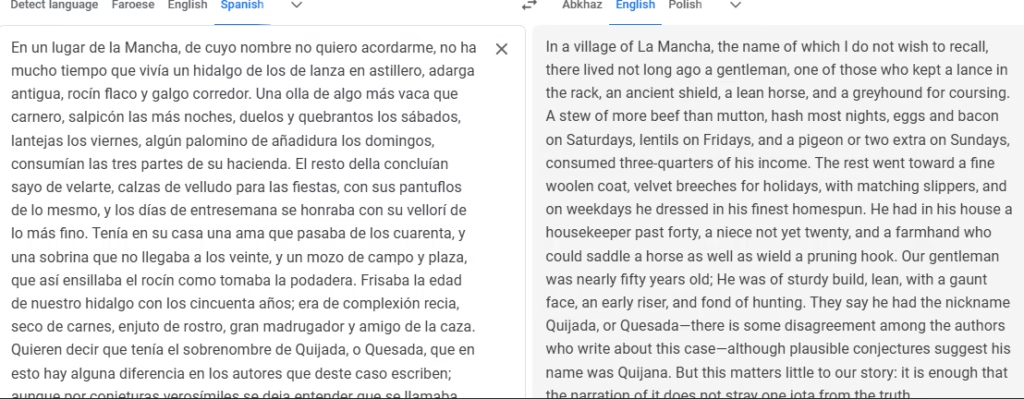
Text 2. Spanish to English
DeepL: Linguistic Quality and Professional Nuance
This tool earns a rating of 4.2 / 5, standing out mainly for the naturalness and coherence of its output. Unlike more literal translators, this platform focuses on nuance and style, which makes it the favourite of marketing and content teams. In addition, tools such as DeepL Write let you adjust the tone (professional, academic or colloquial) to make sure the message resonates properly with the audience. Although the languages supported in this feature are more limited (36 for now), its accuracy in European language pairs and its ability to preserve the original formatting of documents make it a safe recommendation for writing high-fidelity corporate texts.
Text 1 Technical Translation
DeepL doesn't just translate — it performs advanced localisation by precisely distinguishing between American and British English. While the American variant opts for pragmatic terminology, translating "ámbito" as business sector, the British version raises the tone to a more formal, academic register with the term business sphere. This adaptability also shows in punctuation, where the tool automatically applies the Oxford comma in the US version and omits it in the UK one, respecting each region's style standards. For an SME, this means DeepL not only guarantees brand consistency and respect for local grammatical conventions, but drastically reduces the need for human review by keeping the chosen variant pure from start to finish.
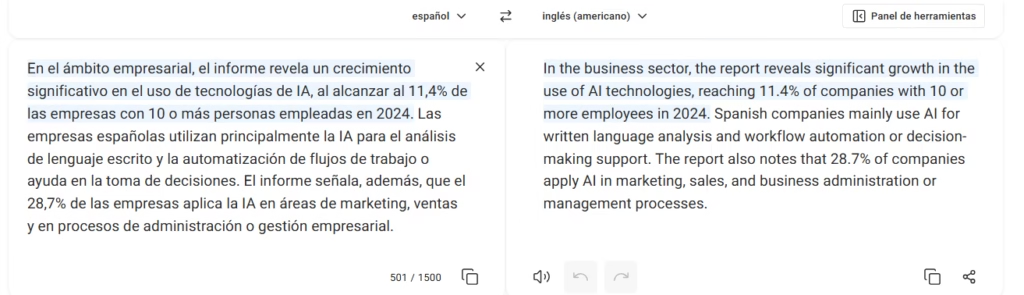
Text 1. Spanish to English translation (US)
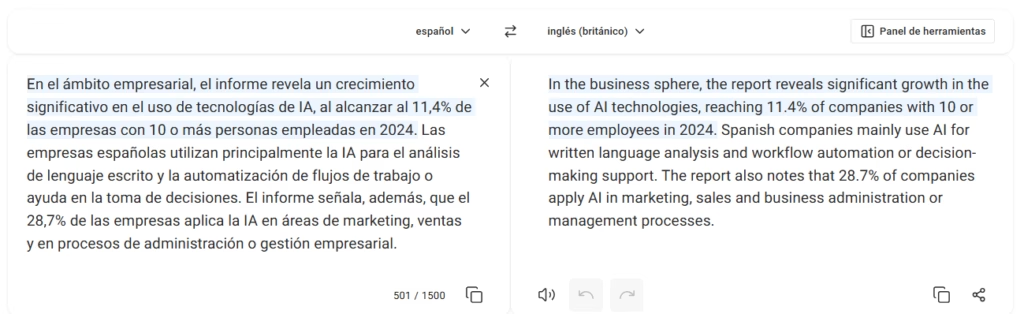
Text 1. Spanish to English translation (UK)
Text 2 Creative Translation
In creative translation, DeepL delivers impeccable grammar and effective localisation: while American English opts for functional terms (armory, fast horse), the British version adds a superior literary nuance by translating "rocín" as nag. Although it scores points for fidelity by respecting cultural terms such as "duelos y quebrantos", it fails on historical accuracy by translating the humble "vellorí" (wool) as velvet. This anachronism shows that, while AI achieves a high degree of naturalness, it still requires expert supervision to avoid distorting classic technical terms in favour of a merely functional translation.
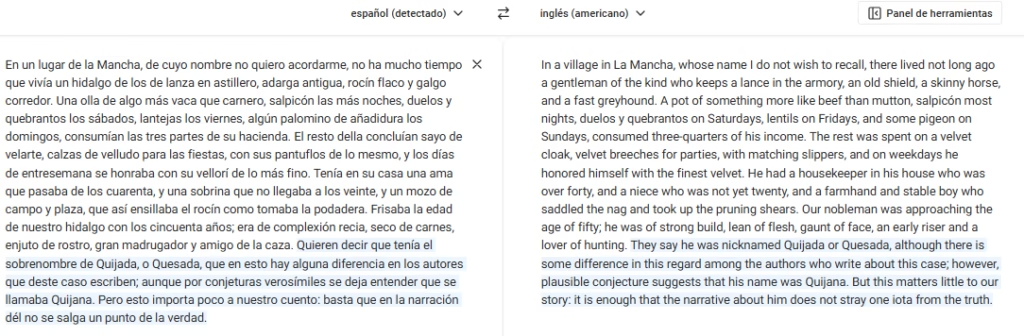
Text 2. Spanish to English translation (US)
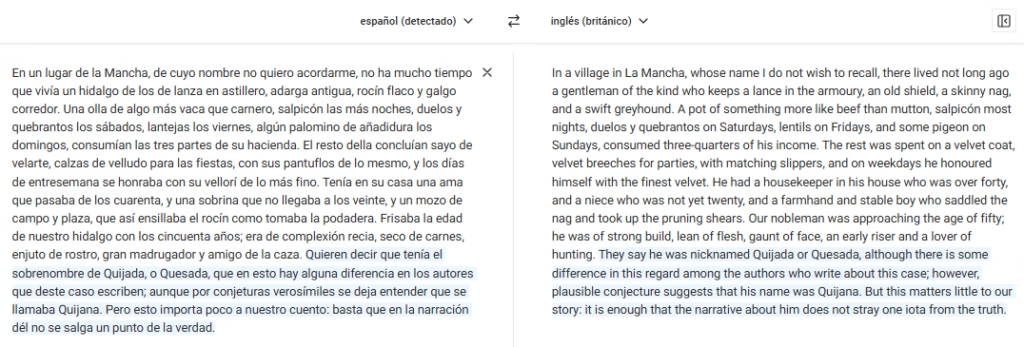
Text 2. Spanish to English translation (UK)
Microsoft Translator: Total Integration Into Your Workflow
Closing the comparison with a 4.0 / 5, Microsoft Translator is the natural ally for companies already living in the Microsoft 365 ecosystem. Its biggest competitive advantage is native integration into tools such as Word, PowerPoint and Teams, enabling multilingual workflows without switching applications. It's an extremely intuitive tool for non-technical users and offers exceptional Spanish-language support in both its interface and customer service. Thanks to features such as Custom Translator, SMEs can train the engine with their own sector terminology, obtaining consistent, secure translations within the Azure environment.
Text 1 Technical Translation
Microsoft Translator correctly translates "en 2024" as in 2024, preserving the statistical meaning of the figure. Although it doesn't offer regional variants (UK/US) like DeepL, it compensates with three tone options (standard, casual and formal). The formal version uses primarily and support in decision-making, while the casual one opts for more colloquial expressions such as big jump and helping with decision-making — a useful flexibility for generating content aimed at different audiences.
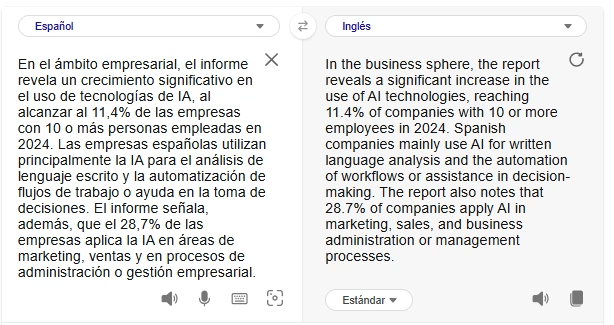
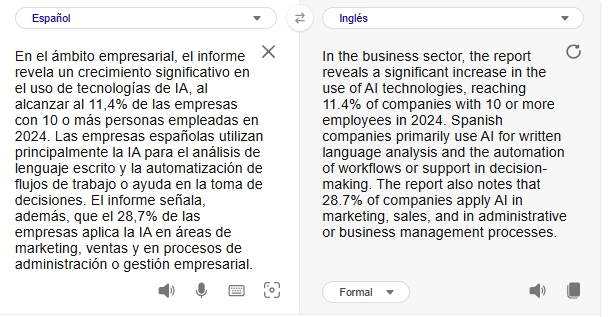
However, the register assignment is subjective: Microsoft classifies business sphere as "standard" tone, when by British English conventions this term belongs to a more formal, academic register. As an American company, it's logical that its engine favours American English, a variant where the term business sector (which Microsoft assigns to the "formal" tone) is actually the more neutral option in corporate contexts. For SMEs that need consistency with British standards, DeepL remains the more reliable option. Microsoft Translator is ideal for teams embedded in the 365 ecosystem who prioritise tonal adaptation over precise regional localisation.
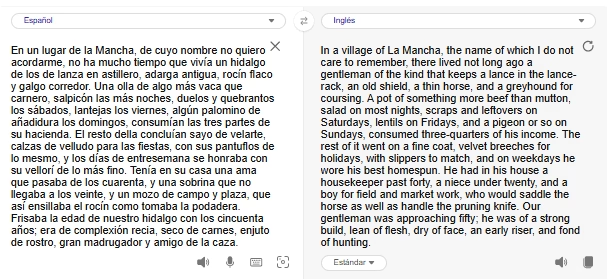
Text 2 Creative Translation
The free version of Microsoft Translator limits translations to 1000 characters, a notable restriction compared with its competitors, which allow longer texts. In lexical accuracy, Microsoft translates "vellorí" correctly as homespun (standard) and fine woolen coat (formal), avoiding the error of rendering it as velvet. However, it fails with "duelos y quebrantos": the standard version uses scraps and leftovers and the formal one griefs and losses, both incorrect compared with Google's eggs and bacon, the accurate cultural equivalence.
The differentiation between tones is effective: the standard version uses thin horse and income, while the formal one raises the register with lean horse, estate and countenance. For historical or literary content, Google leads in cultural accuracy; Microsoft offers good grammar but requires review of period terms.
Quick-Selection Comparison Table
| Tool | Score | SEO Speciality | Recommended for... |
|---|---|---|---|
| SYSTRAN | 4.6 / 5 | Customisation, Security and Privacy | Contracts and sensitive reports |
| Google Translate | 4.4 / 5 | Global Coverage | Retail and mobile customer service |
| DeepL | 4.2 / 5 | Style and Naturalness | Marketing and web content |
| Microsoft | 4.0 / 5 | Office Integration | Teams using Teams and Word |
Verdict: Which One Should You Invest In?
The final choice depends on your business priority. If the goal is to project an impeccable brand image with fluent copy, DeepL is the tool that writes best. For large-scale expansion at low cost, Google Translate has no rival in reach. However, if your SME handles intellectual property or confidential customer data, investing in SYSTRAN or integrating Microsoft Translator are the only options that guarantee a secure, scalable professional environment.