
Vic AI: Automate Accounts Payable with Artificial Intelligence
Vic AI is an accounting add-on specializing in accounts payable (AP) automation. Its proposition is eliminating the manual burden of the invoice cycle through autonomous artificial intelligence: capture, data extraction, accounting coding, purchase order reconciliation (PO matching), approvals, and payments within a single flow.
In this review, we evaluate whether Vic AI can be a good AI tool to complement and streamline accounting workflows, considering its capabilities, integrations, security, and localization.
AgentAya Verdict
This platform stands out when an SME or accounting firm seeks to automate AP end-to-end and reduce human touches. Its Autopilot engine processes invoices with high accuracy, learns from organization data, and adds VicPay™ to execute payments in the same environment.
It also introduces VicAgents™, AI agents that execute repetitive financial tasks like reviewing contracts, classifying emails, or analyzing indicators without human intervention.
The main limitation for international markets remains localization: interface and documentation in English, though the application natively supports English, Swedish, and Norwegian. For other languages, browser auto-translation can be used.
Recommendation: Ideal if you operate with compatible ERPs and seek a high level of AP automation; if you need support in other languages or local tax functions, combine it with regional solutions.
Score Breakdown
| Category | Score | Description |
| Features and Functionality | 4.8/5 ⭐⭐⭐⭐ | Autonomous AP with Autopilot, VicPay™, VicInbox™, VicAnalytics™, and VicAgents™ |
| Integrations | 4.6/5 ⭐⭐⭐⭐ | Compatible with NetSuite, Microsoft Dynamics, SAP, and Oracle |
| Language and Support | 4.0/5 ⭐⭐⭐⭐ | Interface in English, Swedish, and Norwegian; no support in other languages |
| Ease of Use | 4.0/5 ⭐⭐⭐⭐ | Modern interface; requires initial onboarding |
| Value for Money | 3.8/5 ⭐⭐⭐ | High ROI with medium/high invoice volumes; custom pricing |
AgentAya Overall Score: 4.1 / 5 ⭐⭐⭐⭐
Powerful for automating AP with enterprise AI; localization limits adoption to SMEs operating primarily in English-speaking markets.
Ideal For
- SMEs with high accounts payable volume wanting to reduce manual entry and closing times
- Finance teams using ERPs like NetSuite, Microsoft Dynamics, SAP, or Oracle
- Accounting firms or control departments needing traceability and centralized approvals
Not Ideal For
- Businesses requiring interface or technical support in languages other than English
- Micro-enterprises with low invoice volume or reduced budget
- Companies seeking a complete accounting suite beyond AP
Key Features
Vic.ai’s accounts payable modules are grouped under the APSuite™ line:
- Autopilot: Processes and codes invoices without templates or fixed rules, reducing errors and time
- PO Matching and Smart Approvals: Automatic reconciliation and complete traceability
- VicInbox™: Classifies vendor emails, detects duplicates, and generates automatic AI responses
- VicPay™: Manages payments by check, ACH, or virtual card within the same accounting flow
- VicAnalytics™: Real-time performance dashboards, approval cycle, costs, and efficiency
- VicCard™: AI-powered corporate card expense management, within the same environment.
- VicAgents™: AI agents that execute structured tasks like reviewing contracts or detecting early payment discounts
Geographic and Payment Limitations: Vic AI supports common currencies like USD, GBP, EUR, AUD, JPY, NOK, CAD, SGD, CNY, DKK, and RON. However, it currently only supports payments within the United States, so companies outside that territory must make transfers manually or through their own banking systems.
For small businesses, Vic AI is especially useful because it reduces the need for additional administrative staff and eliminates repetitive data entry and manual review tasks. This allows small teams to work with the efficiency of a large finance department, improving control and visibility without increasing operational costs.

AI Features
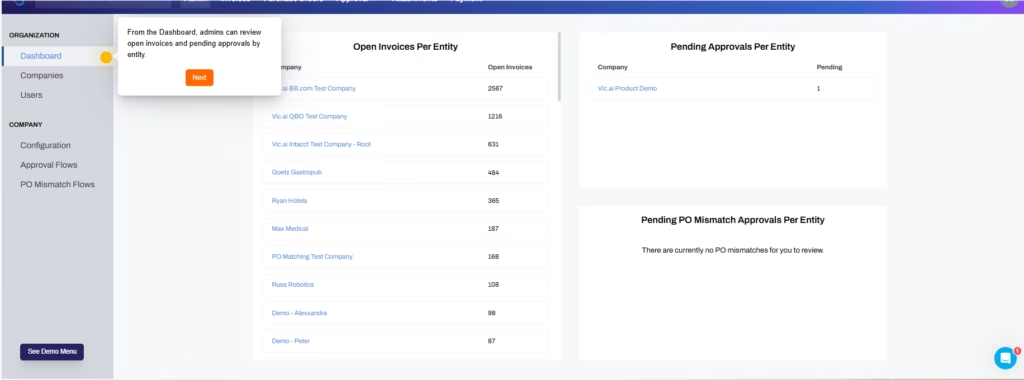
Vic.ai’s AI is built on proprietary deep learning models trained on more than one billion invoices. Unlike traditional OCR, it interprets accounting context and classifies and approves autonomously. Autopilot handles data extraction, GL coding and approvals, with 97–99% accuracy and a no-touch rate above 80% in cases such as Diesel Direct.
Built on this foundation, VicAgents™ is a line of autonomous agents that execute full financial workflows rather than simply answering queries. Their logic is grounded in what Vic.ai calls agentic tasks: structured, repeatable work that finance teams typically handle manually (reconciling contracts against actual spend, documenting approval trails, validating vendor insurance requirements or detecting duplicate payments across subsidiaries) and that is now delegated to an agent trained to resolve it with precision.
Victoria™ is the central intelligence that orchestrates the platform and coordinates this line of agents, currently made up of three:
- Inbox Agent, available as VicInbox™, manages vendor email.
- Contract Agent, in limited beta, interprets vendor contracts, reconciles spend against agreed terms and flags compliance gaps, audit risks and opportunities for early payment discounts or renewal.
- Analytics Agent, also in limited beta, answers analytical queries without the need to review dashboards.
Vic.ai’s roadmap also includes additional agents: spend forecasting based on contract terms and payment patterns, compliance monitoring against internal policies and regulations, and payment optimization.
These functions are particularly useful because they reduce errors, accelerate financial close and free up time for analysis and strategy. In practice, SMEs can maintain financial control efficiently and with fewer human resources at every stage of the process.
Integrations
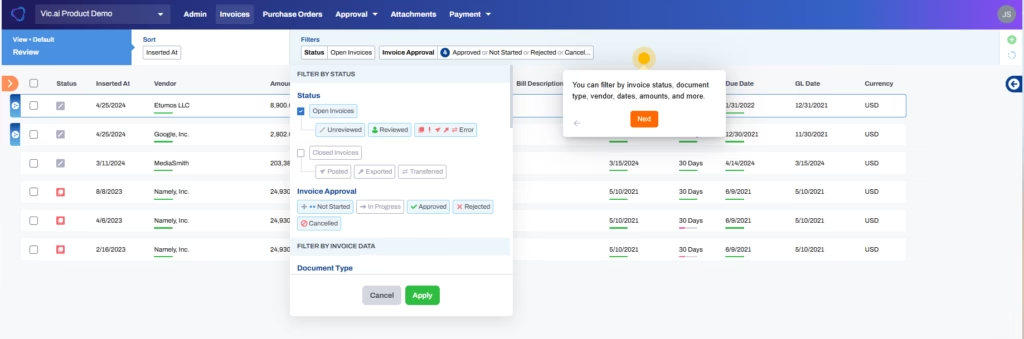
Vic AI is compatible with major ERP systems:
- Oracle NetSuite
- Microsoft Dynamics
- SAP
- Oracle ERP Cloud
The tool allows synchronizing accounting data, vendors, and approvals in real time to maintain coherence in financial records.
Data Security and Compliance
Complies with SOC 1 and SOC 2 Type II, with TLS encryption in transit and encryption at rest, role-based access controls, incident response policies, and AICPA audits. The platform is hosted on Amazon Web Services, with encrypted S3 storage, PostgreSQL databases and multiple availability zones for resilience and disaster recovery. Vic.ai also operates under an ISO 27001 framework, with AES-256 encryption at rest, SHA-256 in transit and periodic key rotation.
Complies with GDPR and applies background verification for operational personnel. Data access is controlled and logged through secure authentication and enterprise password managers. It supports single sign-on (SSO) via Auth0 and multi-factor authentication when the customer’s identity provider enables it. An external firm conducts annual penetration tests on the platform, and the ingestion channels (email, SFTP, API and mobile upload) require encrypted transport. Data is retained for the duration of the customer agreement and as required for operational, legal and audit purposes; customers may request export or deletion at any time.
Language: Customer Support and Interface
The interface, documentation, and support are available in English, Swedish, and Norwegian.
There’s no official support in other languages, though browser auto-translation can be used (for example, Google Chrome).
AI Language
Automations don’t depend on natural language but on accounting structures and numeric fields. The AI recognizes common multilingual formats, so it can process invoices in different languages without affecting model logic.
Geographic and Monetary Limitations: Vic AI processes invoices in multiple international currencies, but automated payment operations are only enabled for the United States. This means companies from other regions must use Vic AI primarily for processing and approval, integrating their own local payment methods.
Mobile Access
The tool is available in applications for iOS and Android, plus the responsive web version. It allows capturing, reviewing, and approving invoices or payments from mobile devices.
Support, Onboarding Process, and Account Management
Vic AI offers a guided onboarding process backed by specialized resources, technical guides and AP automation best-practice materials. The resource center brings together case studies, guides, datasheets, videos, podcasts, webinars and an interactive demo. These materials support team training and the platform adoption.
Ease of Use / UX
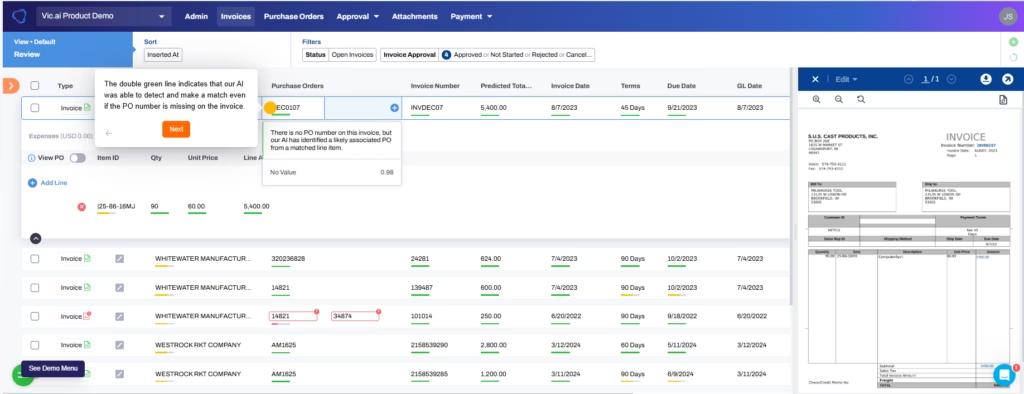
The interface is built around the natural journey of an invoice, which shortens the learning curve for finance teams already working with an ERP. Once the document is ingested, Vic.ai’s proprietary computer vision extracts the data, codes it and matches it against purchase orders without the need for templates. Each field is assigned a confidence level, so the user only steps in on the cases the model flags for review: the rest moves straight to the approval workflow or to payment if Autopilot meets its threshold.
This review-by-exception logic is what defines the experience: the team no longer opens invoice after invoice, but only handles the ones that require human judgment. Vendor payments are consolidated into a single workflow regardless of method, and records are automatically posted to the ERP through native integrations.
An initial setup is required to map accounts, approvers and rules, but the return is felt from the first invoicing cycle. The VicInbox™ and VicAnalytics™ modules reinforce this logic by centralizing vendor email and operational metrics within the same platform, preventing the user from jumping between tools.
Pricing and Plans
Vic AI works with custom pricing based on invoice volume and contracted modules (Autopilot, VicPay™, Analytics, Inbox).
No free version or public pricing is offered; access is managed through demo and quote.
Documented average ROI equals 3-6 hours freed weekly per AP analyst.
Case Study
A distribution company with 40 employees, and operations in three countries implemented Vic AI to digitize its accounts payable process. In just three months, it automated over 80% of invoices and nearly eliminated the manual coding burden. The team reduced processing time from 5 days to 1 day, improved accuracy to 99%, and redirected freed time to cash flow analysis and vendor negotiation.
Cases like Diesel Direct and HallKeen Management demonstrate similar results: reduction of between 25,000 and 40,000 annual hours in manual tasks and measurable increase in operational efficiency when integrating Vic AI into their accounting flows.
Tool vs Alternatives
| Vic.ai | Botkeeper | |
| Core focus | End-to-end accounts payable automation | Multi-client bookkeeping operating system |
| AI engine | Proprietary deep learning models trained on more than one billion invoices | Machine learning for transaction categorization |
| Invoice processing | Autopilot: extraction, GL coding and autonomous approvals | AutoPush in Transaction Manager: categorization and posting to the general ledger |
| Reconciliation | Automatic PO matching against purchase orders | Auto Bank Rec: statement reconciliation against the general ledger or Smart Connect |
| Vendor payments | VicPay™ built in (check, ACH, virtual card, US only) | No native payments module |
| Banking connectivity | Through the customer’s ERP | Smart Connect: more than 10,000 financial institutions across the US and Canada |
| Document management | Multi-format invoice capture via VicInbox™ | Documents module with version control, comments and audit log |
| Exception detection | Duplicate detection and validation in VicInbox™ | Bot Review: 13 exception types across the general ledger |
| Close tracking | Indicators in VicAnalytics™ | Close Tracker: client-by-client close status in a single view |
When to choose Vic AI? When you need autonomous accounts payable with PO matching, intelligent approvals, payments and analytics unified in a single workflow, inside an in-house finance team. Botkeeper is the better fit when the goal is an operating system for an accounting firm that automates bookkeeping across multiple clients on QuickBooks Online or Xero.
Related Tools
| Tool | |
|---|---|
 | |
 | |
 | |
 | |
 |
FAQs
Is Vic AI a suitable add-on for SMEs?
Yes, especially with high invoice volume and compatible ERP.
Does it support languages other than English?
Not officially. Supports English, Swedish, and Norwegian; other languages only through auto-translation.
Does it replace my ERP?
No. It functions as an AI layer on top of your existing accounting system.
Does it have a mobile app?
Yes, for iOS and Android.
How does it protect data?
Complies with SOC 1 and SOC 2 Type II, GDPR, TLS encryption, and AICPA audits.