
Vercel Review: The AI Cloud for Building and Shipping Web Apps
Vercel is a cloud platform for building, deploying, and scaling web applications on managed infrastructure that removes most of the work of running servers. It sits in the category of web deployment and AI application platforms, and it is the company behind Next.js, the v0 app builder, and the open-source AI SDK. Its focus is the “AI-native web”: shipping intelligent applications quickly on global, managed infrastructure.
This matters for SMEs because launching a modern web app usually means assembling hosting, a content delivery network, continuous deployment, monitoring, security, and AI model access separately. Vercel pulls all of that into one platform, with a free starting tier and a guided setup, so a small team can go from a Git repository to a live, monitored application without building the stack piece by piece. This Vercel review covers what it does, who it suits, and how it compares as one of the best AI tools for web development.
AgentAya verdict
Vercel is one of the most complete platforms available for teams that want to ship web applications fast without managing infrastructure, and its AI layer is now central to that promise rather than an add-on. Its biggest strength is integration: hosting, continuous deployment, a global edge network, observability, security, and a family of AI products (the AI SDK, AI Gateway, Sandbox, Agent, Workflows, and the v0 builder) all work together under one account.
For SMEs with at least one developer, getting to production is genuinely easy, and the platform actively guides you there with a checklist and contextual recommendations.
Our recommendation: a strong choice for technical SMEs and developer-adjacent teams that value speed, performance, and a unified AI stack.
Score breakdown
| Category | Score | Description |
|---|---|---|
| Features and capabilities | 5/5 ⭐⭐⭐⭐⭐ | Broad and well integrated, from deployment to the AI layer. |
| Integrations | 4.5/5 ⭐⭐⭐⭐ | Extensive catalog, with fewer native regional options. |
| Language and support | 4/5 ⭐⭐⭐ ⭐ | Interface and documentation English-only; multilingual chat. |
| Ease of use | 4.5/5 ⭐⭐⭐⭐ | Guided onboarding; v0 lowers the technical barrier. |
| Value for money | 4.5/5 ⭐⭐⭐⭐ | Solid free tier and consumption pricing with no AI markup. |
Overall AgentAya score: 4.5/5 ⭐⭐⭐⭐.
A highly complete platform with exceptional value for technical SMEs, held back for non-English audiences mainly by its English-only interface and documentation.

Ideal for:
- Small teams with at least one developer comfortable with JavaScript, TypeScript, or modern frameworks like Next.js.
- Founders and product or marketing teams that want to build and ship real apps quickly, including those using v0 to collaborate with developers via GitHub.
- Projects that need AI features such as text, image, or video generation, model routing across providers, or secure execution of AI-generated code.
- Businesses that prioritize performance, global delivery, and a guided path to a well-monitored production deployment.
Not ideal for:
- SMEs with no technical profile that need a fully no-code solution.
- Businesses that require a fully localized interface, documentation, and support as a hard requirement.
- Very simple projects, such as a single static page or form, that do not justify the platform’s depth.
Main features
- Managed deployment and continuous integration: connect a Git repository and every push creates a preview deployment, while merging to the production branch goes live, with deployment URLs and a subdomain provisioned automatically.
- Global edge delivery and scaling: automatic caching, Incremental Static Regeneration, and dynamic scaling to absorb traffic spikes.
- Fluid compute: an execution model that scales resources dynamically and bills only for time when code runs actively, not idle time.
- Observability by default: edge requests, function invocations, and error rate appear from the first deployment, with optional Web Analytics and Speed Insights.
- Guided onboarding: a Production Checklist and contextual recommendations (concurrent builds, larger build machines, Skew Protection) steer new projects toward production-readiness.
- Integrations marketplace and Connect (beta): a broad catalog of native and external integrations, plus short-lived scoped tokens for agents to call third-party APIs without stored secrets.
These features let an SME consolidate hosting, delivery, monitoring, and integrations into one platform, saving the time and budget that assembling and maintaining separate services would require, with a free tier to validate a product before paying.
AI functions
- AI SDK: an open-source TypeScript toolkit (npm i ai) for building AI apps and agents, with one-line switching between providers such as OpenAI, Claude, and Gemini, plus streaming and built-in fallbacks.
- AI Gateway: a single endpoint and API key routing to hundreds of text, image, and video models, with unified billing, automatic failover, per-key spend budgets, and no platform markup on inference.
- Vercel Sandbox: a secure, isolated environment for running AI-generated or untrusted code, with a network firewall, credentials brokering, and restorable snapshots.
- Vercel Agent: an AI layer that performs full-context pull-request reviews and automated anomaly investigation with root-cause analysis.
- Workflows: a toolkit for long-running AI agents that can suspend, resume, and survive function timeouts.
- v0: a separate app that turns natural-language prompts into real full-stack apps, with AI features built in and one-click deployment to Vercel.
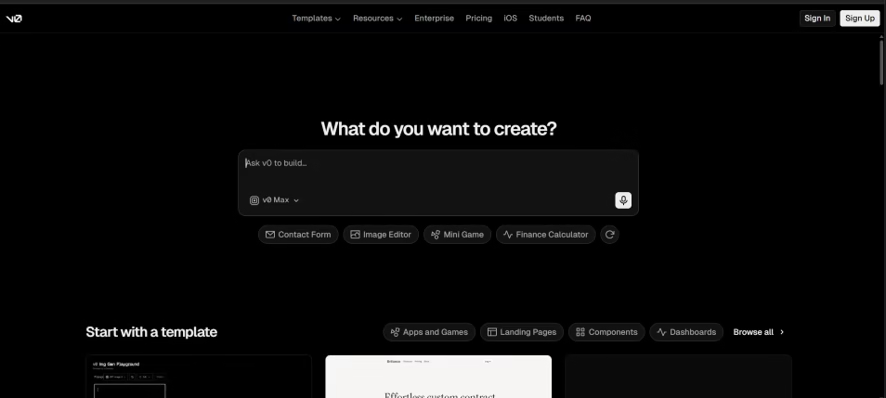
What is genuinely intelligent here, rather than standard software, is the provider-agnostic model routing with automatic failover, the agentic code review and incident investigation that reasons about your specific codebase, and v0’s ability to generate and modify working applications from plain language. The hosting, caching, and deployment pipeline around them is excellent but conventional platform engineering.
Integrations
- Storage and databases: Neon, Supabase, Redis, Upstash, MongoDB Atlas, AWS.
- AI services: fal, Deep Infra, ElevenLabs, Replicate, Together AI.
- Observability and monitoring: Sentry, Datadog, Checkly, New Relic.
- Authentication, CMS, and commerce: Clerk, Auth0, Sanity, Contentful, Shopify, BigCommerce.
- Payments and web automation: Stripe, Firecrawl, Browserbase, Kernel.
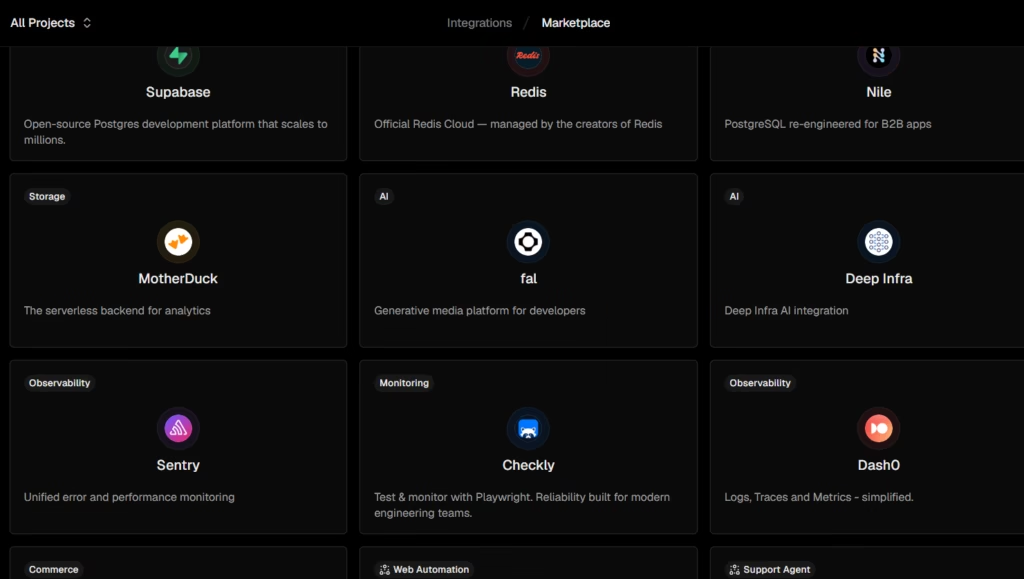
A note on regional fit: the marketplace is broad but developer-focused, and it does not emphasize tools that are especially popular in some regional markets, such as local payment processors or messaging services like WhatsApp Business. Connecting those generally relies on the Custom OAuth or API-key connector paths rather than a one-click native integration.
- API availability: yes. Vercel offers a REST API, a CLI, and the AI Gateway API, and Connect issues short-lived OIDC-based tokens for agents and services to call third-party APIs.
Security and data compliance
Regarding data ownership, you retain ownership of the code and content you deploy; Vercel operates the hosting and processing infrastructure. On training, Vercel Agent does not train on customer code when a team’s data-sharing setting is off or on the Enterprise plan, and individual model providers reached through the AI Gateway set their own data-retention policies, which is worth checking per model.
Vercel encrypts data in transit and supports sensitive environment variables that are decryptable only by its deployment system. Its Trust Center lists a broad compliance posture, including SOC 2, ISO/IEC 27001, PCI DSS, HIPAA, HITECH, GDPR, CCPA, and CPRA, with infrastructure running on Amazon Web Services. Security controls include a Web Application Firewall, DDoS mitigation, role-based access control, SAML single sign-on with Directory Sync, and enforced two-factor authentication, with some advanced controls reserved for the Enterprise plan. Teams handling sensitive data should review Vercel’s current terms, since specifics can change.
Language: support and interface
Live support is delivered first through an AI assistant, then a community forum, with direct human support, faster response commitments, and the uptime SLA available on higher tiers. The interface and the official documentation are in English, which is the platform’s main language limitation. Users who prefer other languages can find help in community channels, and Enterprise customers may be able to discuss support arrangements with the sales team.
AI language
Localization matters for adoption in non-English markets, and here Vercel is mixed. The static interface and documentation are English-only, but the natural-language AI features (the support assistant and the v0 prompt) understand and respond in multiple languages, including English. So a user can describe what they want to build, or ask for help, in their own language, even though the surrounding product is not localized. The platform’s core deployment functions do not depend on language at all.
Mobile access
Vercel is used primarily from its web dashboard, which is responsive but designed for desktop work. The v0 builder offers a dedicated iOS app, allowing users to create and iterate on projects from a phone. Note that Vercel hosts and deploys the web apps you build rather than acting as a backend for native mobile apps.
Support, onboarding, and account management
Vercel provides extensive documentation, a large library of templates, an Academy with a beginner-to-expert learning path (covering Vercel, Next.js, Turborepo, and the AI SDK), a Knowledge Base, a blog, a changelog, and events with the Vercel teams. Onboarding is a real strength: after connecting a repository, a Production Checklist and contextual recommendations walk new users through the steps that make a project production-ready. Dedicated account management and advanced support are Enterprise-tier benefits. For SMEs with limited technical experience, the core platform still assumes some developer familiarity, though v0 and the guided prompts substantially lower that barrier.
Ease of use and UX
The dashboard’s lateral menu organizes the full platform clearly. The learning curve is gentle for basic deployment and steepens for advanced configuration.
For developers, the path from a Git repository to a live, monitored deployment is low-friction: importing a repository is simple, deployments reach a ready state quickly, and the dashboard immediately surfaces status, metrics, and improvement suggestions.
Observability appears from the very first deployment. Even on a brand-new project with no traffic, the dashboard immediately surfaces edge requests, function invocations, and error rate, alongside prompts to enable Web Analytics (visitors, page views, top pages) and Speed Insights (Core Web Vitals). The Production Checklist walks you through five steps with a short rationale for each. Alongside it, contextual Recommendations link directly to the relevant settings. Each suggestion is one click from where you act on it, which makes the platform feel guided rather than overwhelming.
For non-technical users, v0 changes the experience entirely, letting you build and refine real applications through conversation and publish them in minutes. In practice, an SME can get tangible value within the first session.
That said, the platform moves fast, and breaking changes between versions can be difficult to keep up with. While onboarding for basic features is smooth, the documentation can get sparse or confusing once you move into more advanced territory, such as complex multi-step agents or custom middleware. And because the experience is so tightly optimized for Vercel and Next.js, using it with other frameworks or in non-Vercel environments can feel less seamless, without the same effortless quality found inside the native ecosystem.
Pricing and plans
Vercel offers a free tier, a paid Pro plan, and a custom Enterprise plan, with a consumption-based usage model on top.
- The free tier includes repository import, automatic continuous deployment, a Web Application Firewall, a global CDN, Fluid compute, and traffic and performance insights, making it viable for validating a project.
- The Pro plan includes usage credit, advanced spend management, team collaboration with free viewer seats, faster builds without queues, and cold-start prevention, billed as a monthly subscription plus usage.
- The Enterprise plan adds access controls, SCIM and Directory Sync, managed firewall rulesets, multi-region compute, an uptime SLA, and advanced support.
The defining trait for value is control: you pay only for active compute, can set spend limits and alerts, and the platform stops usage before you exceed your budget. The AI Gateway follows the same logic, with no platform markup on inference. As Vercel pricing and plans change over time, confirm current cost details on the official pricing page.
Case study
Fern is a documentation platform that serves the API documentation of companies such as Webflow and ElevenLabs from a single Next.js application hosted on Vercel. Rather than spinning up one instance per customer, Fern uses Vercel Middleware to route traffic across many domains, with custom subdomains and subpaths, and in this way serves more than six million monthly views.
The results are concrete. After migrating to the Next.js App Router (65 percent of the platform in seven days), the team reported page load times 50 to 80 percent faster and a time to first byte three times lower. By moving backend work to Vercel Functions, deploy times dropped from roughly 30 minutes to about five, an 83 percent reduction, which opened the door to multiple deploys per day with preview environments and instant rollbacks.
As Danny Sheridan, co-founder and CEO, summed it up: “Vercel lets us focus on shipping user-facing functionality, abstracting away the infrastructure that would otherwise slow us down.”
Videos
Vercel vs alternatives
A natural point of comparison is Supabase, another platform popular with fast-moving teams. The honest framing is that the two solve different parts of the stack and are often used together rather than as direct substitutes: Vercel’s center of gravity is the frontend and full-stack delivery layer (hosting, global edge delivery, continuous deployment, observability, and an integrated AI product family), while Supabase’s center of gravity is the backend (a dedicated Postgres database, authentication, storage, serverless functions, realtime, and vector search). A common pattern is to use Supabase for the database, authentication, and backend services and Vercel to host and deploy the frontend and deliver the AI layer.
| Tool | Pros | Cons |
|---|---|---|
| Vercel | Top-tier deployment and global delivery; integrated AI family (AI SDK, Gateway, Sandbox, Agent, v0); creators of Next.js; guided onboarding and consumption pricing with no AI markup | Interface and documentation English-only; developer-oriented; excessive depth for very simple projects; not a backend-as-a-service |
| Supabase | Complete backend (Postgres, auth, storage, realtime, vectors); open source; Firebase alternative; generous free tier | Interface and documentation English-only; requires a technical profile; less focused on frontend delivery and hosting |
Related Tools
| Tool | |
|---|---|
 | |
 | |
 | |
 | |
 |
FAQs
Is Vercel a good tool for SMEs?
Yes, especially for SMEs that build and ship web applications and have at least one developer, or that use v0 to let non-developers collaborate with a development team. The free tier and guided onboarding make it easy to start.
Does Vercel support other languages?
The interface and official documentation are English-only, but the natural-language AI features understand and respond in multiple languages, including English, so daily building and troubleshooting can be done in those languages.
Can I use Vercel without coding?
The core platform assumes some technical familiarity, but the v0 builder lets non-developers create and modify real applications using natural language, generating code developers can review and deploy.
What are the best alternatives to Vercel?
Supabase is a complementary backend platform often used alongside it, and Firebase is a fully localized backend option.
Is Vercel secure for sensitive data?
Vercel maintains broad compliance (SOC 2, ISO/IEC 27001, PCI DSS, HIPAA, GDPR) with a firewall, encryption in transit, SSO, and granular access controls, though some advanced features are Enterprise-only.