
Salesloft and Drift AI Review
Discover how Drift AI's autonomous agents handle sales, marketing, support, and operations without constant supervision. Full review for growing SMEs.
What makes Salesloft convincing is that it doesn't just promise artificial intelligence, it builds AI into every stage of the sales cycle, with data that updates in real time and agents that work inside the seller's daily workflow instead of off to the side. That's exactly why companies with complex sales processes, long cycles, and several decision-makers on every deal tend to choose it over more single-purpose tools.
Our recommendation is clear: this platform shines for mid-sized and large B2B teams that want to bring sales, revenue operations (RevOps), and customer success together on a single tool with AI built in. For a smaller team, the main trade-off to weigh is the cost, which is what you'd expect from an enterprise solution. If your business is just getting off the ground or doesn't have a structured sales process yet, it will probably give you more than you need.
Averaged from the breakdown below
- Sales, revenue operations (RevOps), and customer success teams that want to work from a single platform.
- Mid-sized and large B2B companies with long sales cycles and several decision-makers behind each purchase.
- Organizations that already use a CRM, especially Salesforce, and want to orchestrate the full process on top of it.
- Teams that want to add AI agents to their daily routine without switching tools.
- Very small businesses or those without a structured sales process.
- Teams on a tight budget, or that aren't using a CRM yet.
- Companies that need documentation and training fully localized in a language other than English.
- Simple B2C models built around a one-off sale with no follow-up afterward.
Key Features
- Cadence: builds and nurtures the sales pipeline (prospecting, follow-up, and renewals) and orchestrates every call, email, and meeting with AI support.
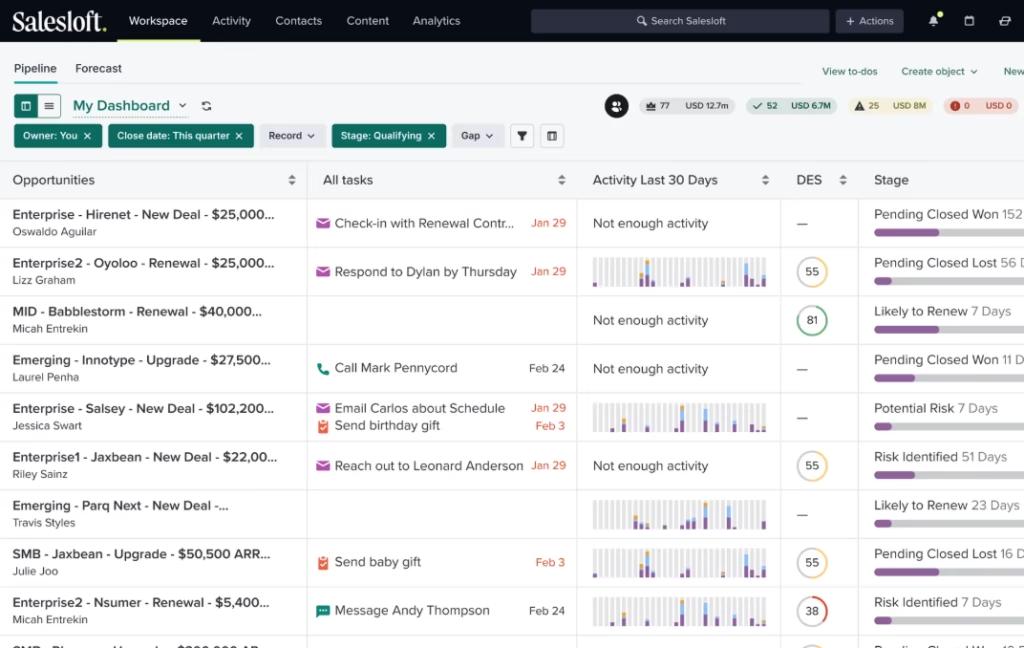
- Rhythm: ranks the seller's actions based on buyer behavior and lays them out in a daily workflow, complete with a home dashboard, configurable widgets (task progress, pipeline metrics, leaderboards), and Focus Zones.
- Conversations: records, transcribes, and summarizes calls, and highlights the key moments. It now runs on Clari Copilot, which adds smart chapters and live support guidance during the call.
- Deals: manages and closes opportunities with automatic summaries and a real-time engagement score that combines more than 30 signals.
- Analytics: turns data into action through team and account performance reports, along with a Command Center.
- Forecast: anticipates sales results by pairing AI with the team's own judgment.
- Chat Agents: turns website visitors into opportunities. This is where Drift's legacy lives on, with real-time web personalization, traffic identification, account-based marketing (ABM), and results-driven chat.
- Other pieces of the suite: the Enterprise Data Platform, Plays, the dialer, the mobile app, the Chrome extension, and the connection with Gmail and Outlook.
All of this saves time and money, because it swaps out manual processes and disconnected tools for a single place where the team knows what to do, when, and why. With less administrative busywork and a tidier pipeline, sales cycles get shorter and decisions rest on data you can trust.
AI Features
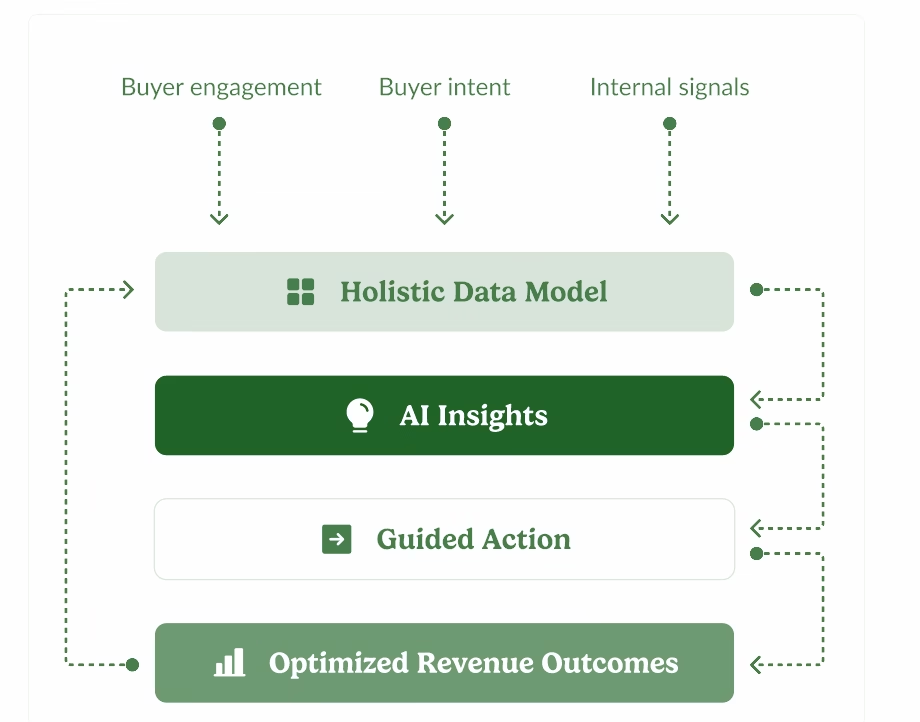
- Agents for building pipeline: research accounts and people, identify buyers (with ZoomInfo), answer questions about any account through Ask Salesloft, and draft personalized emails.
- Agents for converting and closing: summarize opportunities, map call information onto frameworks like MEDDPICC, spot stalled deals, support objection handling, and prioritize actions within Rhythm.
- Agents for growing and retaining: the analytics interpreter explains trends and suggests next steps, and another agent generates internal prep notes.
- Agent for scaling best practices: a sales strategist offers coaching recommendations based on the behaviors that win deals.
- MCP server: connects external assistants that support the protocol, such as Claude, ChatGPT, or Copilot, with the platform's live data, and links to systems like IBM watsonx.
The truly clever part isn't that the tool can draft an email, something any assistant can do these days, but that its agents work inside the seller's workflow with real business context: they know which opportunity has lost steam, which account needs attention right now, and why. The company makes an argument we agree with, and one worth keeping in mind for any SME weighing AI solutions: the deciding factor is no longer the model but the context feeding it. And that context only pays off when it checks three boxes, namely that the information is complete, up to date, and stays connected. A powerful but poorly informed assistant will always fall short of one that can see the whole sales process as it unfolds, in real time.t notifications and unified context across multiple channels, helping commercial and marketing teams make faster, better-informed decisions.
Integrations
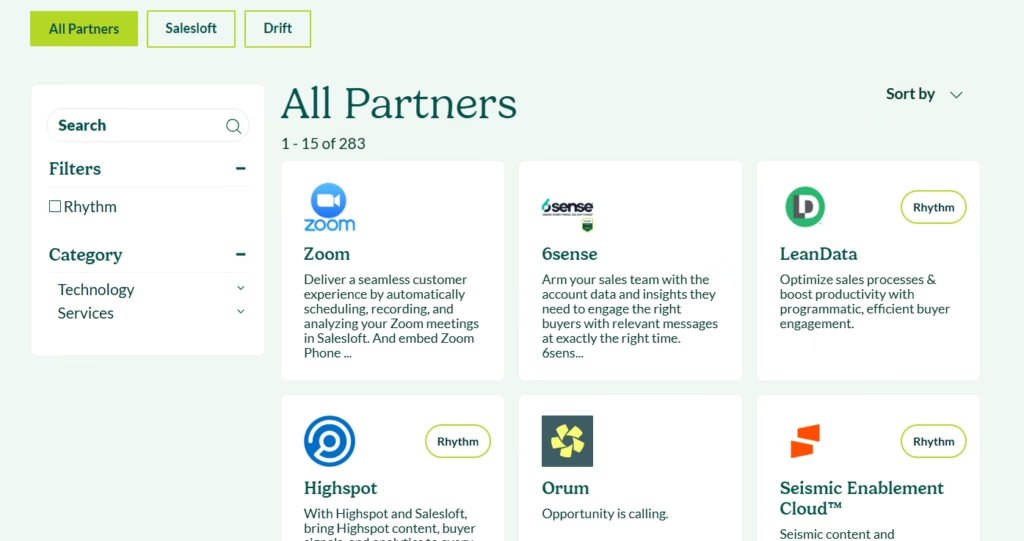
One of the platform's biggest draws is its ecosystem of connections. The CRM integration keeps data in sync between that system and the rest of the sales workflow, and from there it branches out to prospecting, conversation intelligence, content, and internal communication tools. The partner Marketplace sorts these connections into two broad buckets, technology and services, and many of them show up right inside the Rhythm workflow, so the seller can act without ever switching screens.
The integrations on offer include:
- CRM and data synchronization: Salesforce, HubSpot, and Microsoft Dynamics, with single sign-on in the case of Salesforce. Connecting a CRM is not mandatory: the platform keeps its features even if the team does not use one.
- Email: Gmail, Outlook, and Salesloft Mail.
- Prospecting and account intelligence: ZoomInfo, 6sense, Cognism, and DiscoverOrg.
- Conversation and call intelligence: Gong, Mindtickle's CallAI, and Orum.
- Content and sales enablement: Highspot and Seismic.
- Video, internal communication, and meetings: Vidyard, Zoom, and Slack.
- Lead routing and direct mail: LeanData and Reachdesk.
- Electronic signature and advertising signals: DocuSign and Influ2.
All told, the ecosystem brings together more than 180 technology and service partners, plus the Chat Agents layer inherited from Drift, which enriches web conversations with data from 6sense, ZoomInfo, and Crunchbase. And if you need to go beyond the catalog, an open API and an MCP server connect external AI assistants and in-house systems to the live data of the business.
Data Security and Compliance

Security here is enterprise-grade: ISO 27001, ISO 27701, and SOC 2 Type II certifications, plus compliance with GDPR, the CCPA, and the EU-US and UK-US privacy frameworks. The company runs annual third-party audits and annual penetration tests, and maintains a disaster recovery plan, a public subprocessor list, cybersecurity insurance, a data processing agreement (DPA), a vulnerability disclosure program, data deletion on request, and centralized single sign-on (SSO). You keep ownership of your information, and the AI runs on a governed data model.
Language – Customer Support and Interface
Inside the app, each user picks the interface language from five options, and that choice also sets the date, time, and currency formats. The company offers customer support and maintains offices in Atlanta, London, and Mexico. The help center now covers the main guides in more than one language, but the English version is your best bet for the full documentation.
AI Language – The Tool Itself
Call transcription picks up on the spoken language and produces transcripts in several languages, so teams can review customer conversations in their original language. The language-focused AI features, on the other hand (AI email drafts, action items, conversation key moments, and email sentiment analysis), only work in American English for now. In practice, that means the tool can understand and transcribe many languages on calls, but it doesn't yet produce that AI-assisted content in anything but English. If your team leans on those features in a particular language, it's worth confirming they're available with the sales team before you sign up.
Mobile Access
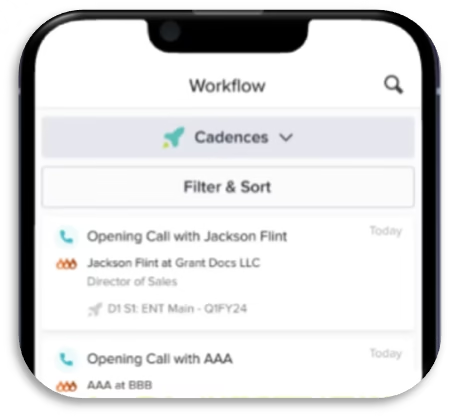
The Salesloft Mobile app runs on both iOS and Android and mirrors the look and feel of the desktop version, so there's no extra training to worry about. Right from the phone, a seller can run any step of a cadence or a one-off action, enroll contacts, look people up, and keep an eye on the live activity log (Live Feed). They can also send personalized emails with dynamic fields and meeting links, and schedule, reply, and follow up exactly as they would on desktop.
Support, Onboarding, and Account Management
The platform combines self-service with personalized support:
- Training and self-service: the Resource Center (research, guides, and videos), the blog, live and on-demand webinars, customer stories, and in-person and digital events.
- Guided learning and community: the Customer Education academy, aimed at revenue teams, and the Champions Hub community, which connects users with each other and with the company's staff.
- Direct help: the help.salesloft.com portal, the daily Office Hours (11 a.m. Eastern time), and the Professional Services team for implementation, onboarding, and account optimization.
- Trust and service status: the trust center, with privacy and security documentation, and the real-time status page.
- External support: certified consultancies and implementation partners in the partner marketplace.
If you want to try the tool with no strings attached, you can run through the 10-minute self-guided tours, no sign-up required, and then lean on the customer success team during rollout. The company points to one of the fastest implementation and payback times in the industry. For an SME without much technical experience, this web of resources goes a long way, with one caveat: the help center already has much of its guidance available in more than one language, but until localization is finished, the complete documentation is available only in English.
Ease of Use / UX
The interface has won awards for its user experience in the SaaS category, and it lives inside your inbox through the Chrome extension and the Gmail and Outlook add-ins, all with single sign-on. In June 2026 the platform gave its navigation bar a lighter look, a cosmetic change that leaves the features untouched. Like any enterprise solution with this many capabilities, it comes with a learning curve, especially on the admin side. An SME can get quick value from the basics, cadences and follow-up, and roll out the rest in stages.
Pricing and Plans
The company doesn't publish detailed rates on its site. It packages its offering into tiers, with add-ons for certain capabilities: Clari Copilot conversation intelligence calls for an advanced license tier or higher, and the MCP server needs the Agentic add-on. Every price is tailored, so the company invites you to request a demo or talk to its sales team, and it even offers a chat assistant to help you book one. To size up Salesloft's plans and cost, the most practical route is to start from what your team actually needs and ask for a proposal.
Case Study
Seamless.AI, a B2B sales intelligence and lead generation platform, needed to reach its customers at scale without losing the personal touch. Its customer success teams were bogged down by fragmented processes and had no single view of interactions, which made renewals hard to manage and growth opportunities easy to miss. Once they adopted the tool, they automated outreach to thousands of accounts, with alerts and messages that go out 90 days ahead of each renewal, leaned on templates for their trickiest conversations, and saved call recordings to coach their sellers more effectively. The payoff: less customer churn, better retention, more visibility for leaders, and less manual work for account managers. Chris Sexton, the company's Enterprise Customer Success Director, puts it this way: "it gave us the flexibility to customize the platform based on what each team needs." You can read the full case study here.
The company publishes official self-guided tours of the platform, roughly 10 minutes each and with no sign-up,with dedicated paths for each module (Cadence, Rhythm, Conversations, Deals, Forecast, and AI agents).
Drift AI vs Alternatives
The AI sales tool space is crowded, so it's worth putting Salesloft next to options that tackle different parts of the process. Set against a full CRM like Zoho CRM or a conversational agent platform like Darwin AI, the difference comes down to scope: Salesloft orchestrates the entire B2B revenue cycle, while the other two handle specific tasks very well. If you're shopping for alternatives to Salesloft, your choice hinges on whether you need a CRM, a conversational support layer, or orchestration sitting on top of your CRM.
| Tool | Main focus | Pros | Cons |
| Salesloft | Revenue orchestration and B2B sales with AI across the entire cycle | Complete, current, and connected context; AI agents inside the seller's workflow; more than 180 integrations; enterprise-level certifications | Aimed at the enterprise segment: high cost and learning curve |
| Zoho CRM | All-in-one CRM with contextual AI (Zia) | Free plan for up to three users; native WhatsApp; interface in 28 languages; more than 1,100 integrations; option to connect external models | The most advanced AI and deep analytics are reserved for the higher plans; the breadth of modules calls for some initial guidance |
| Darwin AI | Conversational AI agents for SMEs | Multilingual support; support via WhatsApp, Instagram, and calls; fast implementation with no technical team; focus on specific sales actions | Less suited for large corporations; requires digitized internal systems |
Go with Salesloft if your priority is orchestrating the B2B sales cycle with AI wired into your real business data. Pick Zoho CRM if you want a complete, affordable CRM with built-in AI and native WhatsApp. And choose Darwin AI if you're an SME that wants to automate support and sales over messaging without the technical headaches.
FAQs
What is Salesloft?
A revenue orchestration platform that brings together data, automation, and AI agents to support the entire B2B sales cycle, from first contact to renewal.
Is Salesloft a good option for SMEs?
It's a better fit for B2B SMEs that have reached a certain level of maturity and run a structured sales process, especially if they already use a CRM. For very small businesses or those without a CRM, it's usually overkill.
What happened to Drift?
It's been folded into the platform as its chat and conversational marketing layer.
What are the best alternatives to Salesloft?
It depends on what you need. Zoho CRM is a strong choice if you're after a complete, affordable CRM; Darwin AI, if you want to automate support and sales over WhatsApp and Instagram.
Still weighing up Salesloft and Drift AI?
See how it compares with the other tools we've reviewed in Marketing with AI.