
Kilimo Review
Kilimo combines satellite data, weather intelligence, and AI to optimize irrigation and measure water impact. Full review covering ROI for agricultural SMEs.
Kilimo stands out as a comprehensive irrigation and water management partner for agricultural businesses. It integrates operational recommendations with the internationally recognized VWBA framework and an educational ecosystem (Irrigation Academy, Water Talks). Its core strength lies in translating data into verifiable actions that improve both productivity and sustainability, even in areas with limited connectivity thanks to its mobile apps.
Its limitations: sparse technical documentation on integrations or APIs, and publicly available materials don't include formal certifications.
Recommendation: First choice for agricultural businesses prioritizing irrigation efficiency and looking to participate in water impact projects with auditable metrics.
Averaged from the breakdown below
- Producers and advisors who want plot-level irrigation recommendations and clear tracking of water savings
- Cooperatives or SMEs seeking verifiable reports for ESG goals and relationships with clients or financiers
- Companies with agricultural operations interested in climate action projects and watershed restoration
- Users who require public pricing lists and standardized plans before a demo
- Teams needing exhaustive technical documentation on integrations/APIs from day one (not publicly available)
- Areas without minimum mobile connectivity, where offline functionality would be unworkable
Key Features
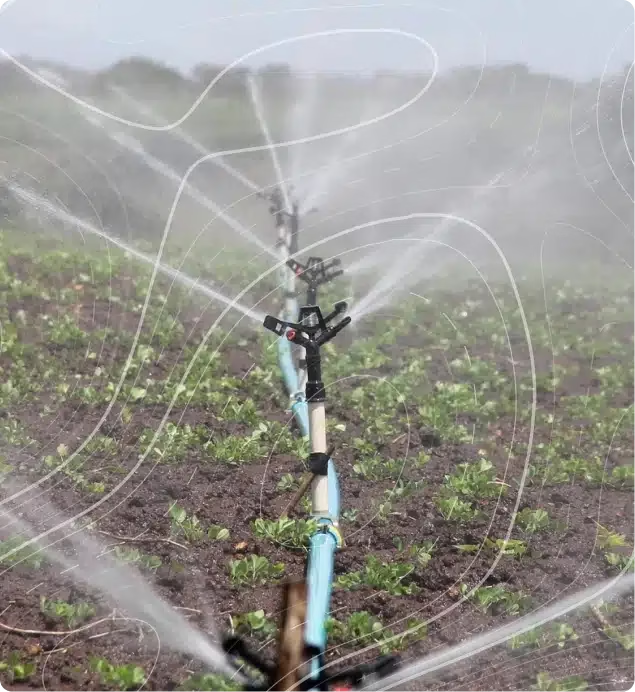
- AI-Powered Irrigation Recommendations: Kilimo uses machine learning and consolidated weather data from public stations and multiple satellites to calculate hyperlocal evapotranspiration and field-specific crop coefficients. No additional hardware required. Delivers simple, actionable recommendations that adjust irrigation to actual needs.
- Volumetric Water Benefit Measurement (VWBA): Applies the Volumetric Water Benefit Accounting methodology, developed by The Nature Conservancy, WBCSD, and WRI, to validate volumetric benefits and report them with internationally comparable standards.
- Climate Action Programs and Projects: Kilimo supports companies in watershed restoration, validating volumetric benefits with partners including AWS, SQM, BEF, IDB, and local governments.
- Mobile Applications: Available on Google Play and App Store, allowing users to log rainfall and irrigation, calculate available water, and operate offline. Recent versions include historical comparison by crop.
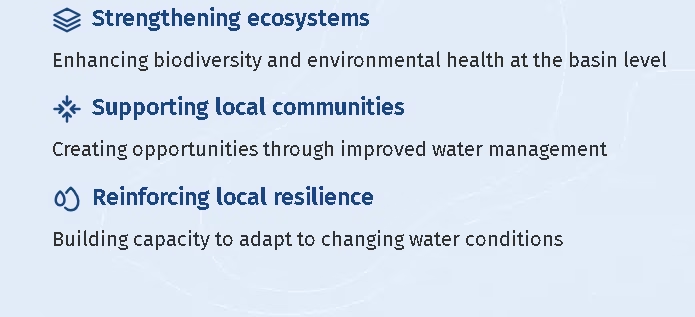
Kilimo designs and runs water security projects alongside companies, foundations, and governments, with partners such as Microsoft, Amazon Web Services, and The Coca-Cola Company. Projects are organised basin by basin across countries including Chile, Mexico, Argentina, Brazil, and the United States, combining two lines of work: converting fields to more efficient irrigation systems (Irrigation Conversion) and data-driven irrigation management (Irrigation Manager). In Mexico, Kilimo takes part in the collective-action initiative Latidos del Agua, which brings together basin projects such as Pulso Norte (Bravo-San Juan), Cinco Aguas (Moctezuma), and Caudal Vital (Lerma). One example is the project with Procter & Gamble and the Bonneville Environmental Foundation (BEF) in the Moctezuma basin (Hidalgo, Querétaro, and the State of Mexico), under way for a year, which aims to conserve more than one million cubic metres of water by 2030 by converting flood irrigation to efficient systems and tracking results parcel by parcel. Each intervention validates the volumetric benefits it generates and delivers co-benefits for ecosystems, local communities, and territorial resilience.
AI Features
Kilimo's AI doesn't rely on prompts. It employs time series data, satellite imagery, and machine learning to calculate evapotranspiration and crop coefficients. Predictions are adjusted weekly through supervised learning based on field validations.
The system doesn't store personally identifiable data and focuses on physical parameters (water balance, humidity, NDVI). The intelligence lies in its ability to estimate, predict, and verify real impact, enabling verifiable ESG reports.
Integrations
Kilimo connects stakeholders and data for water security reporting and corporate compliance. Public APIs are not available; integrations are managed on a per-project basis with technical support and customized validation.
Data Security and Compliance
Kilimo maintains region-specific privacy policies. Alongside the laws of Argentina (Law 25.326), Chile (Law 19.628), and Mexico (Federal Law on the Protection of Personal Data Held by Private Parties), it keeps a United States policy that references California's CCPA; in it, Kilimo states that it is not currently subject to that law. The service is intended for users aged 18 and over. In Mexico, data is retained for five years, and data-subject requests (access, rectification, cancellation, objection) are handled at info@kilimoagtech.com.
Recommendation for SMEs: Request the DPA, retention matrix, access controls, and encryption description before integrating.
Language: Customer Support and Interface
The website, apps, and educational programs are available in multiple languages. Support is provided through the Irrigation Academy, Water Talks, and direct contact channels.
AI Language: The Tool Itself
Kilimo's AI works with environmental and satellite data, not natural language. In this case, the interface and support language matters more than AI language capabilities.
Mobile Access
Native applications available for both Android and iOS. They support offline mode, event logging, automatic synchronization, and available water visualization by sector. Optimized for field teams with limited connectivity. Recent versions include performance improvements, iPad compatibility, macOS support (M1 chip or later), and content available in multiple languages.
Support, Onboarding Process, and Account Management
Onboarding combines direct support (plot setup, polygon validation, and digital-workflow adoption) with training from Kilimo's academy (Academia del Agua y el Agro), which pairs an on-the-ground space for farmers and local stakeholders with Water Talks aimed at corporate leaders. This community has trained more than 100,000 people through over 220 training sessions and more than 200 speakers, with over 40,000 subscribers and more than 60,000 views. For corporate projects, an internal lead is assigned for data governance and VWBA reporting.
Ease of Use / UX
The design prioritizes operational clarity: view available water, log events, and apply recommendations by crop and sector. The learning curve is moderate: teams see tangible results within a few weeks if they standardize irrigation logging. Traceability enables audits and ESG reporting.
Pricing and Plans
Pricing is not published. Kilimo works through projects or water compensation agreements. Cost depends on plot size, satellite monitoring frequency, and ESG reporting requirements. We recommend requesting comparative scenarios to estimate ROI based on water savings, energy savings, and production stability.
Case Study
Microsoft and Kilimo in the Maipo Basin (Chile)
In Chile's Maipo basin, where agriculture uses roughly 68% of the available water and which supplies about 80% of the water reaching Santiago, Microsoft and Kilimo worked with growers to irrigate more precisely using AI. Farms that adopted the technology adjusted when and how much to water based on crop-specific data and weather conditions. According to Kilimo, the system covered 450 hectares and reduced water use by about 13% compared with traditional irrigation, saving 1.5 million cubic metres over three years. The initiative is part of Microsoft's water positive commitment.
Kilimo, Liderando el camino hacia un futuro agua-positivo
Tool vs Alternatives
Kilimo vs Hispatec
Hispatec is an agricultural ERP covering comprehensive management (traceability, logistics, commercial). Kilimo specializes in smart irrigation and VWBA measurement. Hispatec is preferable if the priority is complete business management; Kilimo if the goal is water optimization and ESG benefit reporting.
Kilimo vs Taranis
Taranis focuses on pest detection and plant health through computer vision. Kilimo addresses water management and irrigation efficiency. Both tools are complementary: Taranis prevents production losses; Kilimo maximizes water resource utilization and provides environmental validation.
FAQs
Is Kilimo a good tool for SMEs?
Yes. It offers AI-based irrigation recommendations, mobile apps, and verifiable reports that improve water efficiency and support ESG goals.
Does Kilimo use my data to train models?
There's no public evidence of personal data being used for training. The AI works with environmental and agronomic variables.
Are there mobile apps?
Yes. Android and iOS apps with crop irrigation logging, offline mode, and available water visualization.
Still weighing up Kilimo?
See how it compares with the other tools we've reviewed in AI for Agriculture.