
Polsia: Build and Run a Company with Autonomous AI Agents
Polsia is a platform for building and running autonomous companies managed by AI agents. It belongs to the emerging category of autonomous AI companies, alongside NanoCorp and Cofounder: rather than an assistant that answers questions, it generates and runs a company from a single idea and reports back to the owner. The introduction is signed by Victor-Benjamin (known as Ben), who recounts in the first person where the project came from and the idea driving it: that one person should be able to build and launch anything without a team behind them. This review looks at a recent product that is still very much evolving.
AgentAya Verdict
Polsia makes good on its promise of a fast start. Within minutes it creates a company, researches the market, names it, puts up a landing page on its own subdomain, and writes the first round of content, all on its own. The agentic experience feels smooth and well built: the system assigns itself tasks and carries them out, a chat lets you request changes, and the agent’s status updates come with a personality all their own.
That said, it pays to use it with a critical eye. Autonomy runs high, with no decision points along the way. The platform picks the name, positioning, and design without offering options, and undoing those choices later costs credits. In our test, the research report even credited the user with building a company they had nothing to do with, apparently confusing two similar names.
AgentAya’s recommendation is straightforward: this is an interesting platform for experimenting and getting a digital business off the ground quickly, provided the owner checks every output and doesn’t blindly hand over decisions that touch money, reputation, or personal data.
Score breakdown
| Category | Score | Description |
|---|---|---|
| Features and capabilities | 4/5 ⭐⭐⭐⭐ | Builds a site, database, payments, email, and ads, and runs on daily cycles. |
| Integrations | 3/5 ⭐⭐⭐ | Integrates Stripe, Meta, GitHub, Render, and Neon; no own keys or self-hosting. |
| Language and support | 4/5 ⭐⭐⭐⭐ | Multilingual AI that produces content in English; English interface, with full documentation only after you subscribe. |
| Ease of use | 3.5/5 ⭐⭐⭐½ | A very fast start, but no decision points and a context error in the research. |
| Value for money | 3/5 ⭐⭐⭐ | Exploring is free; running the work takes a paid subscription, and the published price is inconsistent. |
Overall score: 3.5/5 ⭐⭐⭐½.
A standout agentic experience and a quick start, held back for now by patchy documentation, a core feature under maintenance, and the need to review everything it produces.
Ideal for:
- Solo founders who want to launch and validate an idea without a technical team.
- SMEs and self-employed professionals who need a working site and a way to take payments within minutes.
- Anyone who wants to experiment with business ideas aimed at consumers or small companies.
Not ideal for:
- Businesses selling to large or established companies, where the results still fall short, according to one user’s account.
- Anyone who needs to use their own AI models or self-host the platform.
- Owners who can’t set aside time to review and correct the agents’ decisions.

Key features
- Builds a company from an idea and runs it in an isolated sandbox environment.
- Generates working documents, such as a market research report and a mission statement.
- Sets up a dedicated email address for the company.
- Organizes tasks by category (engineering, research) that run by consuming credits.
- Runs daily operating cycles in which the agent reviews the company, generates tasks, carries them out, and reports on progress.
- Sets up payments through Stripe.
- Manages Meta advertising campaigns through an account that belongs to the platform itself.
- Supports teams with roles (owner, administrator, member).
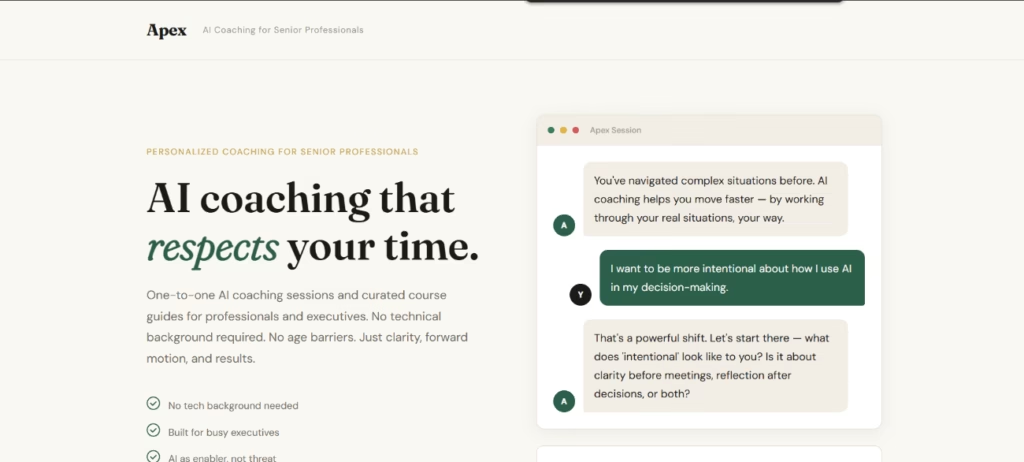
Polsia publishes a landing page on its own subdomain (company.polsia.app, for instance), and you can manage the domain if you like. It gives you no options while generating the page, and in our tests it produced content that fit the topic but came with a generic design and little personality.
AI features
- Market research: it analyzes the business context and the competitive landscape and produces a structured report.
- Site generation: it builds the landing page, the copy, and the content from your business description.
- Social media content: during the test, it wrote a post for X entirely on its own.
- Ad creative: it produces both video and imagery for the ads.
- Outbound email: it identifies recipients, drafts cold messages, and sends them (this feature was under maintenance during our test, with no credits charged).
- Multilingual translation: it produces and translates the business content into several languages, including English.
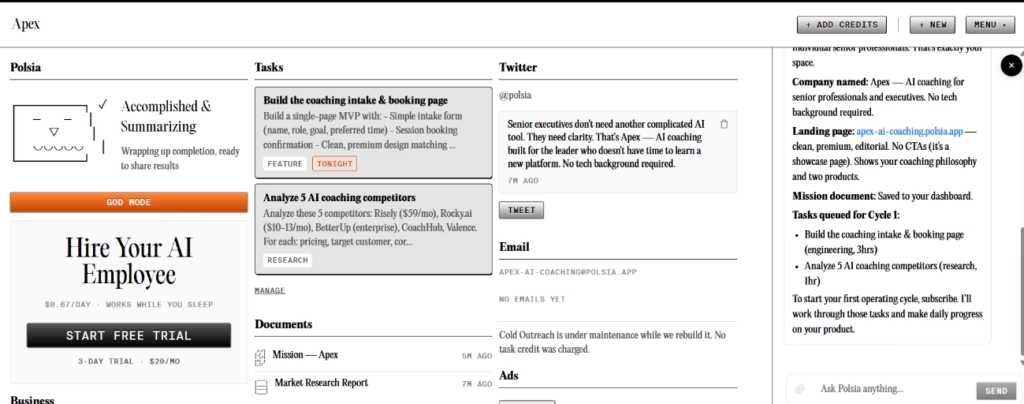
What really sets Polsia apart isn’t generating a one-off piece of text or an image. It’s the way it strings decisions together over time through operating cycles: the agent reads the idea, breaks it into tasks, and works through them in order without stopping for approval at each step.
Integrations
Polsia integrates with:
- Stripe, for processing payments and creating products and payment links.
- Meta, for managing ad campaigns, including sending conversion events through its API.
- GitHub, for hosting the code.
- Render, for deploying the site.
- Neon (PostgreSQL), as the database.
- An API proxy compatible with third-party interfaces that routes requests to several AI model providers.
The documentation confirms that you can’t bring your own AI model keys and that self-hosting isn’t available yet (“coming soon”).
According to the documentation, Polsia standardizes its stack on React with Vite for the web layer, Node.js with Express on the server side, PostgreSQL for the database, and Render for deployment. The platform handles deployments itself.
Data security and compliance
The documentation says users keep ownership of the content and code generated for their use, and that they’re responsible for reviewing the AI’s output before publishing it or charging customers. Polsia claims to encrypt credentials (tokens, database passwords, and deployment configuration) with AES-256-GCM, and it leaves payment processing to Stripe, so it never stores card numbers. If you delete your account, a deferred deletion period of up to thirty days applies.
One detail stands out, because the documentation contradicts itself: the terms of service say each company’s public dashboards are enabled by default and can be indexed by search engines, while the FAQ claims the opposite, that only the owner can see their company unless they choose to make it public.
Language: interface and customer support
Polsia’s interface and documentation are in English. The payment screen, run by Stripe, does show up localized in the user’s language. Official support comes by email (support@polsia.com) and through a built-in support chat. The FAQ is only available once you subscribe, which is a real obstacle for anyone trying to size up the product before paying. There’s also a WhatsApp group (“Polsia Missionaries”).
AI Language
Polsia’s AI is multilingual. During the test, it wrote the business description with clean, correct phrasing, and the agent itself claimed to handle plenty of languages and to translate content for other markets. Translated content can carry over awkward phrasing from the source language, but that’s fairly common with machine translation and easy enough to edit.
Mobile access
Polsia offers no mobile apps for Android or iOS. It’s a web-based platform that works only from its website.
Support, onboarding, and account management
Onboarding is guided and quick. The flow opens with two paths (create a new company or connect an existing business) and, for the first, lets you either describe an idea or have the platform suggest one. From there, the system spins up the company in an isolated environment and gets to work.
Account management, on the other hand, is bare-bones. Profile settings cover little more than your name, email, and Twitter handle, plus an area to delete the account. Removing the company or the account is easy and direct.
Ease of use / UX
Getting started with Polsia takes almost no effort. You describe the idea (or let the platform suggest one), and the agent gets to work right away, displaying status updates with a personality of their own that shifts as the workflow moves from one phase to the next.
Unlike Cofounder, which lays out options and waits for your sign-off, Polsia decides the name, positioning, and design on its own, with no alternatives on offer. You can edit things afterward from the workflow, but every action burns credits, so the less the agent nails on its first pass, the more it costs to get where you want.
There’s room for error here. In our test, the research report wrongly credited the user with building a company, apparently a mix-up between similar names, and it never flagged that detail. The rest of the research, covering market validation and the competitive landscape, held up well, but the slip is a good reminder to check each result before treating it as final.
Pricing and plans
Polsia lets you explore the platform for free, creating a company and seeing what the agent proposes, but running the real work, the operating cycles, takes a subscription. The trial runs three days and asks for a card up front; if you don’t cancel before it ends, recurring billing starts. The plan splits things into “night shifts” (one automatic daily task) and “task credits” (used up when you run specific tasks). On top of that comes a platform fee, around twenty percent, that applies both to your ad spend and to the income you withdraw.
Case study
An independent professional wants to launch a small digital business: a collection of guides and templates for organizing projects. She can’t code and has no interest in setting up infrastructure, so she writes her idea in a single sentence, asks the platform to develop it, and lets Polsia run with it.
In the first session, the agent researches the market, suggests a name, puts up a landing page on its own subdomain, and writes the copy. She reviews the result before going further: she adjusts the positioning through the chat, fixes a couple of sentences that read like a literal translation, and confirms that the English content sounds natural. Then she sets up payment with Stripe and publishes a first product.
From there, she lets the daily cycles roll, but she stays involved. Each morning, she goes over what the agent proposed, approving the tasks that make sense, dropping the ones that don’t fit, and giving clear direction whenever something drifts off course. When she switches on Meta advertising, she sets a modest daily budget and keeps an eye on spending for the first few days before raising it. And when she wants to take the business into another language, she has the agent translate the content and reviews the result before approving it.
Polsia packs into a single automated workflow the kind of work that would normally take several people, and that may be its biggest draw for users.
Videos
Polsia vs alternatives
Polsia competes in the emerging category of platforms that build and run companies with AI agents. Two alternatives take different routes: NanoCorp and Cofounder.
NanoCorp also generates and runs a company from a single instruction, aiming for something that works almost by itself. Cofounder takes the opposite tack, organizing itself like a company with departments, where the agents ask for approval before any sensitive action. Next to NanoCorp, Polsia’s documentation is more opaque, since you can’t reach the FAQ until you subscribe, whereas NanoCorp keeps a public help center.
| Platform | Approach | Pros | Cons |
|---|---|---|---|
| Polsia | Runs the business through autonomous agents. | Very fast start; polished agentic experience that handles advertising and infrastructure for you. | High autonomy with no decision points; corrections cost credits; documentation locked behind the subscription wall. |
| NanoCorp | Autonomous operation with minimal intervention. | Builds and runs from a single instruction; public plan structure; public help center. | No support for your own AI keys or self-hosting; bills advertising separately. |
| Cofounder | Orchestrates agents with human approval. | Approval-based control at every step; extensible with your own code and API; project portability; SOC 2 certification on the Team plan. | Asks more of the founder; closed stack and a platform limited to web apps. |
Which one fits comes down to how much autonomy you’re willing to hand over and how much transparency and control you need. Polsia prioritizes speed and full automation; NanoCorp offers a similar autonomous setup with more open documentation; Cofounder trades some speed for control and portability.
Related Tools
| Tool | |
|---|---|
 | |
 | |
 | |
 | |
 |
FAQs
What is Polsia?
A platform of autonomous AI companies that builds and runs a digital business from an idea, using agents that work in daily cycles with minimal intervention from the owner.
Does it have a free plan?
You can explore for free, creating a company and seeing what the agent proposes, but running the real work takes a subscription that begins with a three-day trial.
Is it safe to charge real customers?
It lets you take payments through Stripe, but the owner remains the commercial and legal party responsible. It’s worth reviewing every output and confirming the product actually exists before accepting payments.
What are the best alternatives to Polsia?
NanoCorp, which takes a similar autonomous approach with more open documentation, and Cofounder, built around orchestrating agents with human approval.