

Qamarero Review
Qamarero stands out for its wide range of features and for a level of ease of use you rarely find in systems this complete. Its reach is still confined to Spain, which limits how useful it is right now beyond that market.
This platform is an excellent option for restaurants, bars, cafés and hotels that want to stop holding their operations together with scattered tools and move to a single system. Its greatest strength is native integration: a change you make in the POS shows up instantly in the digital menu, in the kitchen and on the website, with no external connectors to break down.
The one limitation we flag for our audience is geographical: for now, Qamarero only operates commercially in Spain, even though its interface is available in several languages, including English. For a Spanish SME, or any business that has to meet the country's tax rules (Verifactu, TicketBAI), the offering is hard to beat. If you operate in Latin America, it is worth confirming availability before you commit.
Averaged from the breakdown below
- Spanish bars and restaurants that want to unify payment, order taking, kitchen and bookings in a single system.
- Venues with fast service and demand peaks, where ordering and paying from the table by QR eases the load on the team.
- Hotels that need to run a restaurant, pool bar and room service from the same platform.
- Groups and chains looking for a centralised dashboard to compare the performance of several venues.
- Businesses outside Spain that require immediate local commercial operation and support.
- Restaurants whose central problem is an AI voice agent able to handle phone calls.
- Operations that depend on very specific integrations with external payroll systems or corporate ERPs.
Key features
- Complete POS: cash, card and mixed payments, bills split by person or product, and automatic cash reconciliation at close.
- Digital order pad: each waiter takes the order at the table from their phone, sends it to the kitchen and takes payment from the same device, with no per-terminal licences.
- QR digital menu: synced with the POS, it flags the fourteen allergens, translates into several languages and supports customisable design.
- Order and pay: the customer scans the table QR, chooses, confirms and pays without waiting for a waiter.
- KDS for the kitchen: a screen that receives orders from every channel, with real-time statuses, per-dish timers and separate stations.
- Coursing: organises service into successive courses so the kitchen can progress in an orderly way.
- Commission-free bookings: its own portal, integration with Google and automatic reminders by email and SMS.
- Own website: a site with menu, bookings and orders synced with the POS, with its own domain, local SEO and several languages.
- Delivery, collection and self-service: own channels with no commissions, with rider management and timing analytics.
- Business control: time tracking and shift logging, tax compliance (Verifactu, TicketBAI and invoicing), stock control on the menu, team shift planning and a documents and finance module for invoices, payroll and costs.
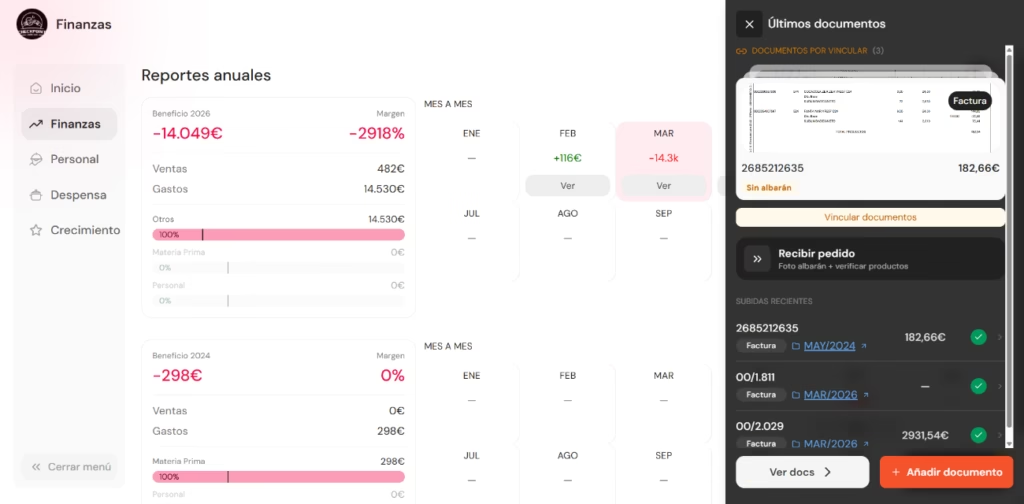
Because they all live in the same system, these features do away with manual re-keying between tools and cut down on order errors, two of the most common drains on time and money in hospitality. A price change reaches every table instantly, and a cash close that used to take half an hour now wraps up in minutes.
AI features
- AI Invoices: upload the supplier's invoice and the system automatically extracts supplier, dates, amounts, line items and VAT, as well as detecting duplicates and linking delivery notes.
- Automatic menu translation: the platform translates your menu into several languages with no need to fill in templates by hand.
- AI shift planning: proposes the team's schedule (rota) based on the venue's needs.
- Assisted review management: suggests replies to Google reviews and spots trends in ratings.
- Sales recommendations (upselling): suggests additional products just before the digital order is confirmed.
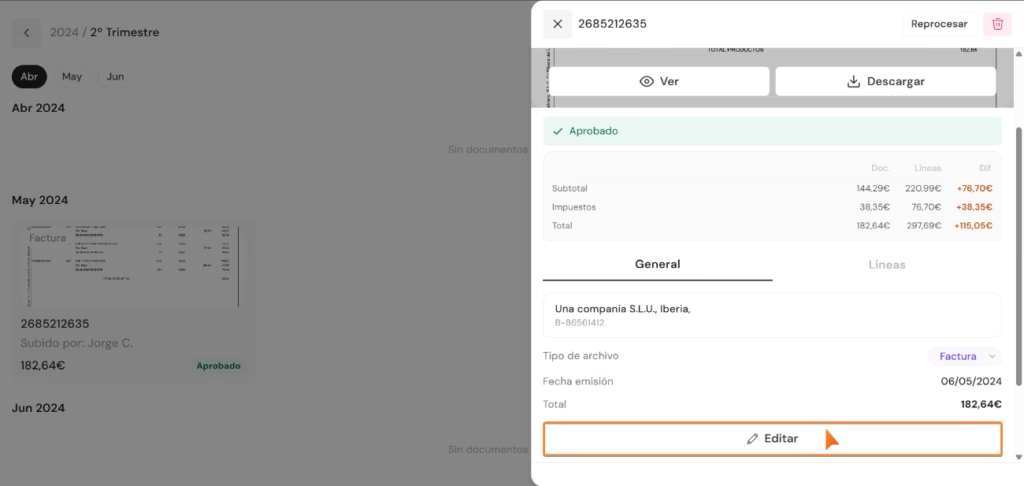
Where the technology is most impressive is in document extraction: having the system read an invoice in Spanish, classify it by category and leave it ready to review is something conventional management software does not do. Other features, such as the floor assistant that displays a customer's preferences when the table is opened, rely more on a well-organised database than on generative models, although their day-to-day usefulness is undeniable.
Integrations
- Stripe for charging deposits and backing bookings with a card.
- Google, so customers can book directly from the business profile on Maps.
- Google Business Profile, to manage and reply to reviews from the platform.
- UberEats, integrated into the same screen as your own delivery.
- WhatsApp and phone agents for communication and support.
The core modules (POS, order pad, KDS and menu) communicate natively, without relying on third-party connectors. WhatsApp, ever-present in the Spanish market, is covered within the ecosystem. The catalogue of external integrations is still somewhat limited, which makes sense for a platform that prioritises handling operations end to end within its own environment.
Data security and compliance
The data entered into the platform is and remains the customer's property; Qamarero processes it solely to provide the service, acting as a data processor in accordance with the GDPR and Spanish data protection regulations. When the reviews module is activated, the information obtained from Google's APIs is governed by limited-use requirements: it is not sold to third parties, not used for advertising purposes and not used to train artificial intelligence models.
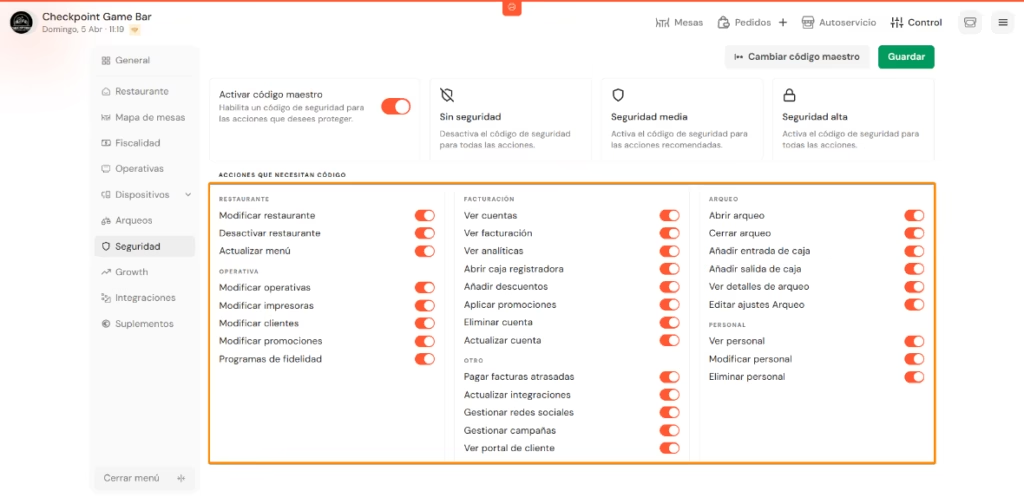
On tax matters, the system is already technically ready for Verifactu (mandatory from 2027) and certified for TicketBAI, with digitally signed receipts, chained records and full traceability of every cancellation. The cloud infrastructure applies data encryption, and the master code allows sensitive POS actions to be restricted through roles and permissions, so each team member only accesses what is relevant to them.
Language: customer support and interface
Qamarero offers Spanish-language support from real people, 365 days a year, with priority service for chains. The help centre is also in Spanish, while the platform interface is available in several languages, among them Spanish and English. In addition, the diner-facing menu can be displayed in Spanish, English, French and Italian.
AI language
The tool's features are designed to work normally in Spanish. The data extraction in AI Invoices processes documents in Spanish and recognises the four VAT types of the country's tax system, while automatic menu translation starts from Spanish as the source language towards English, French and Italian. Unlike a conversational agent, much of the platform's intelligence relies on document recognition and process automation rather than on natural-language dialogue, so the user's language is not a barrier.
Mobile access
Qamarero is a web platform that runs on any tablet, phone or computer with a browser, with no proprietary hardware or dedicated handheld devices. The digital order pad is the part built for mobility: it turns each waiter's phone into an extension of the POS, so the order is taken at the customer's side, sent to the kitchen instantly and charged from the device itself, including the option to split by diner.
From the very first plan, the order pad works as a web app: it opens straight in the phone's browser, with nothing to download from Google Play or the App Store. On the Advanced setup, it also comes as a native app for iOS and Android with an offline mode, a version you don't download freely from the stores but that is included in the contracted service.
Support, onboarding and account management
The Qamarero team handles setup remotely through AnyDesk: they configure the account, import the menu and train your staff, with an account manager guiding you through the first few weeks. Getting started is quick, and the initial activation takes just a few minutes with the manager on the phone.
On top of that, there's a Spanish-language help centre with more than a hundred articles organised by topic, plus genuinely practical free resources for the sector, like a food-costing calculator (it works out the true cost of each dish from ingredients, weights and wastage so you can set the selling price), shift templates and guides to opening or growing a venue. For an SME with little technical experience, this kind of support makes the difference between adopting the tool with confidence and giving up halfway.
Ease of use / UX
The interface is visual, with product photos and quick search, and is designed so a waiter can master it in a single service, with no manuals or multi-day training. That very gentle learning curve is decisive in a sector with high staff turnover: when someone new joins, they fall into the rhythm of the shift almost immediately.
Pricing and plans
Qamarero works with public pricing and a tiered structure that grows with the business:
- Basic: the operational base with POS, order pad, QR menu, order and pay, and KDS.
- Growth: advanced bookings, CRM, loyalty, review management and floor assistant.
- Delivery: its own commission-free delivery channel, aggregators and rider management.
- Control: staff, inventory, costs, advanced analytics and AI shifts.
- Total: all modules included.
- Duo Pack and Enterprise: intermediate combinations and tailored terms for groups and chains.
There's no lock-in, and you can cancel from the dashboard with no penalties. The service also runs an internal credit system for refunds. With no per-diner commissions on bookings and no commissions on your own delivery, the return on investment only gets stronger, since the cost doesn't climb as the venue fills up.
Case study
La Oveja Negra, a restaurant in Novelda specialising in one hundred per cent beef, has spent a decade serving its diners under the lead of its manager, Javier. The venue does not take bookings, so during the town's festivals it would build up between seventy and eighty people waiting for a table, a volume that strained the team and slowed service down. Ordering a beer could take up to two or three minutes at peak time.
After discovering the tool on Instagram, the restaurant adopted Qamarero's order-from-the-table system. The change was immediate: that same beer began arriving in thirty to sixty seconds, a reduction of close to fifty per cent in service times. With customers ordering at their own pace, without waiting for a waiter to come over, the venue managed to comfortably serve up to one hundred and fifty diners without sacrificing quality.
The benefit was not measured in speed alone. The digital menu shows the allergens for each dish, so diners with intolerances check that information before ordering, something the manager describes as one of the most useful features for his business. Adding a new dish is as easy as snapping a photo, and being able to attach an image to each product made the experience at the table richer. The balance the team describes combines faster service, higher revenue, less stressed staff and more satisfied customers.
Qamarero versus the alternatives
A comparison our audience might find useful is Qamarero versus Elyra, two platforms built on different philosophies: Qamarero bets on running the whole venue from one place, while Elyra focuses its intelligence on customer communication and bookings.
| Qamarero | Elyra | |
|---|---|---|
| Main focus | All-in-one restaurant management | Bookings and AI communication |
| POS and kitchen operations | Yes, complete (POS, KDS, order pad) | No |
| AI voice agent | No | Yes, multilingual 24/7 |
| AI email agent | No | Yes |
| CRM and customer intelligence | Yes, with notes and tags | Yes, automatic and across channels |
| Marketing and loyalty | Yes, from the Growth plan | Yes, AI-generated campaigns |
| Delivery and inventory | Yes | No |
| Per-diner commissions | None | None |
| Pricing model | Tiered plans, public pricing | Flat rate, requires a demo |
| Ideal for | Restaurants that want an integrated system of POS, bookings and marketing | Venues that prioritise phone handling and AI customer intelligence |
Elyra is the better choice if your biggest headache is missed calls and the lack of an agent to handle phone and email on its own. Qamarero, on the other hand, takes care of the whole business: it processes payments, manages orders, coordinates the kitchen, handles delivery, tracks inventory and builds loyalty, all from a single dashboard. For a Spanish restaurant looking to digitise its operations from start to finish, Qamarero is the ideal choice.
FAQs
Is Qamarero a good tool for hospitality SMEs?
Yes. Its interface is learned in a single service, it does not require proprietary hardware and it brings together in a single subscription the features an SME usually pays for separately.
Does it work outside Spain?
For now commercial operation is limited to Spain, although the interface is available in several languages, including English.
Does Qamarero charge commissions per booking or per diner?
No. Bookings through its own portal and delivery via its own channel apply no per-diner commissions, which keeps the cost predictable as activity grows.
Does it comply with Spanish tax regulations?
Yes. It is certified for TicketBAI and technically ready for Verifactu, whose mandatory adoption is scheduled for 2027, with signed receipts, chained records and full traceability.
What are the best alternatives to Qamarero?
For AI phone and email handling, Elyra is a good alternative. The choice depends on the business's priority: all-in-one management of the venue with Qamarero, or automation of customer communication with Elyra.
Still weighing up Qamarero?
See how it compares with the other tools we've reviewed in AI Automation.