

CattleEye Review
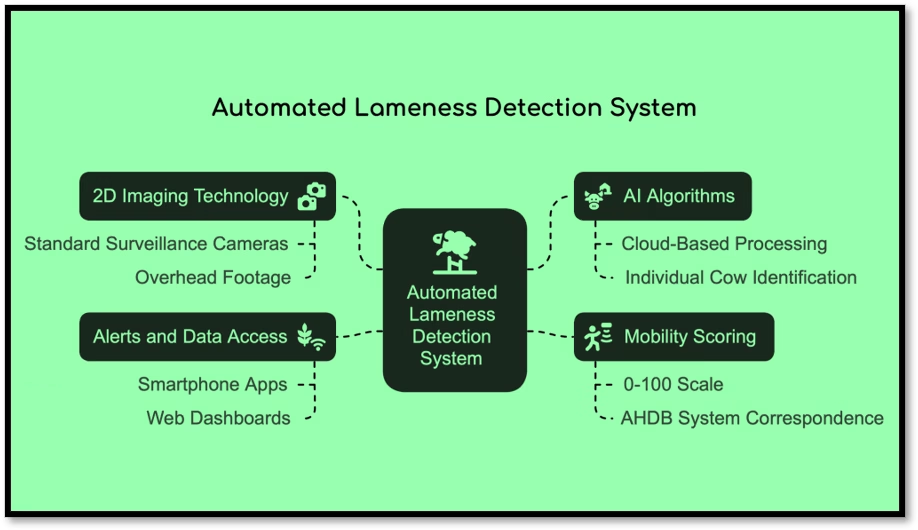
CattleEye is an autonomous livestock monitoring platform that uses computer vision to analyse video captured by a standard camera placed at the exit of the milking parlour.
This tool works as a virtual sensor for dairy farms that need to standardise mobility and body condition scoring without investing in wearables. Its proposition rests on something no human assessment can match: the cow is observed every day, always against the same criteria, with nobody standing in front of her to change the way she walks.
The scientific backing is solid and uncommon in this sector. A randomised controlled trial published in the Journal of Dairy Science in 2026, authored by the University of Liverpool, found that the group monitored by the system had fewer animals with severe lameness and with sustained chronic lameness, better hoof health at mid-lactation, and a longer interval before the first lameness episode. The same trial found no difference in milk production or culling rate, and it did find that the monitored group required more foot trimming sessions.
Limitations: technical documentation, training videos and help centre resources are in English, though the interface is translated into Spanish. There are no published rates. The system does not run in real time, footage uploads after milking and the report arrives the following day, unless you add the optional local processing device. Sensitivity drops considerably in first-lactation cows. And installation calls for electronic identification of the animals, enough height at the parlour exit and a clear stretch of walking length.
Recommendation: a priority option for medium and large dairy farms that already run herd management software, have electronic identification in place and are looking for returns through animal welfare and feed efficiency. The line that captures it best came from the manager of a user farm speaking to the British trade press: the system is not going to make lame cows better, but it will identify them sooner.
Averaged from the breakdown below
- Medium and large dairy farms that want to reduce lameness preventively and standardise scoring without human bias.
- Farms already running herd management software that want alerts and metrics in one place.
- Farms with electronic identification already in place.
- Farms concerned about data sovereignty, which can choose local processing to keep footage on the farm.
- Farms that cannot meet the physical installation requirements: clear height at the exit, an unobstructed walking stretch, adequate and consistent lighting.
- Tie-stall systems, where the technology is harder to apply.
- Producers without electronic identification across the herd.
- Teams that need manuals, training videos and documentation support in Spanish.
- Farms whose management hinges on detection in first-lactation cows.
Key Features
- Autonomous monitoring with an ordinary camera: mounted above the milking parlour exit and running within a day, with no wait for specialist engineers. An initial period follows, during which the system learns to recognise each cow by her combination of body shape and coat pattern.
- Mobility scoring: every pass under the camera produces an objective score, with accuracy comparable to a trained mobility scorer, every day of the year. The threshold that defines lameness is configurable, and can be adjusted by group according to parity.
- Automated body condition scoring: continuous analysis to fine-tune rations, flag animals at risk of production loss and inform transition management decisions.
- Management lists and alerts: daily lists of animals needing immediate attention, weekly digests of herd-level trends, and flagging of animals whose scores are trending the wrong way. Trim list criteria can be modified using user-defined tags.
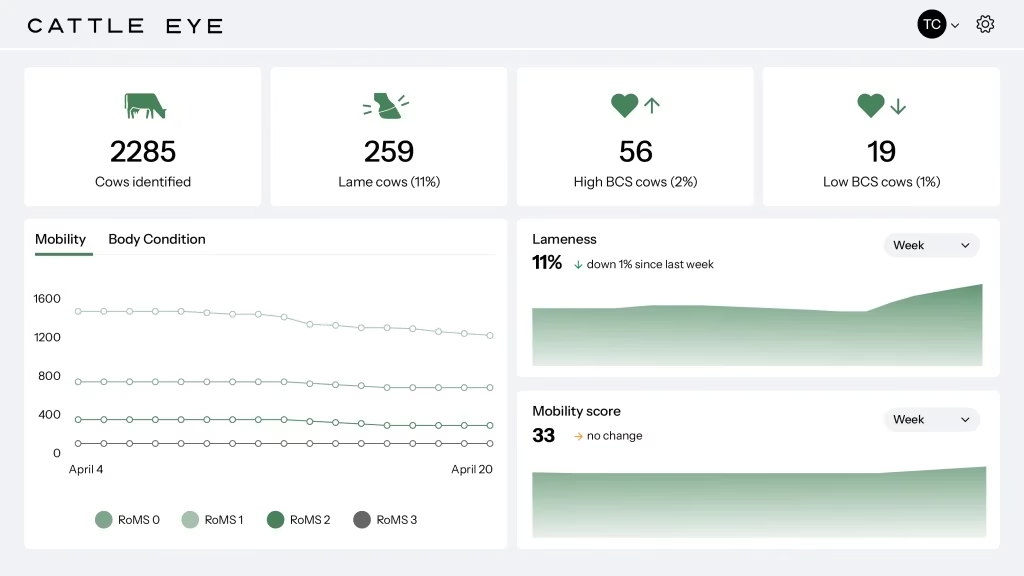
- Cross-platform dashboard: available on tablet and PC, with a full-herd view or a recently seen view, every column sortable and data export available.
- Integration with herd management software: identifiers, events and production data flow in both directions.
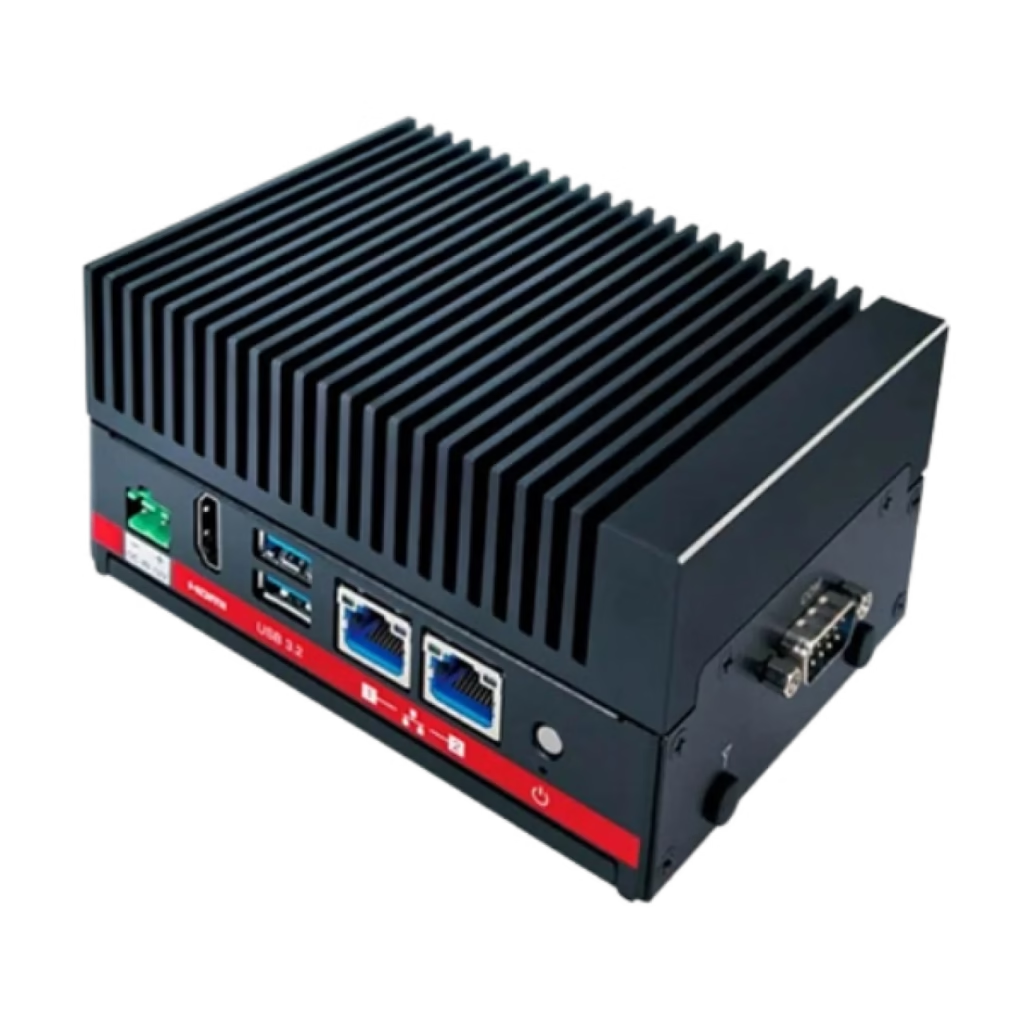
The tool also offers a local processing option, the Booster Box, a device installed on the farm that processes monitoring data without sending it to the cloud. It sits between the cameras and the network, needs no new cameras, and leaves the dashboard and existing integrations untouched. It gets scores through faster and lets farms keep footage on site. It addresses a limitation that has been there from the start: given the connection quality on many rural farms, the analysis never ran in real time, working instead with footage uploaded after milking and a report available the next day. Farms happy with their current setup have no reason to change it.
AI Capabilities
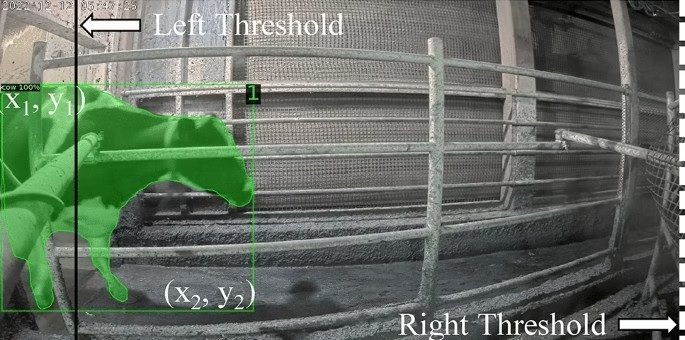
CattleEye applies computer vision and deep learning to two-dimensional video. The camera does not simply photograph the animal, the algorithm picks out key points on her body and reconstructs the mechanics of her movement each time she passes beneath the lens.
What the algorithm watches for. Detection does not hang on a single indicator but on several locomotion traits combined, which makes it more robust than any one of them alone:
- Back posture and arching, one of the most reliable indicators of pain, because an affected animal arches her back to redistribute weight.
- Movement asymmetry: differences in step timing or in how long each limb bears weight.
- Changes in stride length, duration and pattern.
- Head bobbing: abnormal vertical head movement in time with her steps.
- Where the hind hooves land relative to the front hooves.
- Walking speed, which drops when an animal is in pain.
Each pass also produces a body condition estimate, which feeds nutrition decisions and flags animals at risk of production loss.
The advantage of using this tool
The deepest contribution of this class of tool lies not in the power of the algorithm but in something far more basic: the camera watches the animal with nobody there. Cows mask lameness when someone is watching, and young animals with active, painful lesions tend to quicken their pace around people. An assessor, however experienced, changes the very thing they are trying to measure. Researchers put that forward as a hypothesis for a striking finding: on advanced-grade digital dermatitis, the system showed better sensitivity than human observers.
Traditional assessment asks whether the animal is lame today. Continuous monitoring lets you ask whether her mobility is shifting in a way that points to a problem ahead:
- Alert thresholds can be configured by group, so different criteria can apply according to stage of lactation.
- The system builds an individual baseline for each cow and picks up deviations from her own pattern, not from a herd average.
- Analysing trends accumulated over weeks improves lesion detection beyond what a one-off human assessment achieves.
- It registers mobility changes weeks before the animal reaches the trim at which the lesion turns up.
Why it matters for the sector. Lameness is one of the costliest and most poorly measured problems in dairy production, and the difficulty is not only economic: producers systematically underestimate how many animals in their herd are affected. Visual gait assessment, which carried the sector for decades, is subjective and varies between observers, eats time and labour, happens infrequently, and the animal herself distorts it through her own behaviour. That gap between real and perceived prevalence is what automation closes.
Animal welfare is where the technical and the ethical arguments meet. Lameness is painful, and its chronic form brings persistent pain, altered gait and lasting behavioural change: fewer lying-standing transitions, reduced feed intake, poorer social interaction within the herd. Research also notes that prolonged lameness is viewed as unacceptable by sector stakeholders and takes a toll on the morale of the staff working with the animals. Detecting earlier is not only profitable, it is the difference between a lesion that responds to treatment and one that leaves permanent structural damage to the tissue and bone of the hoof, with lower cure rates.
What this AI does not do
- It does not diagnose. It tells you an animal is probably lame, not whether the cause is digital dermatitis, a sole ulcer or something else. Clinical examination is still needed: this is a screening tool, not a substitute for veterinary judgement or for the hoof trimmer.
- It does not perform equally across all animals. Sensitivity is considerably lower in first-lactation cows, where it misses most cases. Human assessors fail much the same way in that group, so the problem lies with gait assessment in young animals rather than with the algorithm itself. Thresholds differentiated by parity are the available way to soften it.
- It does not depend on the user's language. It does not run on written instructions, it analyses video and generates scores and alerts.
- Detecting is not resolving. Without a defined protocol for who reviews the alerts, how often, and what happens next, the information changes nothing.
Integrations
Results are delivered on the dashboard or straight into the herd management software the farm already uses, and data export is included too.
The exchange runs both ways and goes deeper than a simple export of scores. CattleEye pulls in pen, parity, days in milk, reproductive status, the last recorded event relating to trims and hoof checks, days to dry off, and milk production, which arrives as a weekly average updated daily and respects whichever unit the farm works in, pounds, kilos or litres. Going the other way, it delivers its scores into the farm's preferred system.
One documented loop is worth knowing about: when the hoof trimmer uploads records from the All4Feet hoof care programme into Uniform-Agri, that data updates itself within CattleEye. It is the kind of integration that saves keeping the same records twice by hand.
Since CattleEye joined GEA Farm Technologies there has also been an ongoing integration with the group's herd management systems and with its Dairy Net app, announced in March 2026 alongside an investment in research and development.
Security & Data Compliance
The data controller is CattleEye Limited, based in Belfast. The company declares compliance with the European General Data Protection Regulation and with the retained UK version, in force since January 2021.
The policy sorts information into three categories. Raw data is what comes from the farm's IT systems, from third-party products the farm uses, from manual entry, and from the system's own components. Enhanced data covers human or machine interpretation of unstructured material, datasets combining raw data with the company's own data, and the parameters of mathematical models fitted or trained on the raw data. The third category is anonymised or aggregated data, which the company maintains holds no personal information.
The parameters of models trained on customer data fall into the enhanced data category, and the policy states outright that CattleEye is the controller of that category, of the artificial intelligence technology and of the analytics generated. Put plainly: farm data is used to fit and train models, and what comes out of that process sits on the provider's side.
The company acts as data processor when it carries out customer instructions, processes video and content uploaded by others, and responds to information requests. It acts as data controller for the technical information it generates, video analytics, herd insights, site usage, cookies, software updates, the retention and use of enhanced data and of its technology, hosting of the site, and the publication of testimonials and customer case studies. The farm is the controller of the raw data it uploads.
Recommendation: request the data processing agreement, the retention schedule and documentation on the international transfer framework before integrating any personal data. It is also worth asking for explicit clauses on the use of farm material to train models.
Language – Support & Interface
Official documentation, dashboard interface, and help resources are primarily in English. The tool supports several languages, Spanish and English among them. The translation is partial, and it is worth knowing where it stops.
AI Language – The Tool Itself
CattleEye's artificial intelligence does not run on written instructions and does not depend on the user's language. It analyses video to generate scores and alerts. Language comes into play only in the interface and the documentation.
Mobile Access
CattleEye Insights is a cross-platform dashboard suited to tablets and PCs.
One point about data availability deserves spelling out. The system does not run in real time. Footage is recorded locally during milking, uploads once milking finishes, and the report is produced the following day. The company's commercial director told the trade press that they are not aiming for instant analysis because the connection quality on many farms would not allow it. The optional local processing device can shorten that interval.
Support, Onboarding & Account Management
Installation is up and running within a day, with no wait for specialist engineers, and it fits the farm's existing setup. An initial period follows, during which the system learns to recognise each animal. With no collars or sensors to fit, the process is straightforward.
The help centre organises material into sections covering scientific evidence, customer stories, a set-up guide, walk-through videos and frequently asked questions. The videos cover the analysis feature for lameness management, modifying lame trim list criteria using advanced tags, a walkthrough of the body condition dashboard, getting started with trim management, tagging animals, and checking camera status with a live view. All of that material is in English.
The company has a dedicated customer success function and commercial teams in the United Kingdom and the United States, integrated into the GEA structure. Appoint an internal lead to validate camera placement, identifier mapping and the connection to the herd management software.
Ease of Use / UX
The physical requirements are worth checking before you go any further: electronic identification, enough height at the parlour exit, an unobstructed walking length for the camera's field of view, consistent lighting, and protection against dust and moisture. The lens needs periodic cleaning, and tie-stall systems are a harder fit.
Once running, the information sits in a dashboard with two ways in: a widget of animals recently seen and scored, and the full herd including dry cows. Every column sorts with a click, combining what comes from the herd management software with what CattleEye generates: mobility score, trend and change over recent weeks, one-week and two-week averages with their changes, how many times the animal has been scored, body condition and its trend, the historical proportion of scores above the lameness threshold, and her last pass under the camera. Customisable tags let you build your own lists.
Much of the company's training material goes on explaining why the columns should not be read literally. The simple mobility change comes from just two measurements and can mislead if her scores fluctuate. Before pulling a cow out for trimming, check how often she has been scored, because one measurement is not enough to act on. Two-week averages give more confidence and can point to chronic lameness or a treatment that is not working. And the historical proportion column, as the instructor himself warns, should be taken with a pinch of salt: a newly arrived animal with few measurements above the threshold shows the highest possible figure without being a chronic case at all.
The tool, in other words, does not hand you a list to obey but a dashboard that demands judgement. For a dairy SME without its own vet or data manager, that means a real learning curve, made steeper by the resources being in English.
Pricing & Plans
There are no officially published rates. The service is contracted after a demonstration, with a quote tailored to each farm. The British trade press has reported a model combining a monthly subscription per animal, discounted for larger herds, with an initial equipment cost; that figure predates the company's move into GEA and is best treated as a historical reference rather than a current price.
The company offers a public calculator that estimates what lameness costs the farm, not what the tool costs. It asks for herd size, current prevalence, daily cost per affected animal with an adjustable value, target prevalence and expected reduction in days lame per case, and it calculates in pounds, dollars and euros. It is conditional on handing over personal details, phone number included, so it doubles as a lead generation tool.
For an SME, the profitability calculation should weigh three elements that commercial material does not always put side by side. First, the benefit: lower prevalence of severe and chronic cases, better hoof health, and less production loss along with it. Second, an operating cost documented in peer-reviewed research: the system generates more foot trimming sessions, because it is calibrated to favour sensitivity. Third, a caveat the company itself made to the trade press: until a farm has a couple of years of use behind it, seasonal trends are difficult to compare, and part of the variation in prevalence comes down to animals with persistently poor mobility being worked out of the herd.
Case Study
Moreton Farm is a dairy farm in Wrexham, North Wales, already working with structured hoof health protocols and a trusted hoof trimmer. The obstacle was not the protocol but the limit of human observation across a large herd: an animal can walk with a subtle change in gait for days before anyone notices, and by the time she is pulled for treatment the condition may already have progressed.
The farm brought in CattleEye as part of the Farming Connect Healthy Feet Programme, a Coleg Cambria-supported initiative to reduce lameness across Welsh dairy herds. Working alongside that programme and a structured trimming schedule, it achieved a reduction in sole ulcers between two consecutive calving seasons, a result validated through the Farming Connect trial.
The mechanism explains more than the headline: ulcers caught at the subclinical stage, when the animal is only beginning to shift her weight or alter her stride, respond far better to treatment. It is shorter, recovery is faster, and she is back at her usual production level sooner.
Lewis Jones, of Moreton Farm, sums it up this way: "One of our focuses over the last year has been to improve the early detection of lameness through the installation of CattleEye, a validated automated lameness detection system. Alongside implementation of the Healthy Feet Programme and working closely with our foot trimmer, we've seen a huge improvement and have dramatically reduced sole ulcers."
This is not a technological transformation but something more replicable: a farm already managing well that wanted to manage better, adding objective daily data to a programme that was already sound. CattleEye does not replace the hoof trimmer or the vet, nor the producer's own knowledge of the herd; it reaches where manual observation cannot.
The case was published by CattleEye, not by an independent assessor, though the result was verified within the Healthy Feet Programme. You can read the full case study here.
CattleEye vs Alternatives
Across agricultural technology, solutions dedicated to autonomous livestock monitoring through computer vision are thin on the ground. Most recognised platforms point towards crops, agronomic data or business planning rather than animal behaviour and health. Some of the alternatives out there start from a different premise: collars on the animal and grazing management out in the field.
| Aspect | CattleEye | Halter |
| Main focus | Mobility and body condition at the milking parlour exit | Virtual fencing, remote herd movement and pasture management |
| Device on the animal | No, fixed camera | Yes, collar plus towers in the field |
| Species | Dairy cattle | Cattle only, dairy and beef |
| Lameness detection | Core function, validated in peer-reviewed research | Not a specific function; continuous behaviour monitoring for early detection of health problems |
| Pricing | Not public | Not public |
| Confirmed markets | United Kingdom, Europe, United States and Australia | New Zealand, Australia and the United States |
The comparison makes one thing clear: these are not options competing over the same problem. Collar systems handle herd management out in the field and pick up health changes indirectly, while CattleEye works at the point the animal walks through every day anyway and measures gait specifically. They are not mutually exclusive, either. In one randomised controlled trial, the farm used neck-mounted accelerometers for heat detection while the camera system handled mobility. For a dairy farm with a milking parlour, the question is not which of the three to choose but which part of management needs solving first.
FAQs
Is CattleEye a good tool for SMEs?
Yes, on two conditions: that the farm meets the physical installation requirements and has electronic identification, and that the team can work with documentation in English. It automates scoring and prioritises interventions, backed by peer-reviewed research.
Does CattleEye use my data to train models?
Yes. The privacy policy places the parameters of models trained on customer data within the enhanced data category and states that the company is the controller of that category. Ask for explicit clauses on this point in the data processing agreement.
Does it detect lameness equally in all animals?
No. Research documents considerably lower sensitivity in first-lactation cows, a limitation that affects human assessors too. Thresholds that can be configured by group allow it to be partially mitigated.
What is needed to install it?
Electronic identification of the animals, enough height at the parlour exit, a clear stretch of walking length, adequate and consistent lighting, and a connection to upload the footage after milking.
Still weighing up CattleEye?
See how it compares with the other tools we've reviewed in AI for Agriculture.