
Tidio Lyro AI: AI Customer Service Agent for SMEs
Lyro AI is Tidio’s conversational agent, part of a US-based B2B company specializing in customer service automation. It integrates into Tidio’s main platform and enables businesses to offer automated support through generative artificial intelligence, without requiring any coding or programming.
Unlike traditional chatbots, this AI agent doesn’t rely on rigid flows: it learns directly from the content the company provides (such as their website, FAQs, or support articles) and uses that knowledge to deliver natural, reliable responses that always align with the brand. It also features automatic language detection and instant human handoff when a query exceeds its response capabilities.
AgentAya Verdict: Tidio Lyro AI
Lyro AI is a conversational agent that combines advanced generative technology with a 100% secure, business-focused approach. Designed for small teams and medium-sized businesses, it stands out for its immediate learning capability, no-code configuration environment, and native integration with Tidio’s ecosystem (live chat, automations, sales flows, analytics, and omnichannel support).
Lyro is especially useful for companies wanting to offer 24/7 support without increasing headcount. The AI responds to queries about orders, policies, or product availability in seconds, with a resolution rate of around 67% according to performance data published by Tidio.
However, its controlled approach (based on internal data, not public information) means Lyro doesn’t improvise or generate responses outside available knowledge. This makes it more secure and consistent, though less flexible than other open systems.
Score Breakdown
| Category | Score | Description |
| Features and Functionality | 4.5 ⭐⭐⭐⭐⭐ | Generative AI agent, machine learning, intelligent actions, human handoff |
| Integrations | 5.0 ⭐⭐⭐⭐⭐ | Connection with Shopify, Zendesk, Salesforce, HubSpot, Messenger and more |
| Language and Support | 4.5 ⭐⭐⭐⭐ | AI in 48 languages; interface in 6 languages; direct support primarily in English |
| Ease of Use | 5.0 ⭐⭐⭐⭐⭐ | No-code activation and guided configuration |
| Value for Money | 4.0 ⭐⭐⭐⭐ | High operational efficiency with scalable plans and free trial |
AgentAya Overall Score: ⭐⭐⭐⭐ 4.6 / 5
Lyro AI represents an outstanding balance between automation, security, and accessibility for small and medium businesses seeking a reliable, easy-to-manage AI agent.
Ideal for
- SMEs and startups providing intensive customer service
- Small teams needing automated support without technical knowledge
- E-commerce on platforms like Shopify, WooCommerce, or WordPress
Not ideal for
- Companies requiring extreme customization of style, metrics, or dashboards
- Organizations seeking creative AI open to multiple external sources
- Users needing permanent technical support in their native language (Tidio’s direct support is offered primarily in English)
Tidio Lyro AI Key Features
- Automated no-code chat: Lyro learns directly from FAQs or knowledge base.
- Human escalation: Can automatically transfer conversations to agents when detecting complex queries.
- Multichannel: Manages chats from website, social media, email, and messaging from a single panel.
- Unified panel: Allows reviewing and responding to all conversations from a centralized inbox.
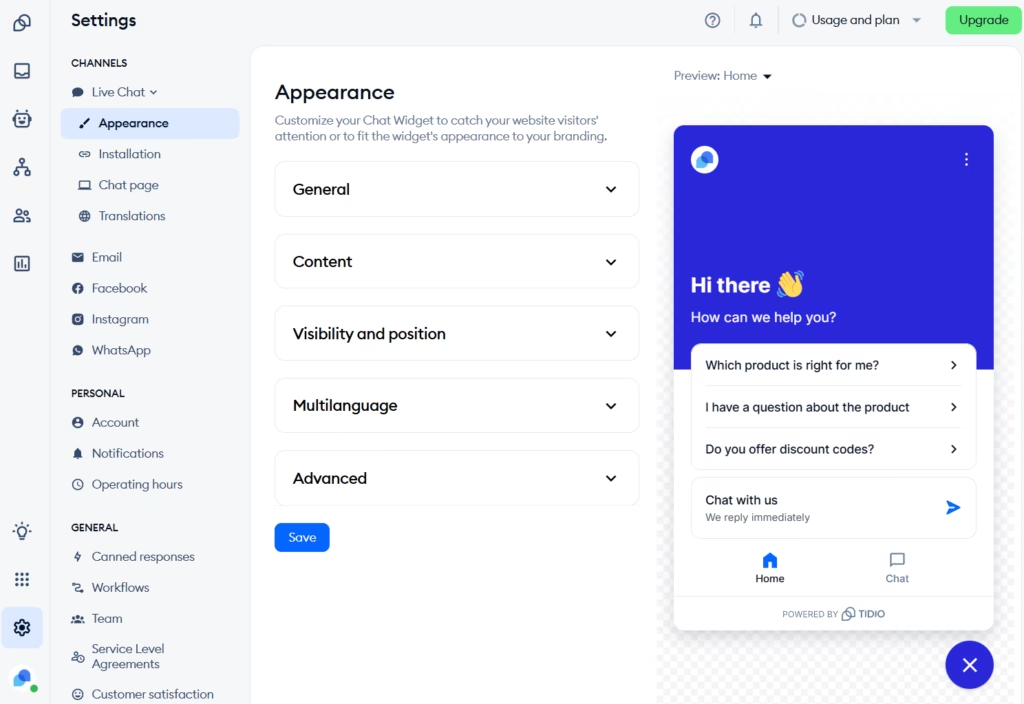
- Visual customization: The chat widget can adapt to brand style and colors.
- Integrated analytics: Offers metrics on response time, resolved conversations, and agent performance.
These features help SMEs reduce response time and increase customer satisfaction, freeing resources for more strategic tasks.
AI Functions
Lyro AI uses generative models optimized by Tidio to understand user intent and respond based exclusively on your company’s content. It answers only when it has enough confidence in its response: if a query touches a topic that is not in the knowledge base, it does not improvise or search the web, but may ask for more detail, give a partial answer, or state that it does not have the information and pass the conversation to a human agent. Its interactions are often hard to distinguish from human support, though you can choose to tell customers they are chatting with an AI-powered assistant.
Its intelligence rests on three key capabilities:
- Semantic understanding: detects the intent and context of each query.
- Continuous learning: improves with real interactions and with the content you add to its knowledge base.
- Smart routing: identifies when a query should go to a human agent, with escalation rules you can set by topic or keyword.
Beyond answering, Lyro can carry out tasks through Lyro Smart Actions, with no human intervention:
- Orders: check status in real time, change the delivery address on pending orders, start returns and generate return labels, and verify product availability.
- Sales: qualify leads, route them to your CRM, schedule meetings, and trigger follow-up email sequences.
- Accounts: update customer details, manage subscriptions and payment methods, run secure password-reset workflows, and update communication preferences.
For deeper connections, Lyro supports the Model Context Protocol (MCP): instead of wiring up single endpoints, you connect Lyro once to a system (a CRM, billing platform, or database) and it can use every tool that system exposes, with real-time access to context such as CRM notes, past tickets, and subscription status. Every external call is scoped, authenticated, and auditable.
Lyro also works over email, scanning incoming messages and resolving common issues automatically; on email it applies additional confidence controls and only responds when it is sure it can help. For online stores, it connects to the store’s inventory and pulls the full catalog in real time to make product recommendations based on what you actually sell.

Integrations
Lyro AI integrates natively with a wide range of platforms, grouped by category:
- Ecommerce: Shopify, WooCommerce, BigCommerce, Adobe Commerce, Shopware, and Ecwid.
- Website builders: WordPress, Joomla, and Drupal.
- CRM and sales: HubSpot, Salesforce, Microsoft Dynamics 365, Zoho CRM, Pipedrive, Agile CRM, Copper, Odoo, Follow Up Boss, Freshsales, and GoHighLevel.
- Email marketing: Mailchimp, Klaviyo, Brevo, MailerLite, Marketo, and ActiveCampaign.
- Messaging and social media: WhatsApp, Facebook Messenger, and Instagram.
- Help desk and email: Zendesk, Intercom, Freshdesk, and Gmail.
- Analytics and advertising: Google Analytics, Google Tag Manager, Google Sheets, and Google Ads.
- Workflow automation: Zapier and Integrately.
- Collaboration and project management: Microsoft Teams, Discord, and Jira.
- AI: use of a custom GPT inside live chat through ChatGPT.
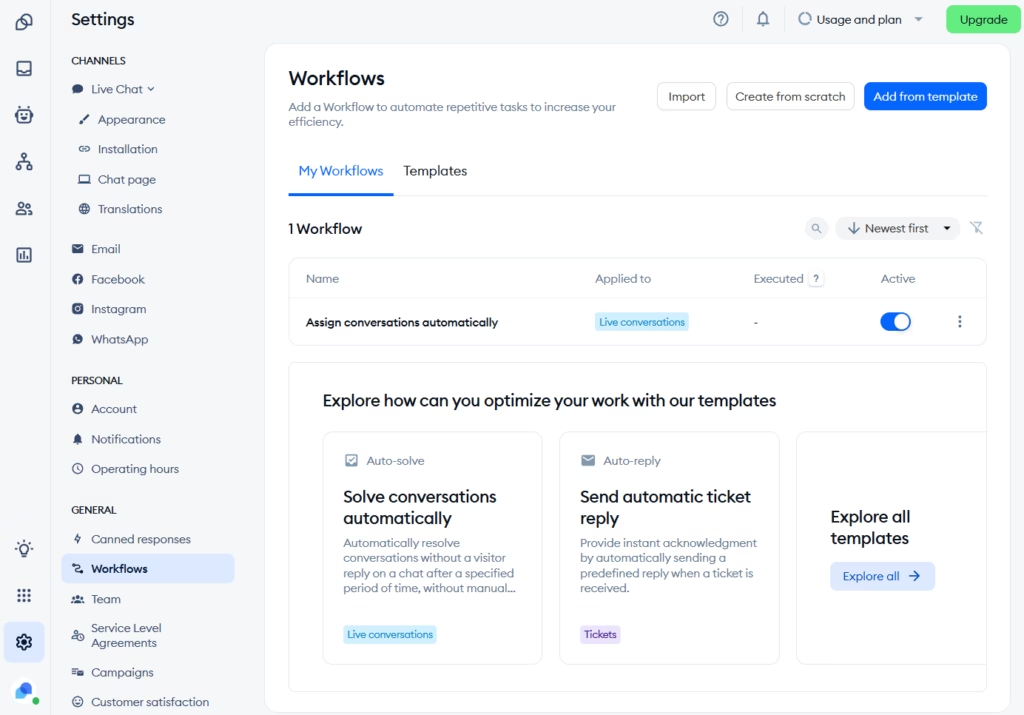
Tidio also offers an open API (OpenAPI) and an SDK to connect virtually any external system. Through Lyro Connect, the agent can be added on top of existing help desks such as Zendesk, Intercom, and Salesforce, along with more than twenty other platforms and without migrating (available with Tidio Premium). For custom needs, integration can be done through REST APIs, webhooks, JavaScript actions, or the Model Context Protocol (MCP).
Security and Data Compliance
Tidio keeps data ownership in the user’s hands, and conversations processed by Lyro are never shared with third parties or used to train external AI models. The platform is also transparent about its sources: every answer shows exactly which content it drew from, so you can verify accuracy and update the knowledge base whenever something changes. Lyro only searches each company’s internal knowledge base, not Google or social networks, which makes it more secure and predictable.
On the infrastructure side, data is encrypted in transit (TLS) and at rest, backups are encrypted, and passwords and credentials are stored as strong hashed values. The platform runs on AWS, has completed a SOC 2 examination, and follows PCI-DSS rules for secure payments through Stripe. Personal data is handled in line with both GDPR and CCPA.
Accounts can be protected with multi-factor authentication (2FA), and a Roles and Permissions system lets you control what each panel user (project owners, administrators, agents with limited access) can see or do. When Lyro connects to external systems through MCP, every call is scoped, authenticated, and auditable. For organizations that need it, a fully custom AI agent is available with SOC 2 and HIPAA compliance.
Language – Customer Support and Interface
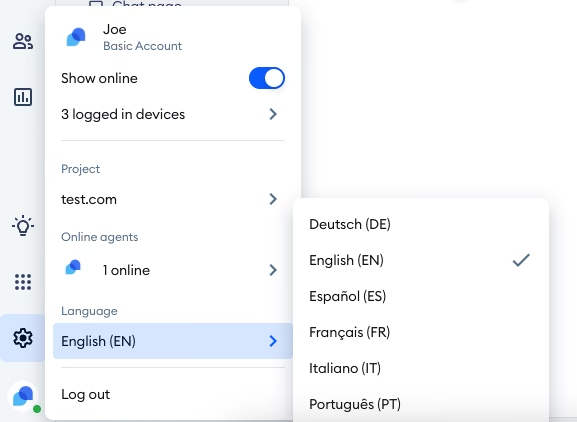
Tidio’s admin panel can be displayed in six languages: English, German, French, Spanish, Italian, and Portuguese, so agents can work in their preferred language. Each agent selects the panel language individually from their own account.
Regarding support, Tidio keeps English as its primary communication language. Some resources, such as the Help Center, blog, and support chat widget, are presented mainly in English. Email and live chat support are available around the clock on weekdays, with a stated average response time of about one minute.
AI Language – The Tool Itself
Lyro AI can understand and respond in 48 supported languages, covering major European languages (English, Spanish, French, German, Italian, Portuguese, and Brazilian Portuguese, among others) as well as languages from Asia, the Middle East, and other regions.
Lyro works natively in the customer’s language rather than translating internally to English first, which results in more natural and accurate communication. Data sources such as FAQs, uploaded website content, and knowledge base articles are processed directly in their original language, preserving product names, tone, and links. For example, if a customer asks “What is the status of my order?” in their own language, Lyro detects the language, searches the knowledge base in that language, and replies in it. If another customer writes in a different language, Lyro answers in that one, all without configuring a separate bot per language.
Tidio lets you customize which languages Lyro uses. In the configuration you can enable all supported languages or restrict Lyro to a specific subset (for example, only English and Spanish). You can also set a default language, which acts as a fallback when a customer writes in a language that is not enabled: in that case, Lyro clearly states it does not support that language and switches to the default. With Lyro Guidance you can even instruct Lyro to use a particular register within a language, such as informal rather than formal German.
Mobile Access
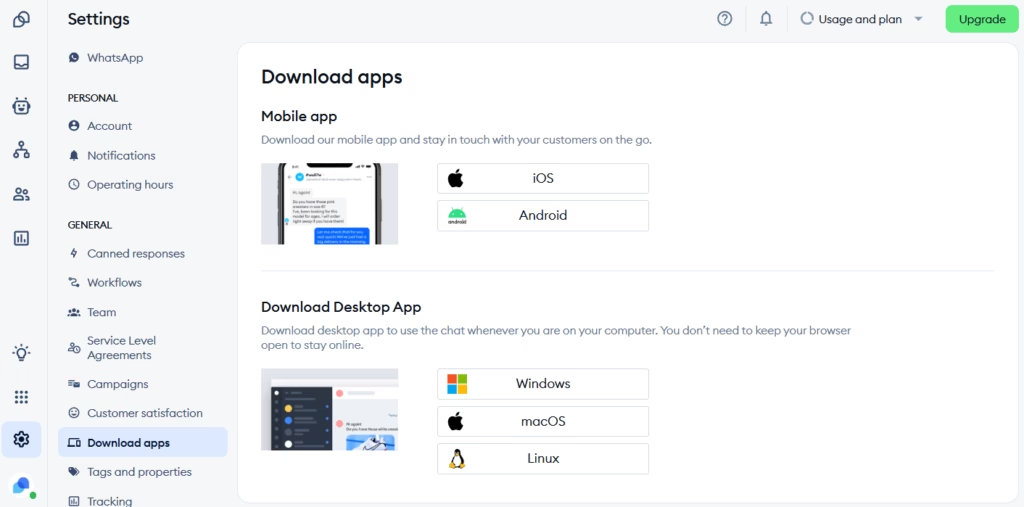
Tidio has mobile applications for iOS and Android, plus a fully responsive web version. From mobile you can manage chats, review tickets, and access metrics, though certain advanced functions (like flow editing) work better from desktop.
These mobile applications have all the necessary functions to keep you in touch with your customers. You can manage all communication channels from the palm of your hand.
Additionally, Tidio also provides desktop applications for Windows and macOS and a browser app, so you can manage conversations from any device. A Mobile SDK is available on the Premium tier for embedding support inside your own mobile app.
Support, Onboarding Process, and Account Management
Lyro AI includes onboarding materials with video tutorials and an official YouTube channel. In their help center you can find guided documentation, ebooks, and interactive articles. New users can activate the agent in less than 10 minutes thanks to a step-by-step configuration wizard.
Tidio’s team offers fast technical support and customer success programs for clients with higher plans, making it suitable even for SMEs without previous software experience.
Tidio also offers a testing area (Playground) where you can see how Lyro answers based on the content you have shared before going live. For agents, a free Copilot Chrome extension suggests AI-powered replies inside your existing help desk.
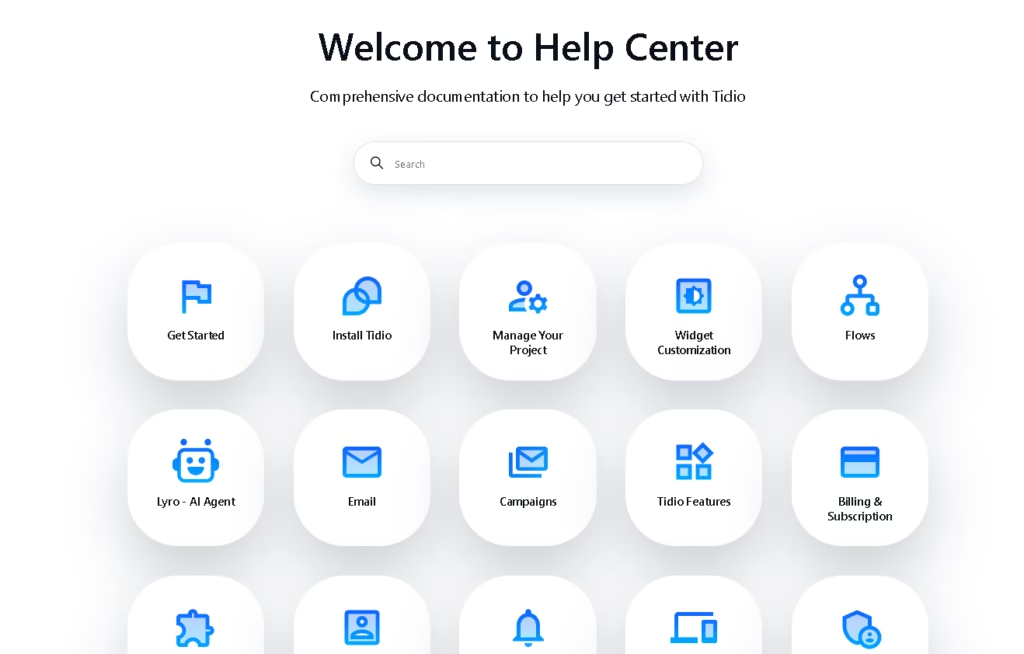
Ease of Use / UX
Tidio’s design is clean, intuitive, and modern. The main panel groups all conversations and configurations in a clear interface.
Lyro AI can be configured without programming knowledge, allowing you to obtain real value in a matter of hours. For small teams, this ease translates to immediate productivity and virtually zero learning curve.
Price and Plans
Lyro AI is part of the Tidio suite, which combines the AI agent with the help desk, live chat, and Flows. The plan structure is as follows:
- Free: a no-cost starting point with basic live chat and ticketing; it includes a one-time allowance of 50 Lyro AI conversations (free for life), a first Action at no charge, and an initial allowance of visitors reached through Flows.Starter: brings all customer conversations into a single tool and adds smarter support features.
- Growth: adds advanced analytics, user permissions, automatic chat assignment, autoresponder, and macros.
- Plus: adds premium support, a dedicated success manager, discounted usage rates, departments, multiproject, custom branding, and OpenAPI, with custom billable conversations.
- Premium: built for higher volumes, with a guaranteed 50% resolution rate, billing per resolution, a Mobile SDK, custom analytics, advanced Copilot, Lyro AI as a managed service, SSO, compliance, and Slack support.
Lyro is also available as a standalone product that can be added on top of Zendesk, Salesforce, or another help desk, priced by the number of AI conversations. Every plan lets you use Lyro AI, and the monthly conversation limit can be raised from 50 up to 1,000; the main difference between tiers is the volume of automated conversations included. A 7-day free trial also unlocks premium features. Because pricing scales with usage, value grows with volume, since Lyro resolves on average around 67% of repetitive queries according to data published by Tidio.
Case Study
Gecko Hospitality, a US recruitment company in the hospitality industry founded in 2000, with a presence across more than 50 US states and Canadian provinces, implemented Lyro AI together with Tidio’s Flows to answer questions and collect candidate and client information around the clock. Using a segmentation flow based on two questions, the company automatically routes each resume to the best-suited recruiter and gets applications into the right inbox in as little as 90 seconds, which amounted to a 99.9% reduction in the time taken to send a CV to the recruiter. According to Max Sealey, the company’s Support Services Manager, about 90% of conversations are handled by Lyro, and its responses are audited daily to ensure accuracy.
In its first six months of use, Gecko Hospitality collected more than 257 leads through chatbots alone, thanks to the lead generation flow set up on its website. Sealey also noted that his main concern, AI hallucination, proved unfounded, since even deliberate attempts to make Lyro provide false information were unsuccessful. You can read this case study and more here.
Tidio Lyro AI vs Alternatives
| Feature | Lyro AI (Tidio) | Intercom (Fin) | Zendesk |
| Main Focus | No-code automated support for SMEs | AI agent (Fin) plus a unified helpdesk; multichannel | Mature ticketing suite with built-in AI |
| Learning Curve | Very low | Medium | Medium-high |
| Initial Cost | Accessible for SMEs | Moderate to high; billed per resolution (per outcome) | High; automation billed per resolution |
| Native Integrations | Shopify, WhatsApp, Messenger, Instagram | Salesforce, HubSpot, Shopify, WhatsApp, Slack | 1,200+ integrations (Salesforce, Jira, Shopify, Slack, WhatsApp) |
| Automation Level | Around 67% of repetitive queries resolved | Around 66% average resolution rate | Resolution-based automation across the ticketing suite |
| Ideal for | Small or medium businesses expanding | SaaS and e-commerce SMEs with an existing knowledge base | Teams already on Zendesk that need to scale support |
In summary, Lyro AI offers faster and more economical implementation, while Intercom and Zendesk deliver a broader, more mature feature set. All three lean on resolution-based value, so the right choice depends on your existing stack and support volume.
Related Tools
| Tool | |
|---|---|
 | |
 | |
 | |
 | |
 |
FAQs
How can Lyro AI help increase sales?
It enables answering questions in real-time, offering product recommendations, and recovering potential customers through automated chats.
What is the return on investment (ROI) when using Lyro AI?
The return is measured in customer satisfaction, team time savings, and higher sales conversion thanks to automation.
How does Lyro AI work?
It centralizes conversations from chat, email, and social networks. It learns from company content and responds automatically or routes to a human depending on complexity.
Can Lyro AI adapt to my brand’s style?
Yes. You can customize the chat widget, the AI’s voice, and base content to reflect your business identity.