

Edge Impulse Review
One of the go-to platforms for edge AI and TinyML, capable and backed by an excellent free plan.
Edge Impulse takes on something hard and pulls it off: it trains an AI model and fits it inside a chip with only a few kilobytes of memory. The whole thing runs in a browser-based flow that walks you from data capture to a model ready to deploy, step by step. If you're an embedded systems engineer and machine learning isn't your strong suit, it shortens the learning curve dramatically.
For an SME, the upside is clear: a powerful free plan for prototyping at no cost, compatibility with hardware from plenty of manufacturers (the ESP32 included), and AI that runs on the device, which trims the cloud bill. However, you need to understand what a sensor is and what you want to detect. If your business doesn't touch hardware, this isn't your starting point. But for hardware SMEs, agritech, wearables, or industrial maintenance, it's an excellent way to bring AI to the device.
Averaged from the breakdown below
- Hardware SMEs that build sensors, IoT devices, or products with microcontrollers such as the ESP32.
- Agritech or environmental monitoring companies that need local detection without a constant internet connection.
- Industrial maintenance teams looking to detect anomalies through vibration or sound right on the machine.
- Systems engineers with little machine learning experience who want to reach a working model fast, or anyone exploring edge AI with low-cost boards.
- Generalist or service SMEs with no technical profile and no hardware work.
- Anyone after general-purpose AI along the lines of a conversational assistant (Edge Impulse isn't that).
- Projects that call for very large models that won't fit on an edge device and inevitably depend on the cloud.
Key features
- Sensor data capture and visualization to build high-quality datasets, with flexible ingestion and a way to flag data quality issues.
- A tracking dashboard that lets you monitor project performance over time and see how changes in the data affect model accuracy.
- Signal processing with feature extraction (DSP) algorithms to tune on-device performance.
- Machine learning model training from the browser, with the option to accelerate with a GPU.
- Model testing against real data to catch bottlenecks before you deploy.
- Optimization through proprietary tools such as the EON Tuner (which balances memory, latency, and accuracy) and the EON Compiler.
- Export of the trained model as a C++ library or an Arduino library, among other options.
- A "Bring Your Own Model" (BYOM) feature for importing models already trained in formats such as TensorFlow Lite, ONNX, or TensorFlow SavedModel.
- Anomaly detection, object detection on microcontrollers (FOMO algorithm), gesture recognition from accelerometer data, keyword spotting by audio, and image, audio, and motion classification.
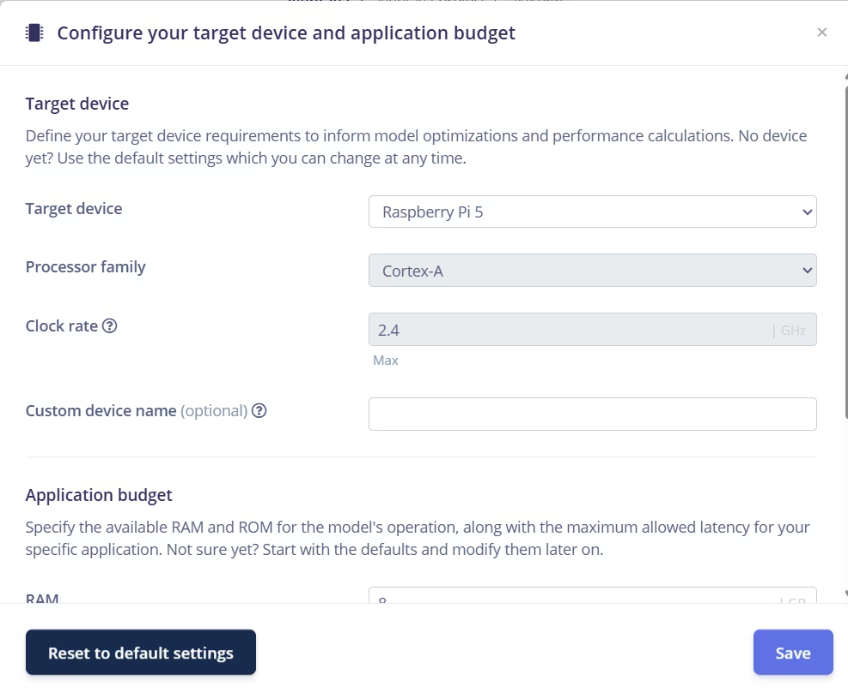
- Definition of the target device and of an application budget (RAM, ROM, and maximum latency) that steers the optimizations and estimates memory usage and processing time before you deploy.
The platform is organized into three products: the Edge AI MLOps platform (the core for building, training, and deploying models), the Visual Inspection Suite (a computer vision solution for industrial quality control), and a library of demos for exploring use cases.
With this tool, work that might otherwise take months of in-house development comes together in days. And since the result runs on the device itself, the business sidesteps much of the recurring cost of cloud servers.
AI features
- Automatic model generation and optimization, tailored to the memory and latency constraints of the target device.
- AI-assisted data labeling to speed up preparing image sets.
- Synthetic data generation (through the NVIDIA Omniverse integration) to make models more robust.
- Real-time object detection on microcontrollers with the FOMO algorithm, up to thirty times faster than MobileNet SSD and able to run in under 200 KB of RAM.
- Anomaly detection with models trained on "normal" data alone, able to flag unexpected signals right on the device.
What's genuinely "intelligent" here isn't just that it trains models, which plenty of tools do, but that it adapts and compresses them to run on tiny hardware without giving up much accuracy. One example of that optimization is the EON Tuner, which automatically hunts for the best balance between feature extraction algorithms and model architectures within a memory and latency budget.
Integrations
- A Python SDK for automating training and deployment.
- APIs and a CLI (command-line interface) for slotting into existing workflows.
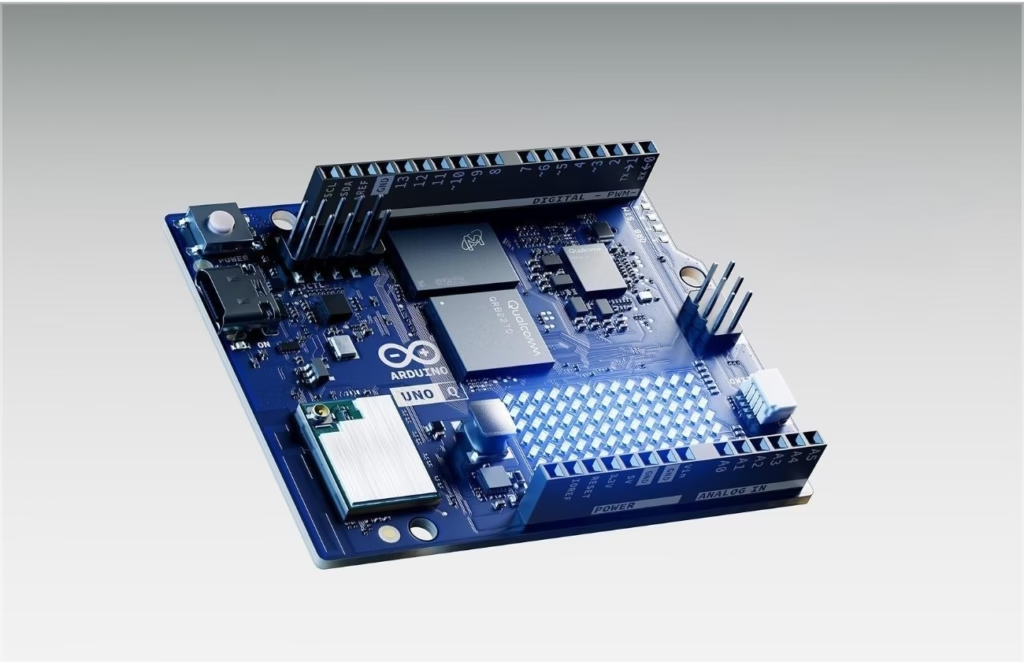
- Native Arduino integration (including the Arduino App Lab environment).
- Integration with Qualcomm (Dragonwing, AI Hub) and with NVIDIA (Jetson, Omniverse).
- Pre-trained NVIDIA models available within the platform.
- Broad hardware compatibility: microcontrollers, gateways, sensors, cameras, and Docker containers.
The platform supports the ESP32 explicitly, through the ESP32-based Espressif ESP-EYE board. Edge Impulse also offers complete APIs, above all on the Enterprise plan.
If you're going to deploy on an ESP32 and use the Arduino integration, it pays to keep the chip's own limits in mind. Memory is tight (up to 520 KB of RAM in the standard versions), so large models or libraries need external memory (microSD). On connectivity, the 2.4 GHz band gives you more range but less speed, while the 5 GHz band (in variants such as the C5/C6) delivers more bandwidth with less penetration. Always-on devices need constant power or higher-capacity batteries, and custom firmware can open up vulnerabilities if you don't set it up properly.
For commercial applications, it's worth weighing the specialized variants: the ESP32-S2 (dedicated cryptographic security), the ESP32-S3 (AI and image processing), or the ESP32-H2 (Zigbee/Thread for advanced home automation).
Data security and compliance
Edge Impulse calls security a core priority and holds SOC 2 Type 2 certification, an annual audit that an independent third party runs under the American Institute of Certified Public Accountants (AICPA) framework; the annual reports are available on request. That's a meaningful signal for any SME handling sensitive sensor or production data.
The Enterprise plan includes user management tools that let administrators set appropriate permissions and access levels. The platform offers multi-factor authentication (MFA) as an option and a "secrets" system for storing sensitive data such as API keys. As a Qualcomm company, it follows that organization's privacy and responsible AI policies.
Language – Customer support and interface
The developer plan leans on the community forum and the English-language documentation; the Enterprise plan adds dedicated email tickets, an assigned solutions engineer, and a guaranteed 24-hour first response time on business days. The community is active, with a forum, Discord, and GitHub.
The documentation and interface are in English. The help assistant built into the documentation is multilingual.
AI language – The tool itself
Edge Impulse's AI doesn't rely on natural language. It isn't a chatbot you instruct in Spanish or English; it's a platform that works with sensor data (signals, images, audio, vibration, motion). The models learn from the data the user collects, no matter what country it comes from.
Mobile access (iOS, Android, Other)
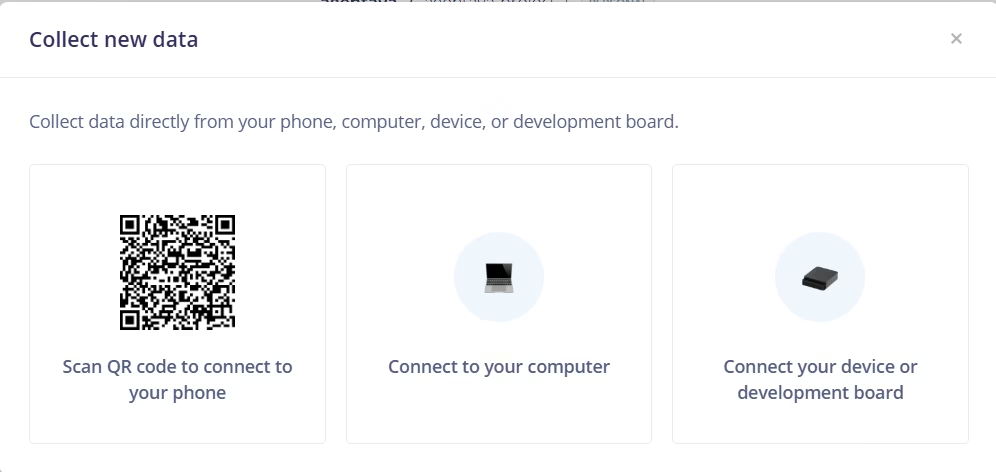
Edge Impulse is fundamentally a browser-based platform, meant to be used from a computer. It does put the phone to work as a data-capture tool: scan a QR code and the phone connects to the project to gather images, audio, or motion through its camera and sensors.
Support, onboarding, and account management
Onboarding is well covered, with thorough materials: getting-started guides split by profile (beginners, embedded systems engineers, and machine learning practitioners), a deep collection of tutorials, community projects, sample datasets, and courses such as "Edge AI Fundamentals" and "Introduction to Embedded Machine Learning."
The free plan already gives access to complete tutorials on: keyword spotting (creating your own voice command from just a minute of audio), gesture recognition with the accelerometer, and object detection with images.
The Enterprise plan offers a dedicated solutions engineer and even an expert-led trial (a 10-to-20-hour proof of concept alongside a solutions engineer) to validate a use case before you commit resources. An SME with limited technical experience can put the platform in place, but it takes time: the assistant guides the first steps, though a basic grasp of electronics and data helps.
Ease of use / UX
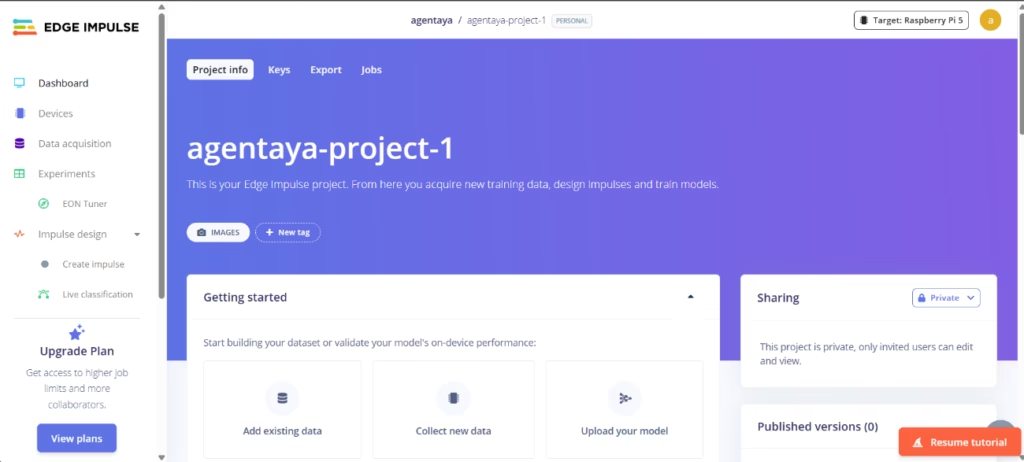
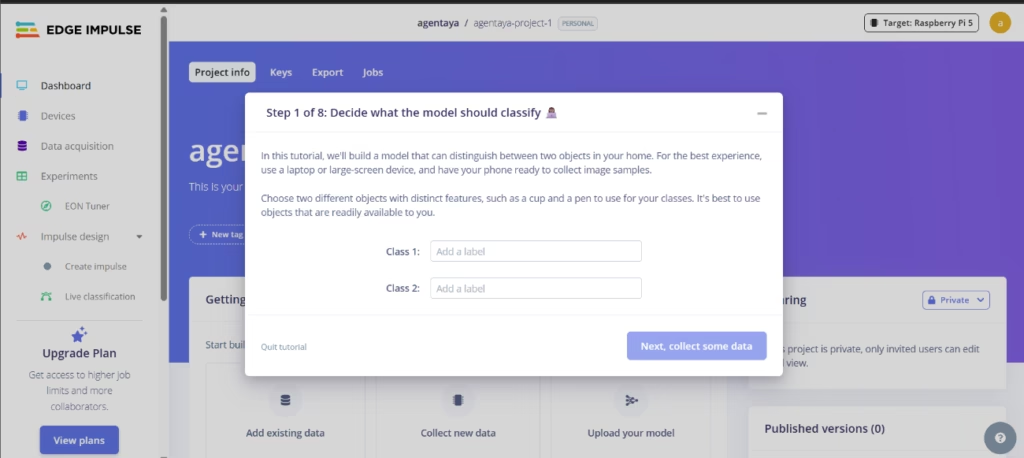
Edge Impulse's browser interface (called Studio) is well organized and walks the user through the stages of those first projects: data acquisition, designing the "impulse," training, and deployment. The platform suits every profile: beginners can follow step-by-step instructions to start from scratch, while experienced engineers get the tools to build, profile, and deploy complex models, wire them into their hardware, and extend the platform with SDKs, custom blocks, or the API. That dual track, with tutorials and assistants from the very first login, takes the edge off what could feel like an intimidating tool.
Pricing and plans
Edge Impulse offers two main plans. The developer plan is free, with no credit card required, and targets individual developers, students, universities, hobbyists, and engineers who want to experiment and prototype on a complete platform. The Enterprise plan, priced to fit, is aimed at organizations that need to scale from prototype to production; it includes robust dataset management, integrations with the major cloud providers, dedicated technical support, custom-block capabilities, and full API access for automation.
For an SME, the value proposition holds up well: the free plan is enough to take a prototype to something functional without spending, which lowers the risk on the upfront investment. The platform even offers a return-on-investment (ROI) calculator to compare using Edge Impulse against traditional in-house development. The jump to the paid plan comes when the project needs to scale, collaborate as a team, or automate production processes.
Case study
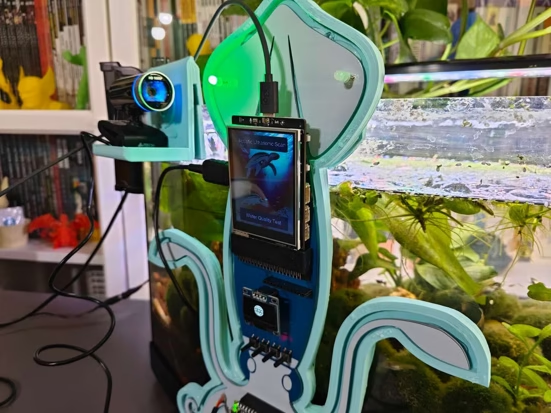
A concrete example of the platform's reach is a water pollution detection project built by the creator Kutluhan Aktar. The goal was to spot toxic air bubbles built up in the underwater substrate (a possible pollution indicator) and to gauge water quality, which is especially useful for aquaculture and fish farms, where a sudden shift in water quality can trigger devastating financial losses.
The project used an Arduino Nano ESP32 board (which carries an ESP32-S3-based module) to generate ultrasound images of the bottom of an aquarium and run a neural network model on it, trained in Edge Impulse with a Ridge classifier that could tell two states apart: "normal" and "bubble." The model ran as an Arduino library directly on the device, with no reliance on the cloud. According to the performance metrics Edge Impulse reports (profiled on a Cortex-M4F target at 80 MHz), the model reached an inference latency of just 2 ms, with peak usage of 2.6 K of RAM and 19.9 K of flash, and 100% accuracy on both the validation set and the test set, the latter down to the modest number of samples. The case captures the promise of TinyML well: real intelligence running on a low-cost chip, working on its own and offline. You can find all the details on the case here.
Videos
Edge Impulse vs Alternatives
Edge Impulse and the NVIDIA EGX Platform compete in the same category, edge AI, while Circuit Mind handles a different, complementary stage of the same hardware project.
| Tool | Category | Pros | Cons |
|---|---|---|---|
| Edge Impulse | Edge AI / TinyML (runs AI on the device) | Powerful free plan; support for the ESP32 and tiny microcontrollers; covers the whole process on a single platform | Documentation and support in English only; takes a technical foundation |
| NVIDIA EGX Platform | Edge AI (enterprise scale, GPU) | Enormous power for real-time video and data; scalability; top-tier support | Built for heavy enterprise infrastructure, not low-cost microcontrollers; overkill for a typical SME |
| Circuit Mind (ACE) | AI-assisted electronic design (complementary, not competing) | Automates component selection, the schematic, and the hardware bill of materials | Doesn't run AI on the device; no Spanish localization or public pricing; built for professional hardware teams |
The NVIDIA EGX Platform is the alternative within the same category of edge AI solutions (edge AI). The practical difference from Edge Impulse comes down to scale: EGX lives on powerful servers and gateways, whereas Edge Impulse reaches all the way down to the smallest microcontroller. For an SME that wants to add AI to an ESP32 device, Edge Impulse is the right-sized option; EGX would be too much.
Circuit Mind complements Edge Impulse. It's a London-based platform whose AI (called ACE, Assistant to Circuit Engineers) takes a hardware architecture laid out as a block diagram and hands back a functional schematic, a bill of materials, and automatic checks. In other words, an ambitious hardware project could, in theory, use Circuit Mind to design the circuit and Edge Impulse to give the device its intelligence.
FAQs
Is Edge Impulse a good tool for SMEs?
Yes, especially for hardware, agritech, wearables, or industrial maintenance SMEs that have at least a minimum of technical capability. Its free plan lets you prototype with no upfront investment, and because the AI runs on the device, it cuts server spending.
Does Edge Impulse work for the ESP32?
Yes. The platform supports the ESP32 explicitly, including the Espressif ESP-EYE board and the ESP32-S3 from the case study. The ESP32-S3 in particular builds in local machine learning (TinyML) capabilities, which makes it a low-cost option for AI products.
What is TinyML and why does it matter?
TinyML means running machine learning models on very low-power microcontrollers such as the ESP32. It matters because it lets you have artificial intelligence working locally, with no internet connection, at low cost and with data privacy.
What are the best alternatives to Edge Impulse?
Within the same category (edge AI), the NVIDIA EGX Platform stands out, geared more toward enterprise scale with GPU.
Still weighing up Edge Impulse?
See how it compares with the other tools we've reviewed in AI Automation.